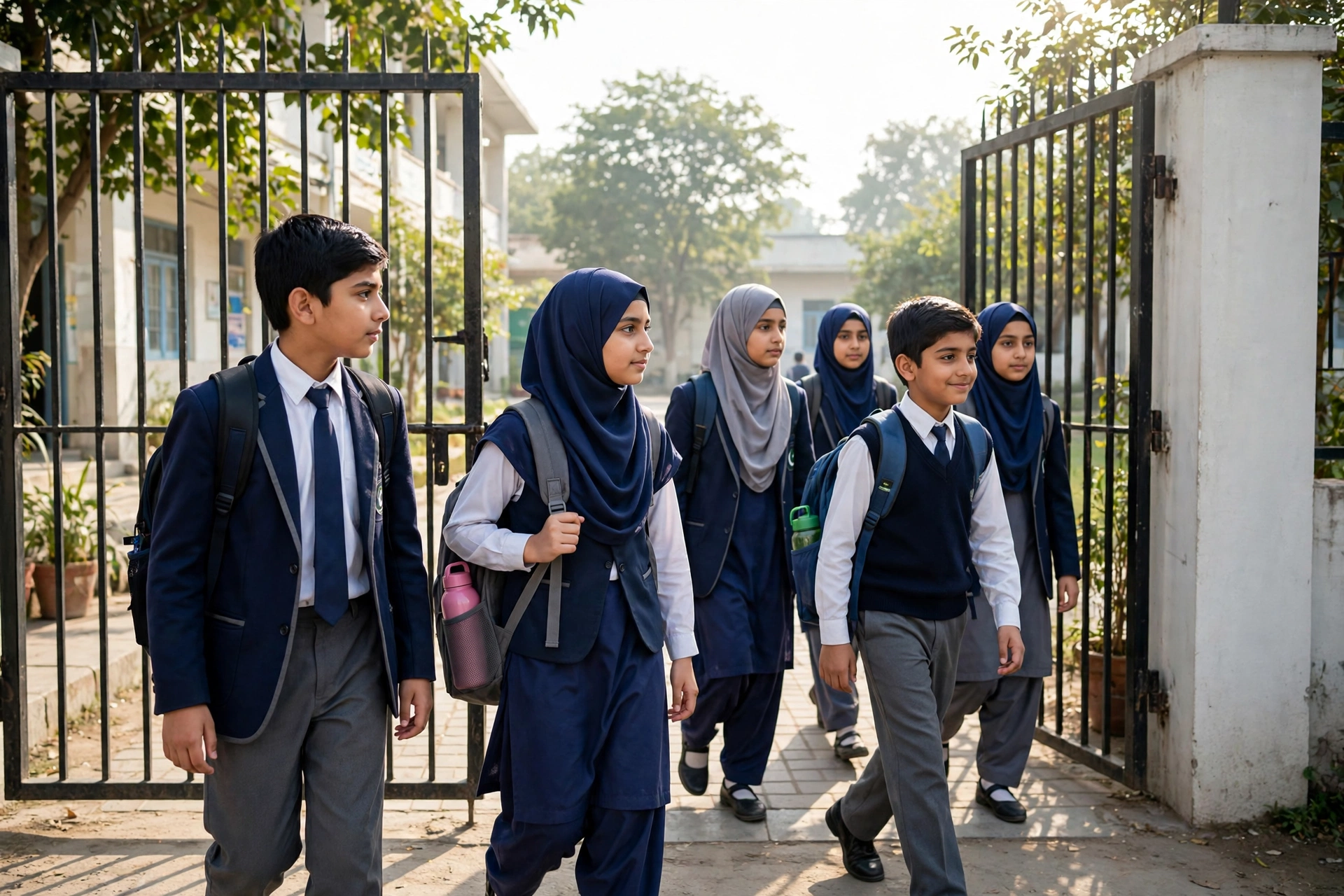
Status first, checked 27 October 2026: Schools and colleges in Punjab, Pakistan, are open normally. There is no new province-wide closure in force, and students should plan for ordinary classes unless their own school tells them otherwise through its usual channel. This is the short answer to the punjab schools open fake notice question that has been circulating again in chats and on social media.
The confusion began with a viral message about 11–12 October. That message was declared fake by the Punjab School Education Department and the Higher Education Department. In plain terms, it was not a genuine department order, even though it looked official enough to be forwarded quickly. This guide does not repeat that message, because repeating a false notice only helps it travel further. What matters now is the current position: open, normal, and unchanged by that viral post.
If you are a student, a parent, or a teacher, the safest habit is simple. Treat a forwarded screenshot as a rumour until it is confirmed. A real change to school opening would be easy to trace back to an official source and to your own institution, not only to a chat group.
Table of Contents
Status at a glance
| Question | Current position on 27 October 2026 |
| Are Punjab schools open? | Yes, normally, across Punjab, Pakistan. |
| Are colleges open? | Yes, normally, unless an individual college has given its own students a separate, confirmed instruction. |
| Was there a new closure for 11–12 October? | No. The viral message about those dates was declared fake by the relevant Punjab departments. |
| Should students stay home because of a forwarded post? | No, not on the basis of a forwarded post alone. Check with the school first. |
That table is deliberately narrow. It does not promise that every single school in every street will never have a local issue, such as a building problem or a district-level instruction. It says the province-wide story is open, not closed, and that a viral post is not evidence to the contrary.
Why the viral message should not be treated as a closure order
A closure order has consequences: transport changes, missed lessons, rearranged tests, and worried families. That is why a genuine order is normally traceable. You would expect it to appear through the department, to be picked up by the school, and to be repeated by teachers in the school’s own notices. A message that arrives only as a screenshot, with no school confirmation and no department link, fails that basic test.
Fake notices also tend to borrow credibility. They use formal-sounding language, a department-style heading, and a short, urgent date range. None of that proves authenticity. In this case, the departments themselves stepped in to say the 11–12 October message was not theirs. Once that clarification exists, the sensible course is to stop sharing the original message and to share the correction instead.
There is another reason to be careful. When a false closure spreads, some students stay away even though classes are running. They miss teaching, notes, and announcements, and then have to catch up under pressure. A five-minute check can prevent a week of confusion.
How to check whether a school notice is genuine
Use three independent checks before you act on any closure claim. If one of them confirms it, you have a solid basis. If none of them does, treat the claim as unverified.
1. Check the official department source
Start with the official website or official channel of the Punjab School Education Department for schools, and the Higher Education Department for colleges. Look for a notice in the department’s own listing, not only in a screenshot of it. If you cannot find the same notice there, that is a warning sign, not a minor detail.
2. Ask your school administration directly
Your school office, principal, or class teacher is the most practical check. Schools receive genuine instructions and pass them on through their normal route, whether that is a notice board, a diary note, a school group, or a phone call. A short question — “Has the school received an official closure order for this date?” — usually settles the matter. If the school says classes are on, follow the school.
3. Look for a board notice where relevant
For board-related matters, such as examinations or registration, check the relevant education board’s notice as well. A board notice will not normally decide whether a school opens on an ordinary teaching day, but it is a useful second source when a rumour also mentions exams, datesheets, or admissions. Keep the two things separate: school opening is a department and school matter; board exams follow the board.
Watch for red flags as well. A notice that only exists as a cropped image, that has no clear source link, that contradicts what your school has just told you, or that is being forwarded with “share quickly” pressure deserves extra caution. Urgency is a common feature of false messages, not a proof of truth.
What to do if a fake notice reaches you
- Do not forward it, even with a warning, unless the warning is clear and you are sharing the official correction rather than the original claim.
- Check with your school before changing travel, attendance, or study plans.
- Tell the person who sent it, calmly, that the Punjab departments have declared the 11–12 October message fake and that schools are open normally.
- If the message keeps circulating in a class group, ask a teacher or group admin to pin the correction so new readers see the current position first.
- Keep your normal routine until a confirmed instruction from your school or the department says otherwise.
Students sometimes worry that they will look careless if they attend school on a day a rumour said was closed. The opposite is true here. Attending on a normal school day, after a quick check, is the careful choice. It keeps you in step with lessons and avoids a gap that is hard to fill later.
Do not mix up different Punjabs and older KPK closures
Two mix-ups cause a surprising amount of confusion. The first is geography. Lists and news items about Indian Punjab describe a different province, in a different country, with different authorities. They do not decide whether schools in Punjab, Pakistan, are open. If a list or headline does not clearly say Pakistan, check the source and the authority before applying it to a school in Lahore, Rawalpindi, Multan, Faisalabad, or any other city in Pakistani Punjab.
The second mix-up is time and place. Some closures reported for districts in Khyber Pakhtunkhwa (KPK) are older and local. They are not a new Punjab update, and they do not change the Punjab position. A district-level decision in another province, at another time, should not be read as a province-wide Punjab closure. Always ask: which province, which district, which date, and which authority? If any of those answers point away from Punjab, Pakistan, the item is not a Punjab closure notice.
What could change
“Open normally” is a statement about today, not a guarantee for every future day. A genuine change could come from the department, from a district administration, or from an individual school for a local reason. Severe weather, a public-safety instruction, or a specific local problem could lead to a limited closure. If that happens, it should be announced through the same channels described above: the department, the school, and, where relevant, the board.
The practical rule does not change. On any day when a new rumour appears, repeat the three checks, and give the school’s confirmed instruction priority over a forwarded image. This guide will remain useful as long as readers check the date: it was checked on 27 October 2026, and any later official change would need its own department or school confirmation.
Related guides for Punjab students
Once attendance is settled, the next practical questions are usually timing and deadlines. For the current winter pattern, see the Punjab Government School Timings Winter 2026-27 — Single and Double Shift Schedule. For older students who are also watching admission dates, the Class 11 Admission and Registration Deadlines — Per-Board Table October-November 2026 post collects the per-board dates in one place. Both are worth bookmarking alongside this clarification, because a normal school day still depends on knowing when to arrive and what deadline is next.
Frequently asked questions About the Punjab Schools Open Fake Notice
Are Punjab schools open today?
Yes. As checked on 27 October 2026, schools and colleges in Punjab, Pakistan, are open normally. The only exception would be a separate, confirmed instruction from your own school for a local reason.
Was the 11–12 October closure notice real?
No. That viral message was declared fake by the Punjab School Education Department and the Higher Education Department. It should not be used to decide attendance, and it should not be forwarded as if it were an official order.
How can I tell a real notice from a fake one?
Check the official department source, then confirm with your school administration, and look for a board notice where the claim touches exams or registration. A genuine notice is traceable through those routes. A screenshot alone, especially one passed through several chat groups, is not enough.
Does a closure in KPK or Indian Punjab mean Punjab schools in Pakistan are closed?
No. Indian Punjab is a different province under different authorities, and KPK district closures mentioned in older reports are local to that province. Neither one is a Punjab, Pakistan, update, and neither changes the current open position for Punjab schools.
Bottom line
Go to school as normal, check the official source or your school if a new message appears, and do not let a forwarded post decide your attendance. The punjab schools open fake notice story is, at its core, a reminder to verify before you share — and, in this case, the verified answer is reassuringly ordinary: classes are on.