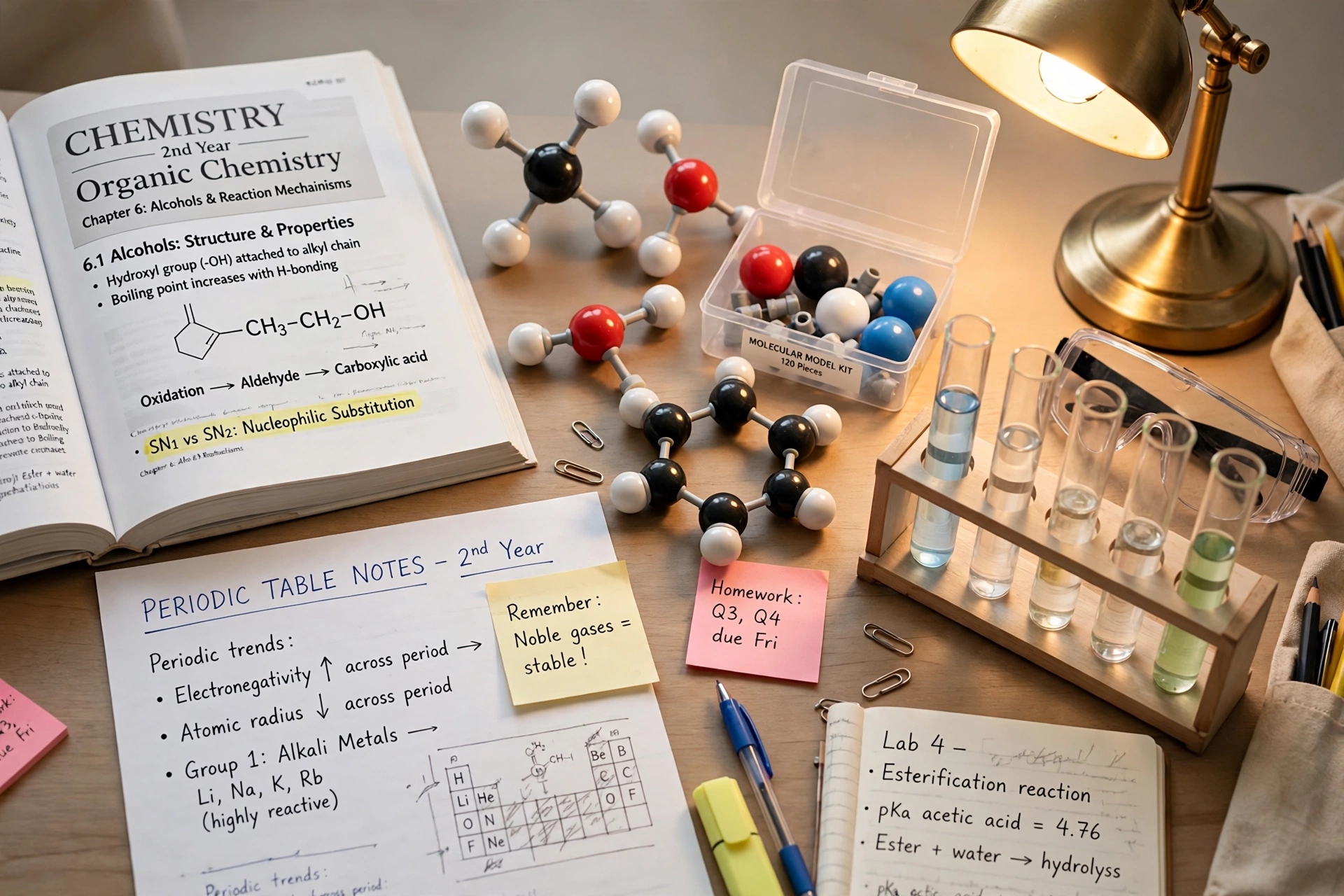
This chemistry 2nd year guess paper 2027 guide is an original revision plan for 12th class students. It highlights the kinds of short questions, long questions and MCQs that have appeared again and again in the general trend of past papers from 2020 to 2026, and turns them into fresh practice topics. It is a study guide only, not a past-papers collection, and it is not an official, leaked or guaranteed paper. Use it to revise smartly, not to skip your textbook.
In This Guide
15 Short Questions and Topics to Revise First
Short questions reward clear definitions, correct formulas and short reasons. Revise each topic in your own words and practise writing it in three to five lines.
- Rate of reaction and the factors that change it, including concentration, temperature and catalyst.
- Chemical equilibrium, Le Chatelier’s principle and a simple shift in equilibrium position.
- Common ion effect and its use in qualitative analysis and solubility.
- Buffer solutions: how an acidic buffer and a basic buffer resist a change in pH.
- pH, pOH and the ionic product of water, with simple numerical practice.
- Electrochemical series and why a more reactive metal displaces a less reactive metal.
- Standard electrode potential and the working of a simple galvanic cell.
- Order of reaction, molecularity and how to find order from experimental data.
- Acids and bases: Arrhenius, Bronsted-Lowry and Lewis concepts compared briefly.
- Alkanes: free radical substitution, with the chlorination of methane as the model example.
- Alkenes: electrophilic addition and Markownikoff’s rule with a clear example.
- Alkynes: acidic character of terminal alkynes and their useful reactions.
- Alcohols: classification, oxidation products and a simple test to distinguish primary, secondary and tertiary alcohols.
- Carboxylic acids: acidity, salt formation and conversion into esters, amides and acid chlorides.
- Transition metals: variable oxidation states, coloured ions and catalytic activity explained from d-orbitals.
8 Long Questions and Topics for Detailed Practice
Long questions need a definition, an explanation, an example and a short conclusion. Practise drawing diagrams and writing balanced equations where they help.
- Chemical kinetics: derive and explain the rate law, discuss factors affecting rate, and explain activation energy with an energy profile diagram.
- Chemical equilibrium: explain the law of mass action, derive the equilibrium constant expression, and discuss the effect of concentration, pressure and temperature.
- Acids, bases and salts: compare theories of acids and bases, explain hydrolysis of salts, and discuss buffer action with equations.
- Electrochemistry: describe the construction and working of a galvanic cell, explain electrode potentials, and discuss electrochemical applications.
- Organic reaction mechanisms: explain nucleophilic substitution in alkyl halides, comparing SN1 and SN2 with conditions and examples.
- Aldehydes and ketones: compare their preparation methods, explain nucleophilic addition, and discuss oxidation, reduction and common tests.
- Carboxylic acids and their derivatives: explain preparation, acidic character and the main conversions used in synthesis questions.
- Transition elements and coordination compounds: discuss general properties, oxidation states, colour, magnetism and the importance of ligands in simple complexes.
8 MCQ Practice Topics: Physical, Organic and Inorganic Chemistry
For MCQs, speed and accuracy matter. Cover one topic from each branch every day, and always check why the other options are wrong.
Physical Chemistry MCQ Topics
- Rate law, half-life and units of rate constants for different orders.
- Equilibrium constant, pH calculations and buffer composition.
- Cell potential, electrolysis and Faraday’s laws in short numerical questions.
Organic Chemistry MCQ Topics
- Functional group identification, IUPAC naming and isomerism.
- Reaction types: substitution, addition, elimination and oxidation.
- Tests for alcohols, aldehydes, ketones and carboxylic acids.
Inorganic Chemistry MCQ Topics
- Properties of transition metals, oxidation states and coloured compounds.
- Common compounds, their formulas and everyday uses in simple recall questions.
How to Use This Guess Paper for Revision
- Start with the short questions. Write each answer from memory, then check it against your textbook.
- Move to one long question per study session. Time yourself and practise a complete, organised answer.
- Use the MCQ topics for a quick daily quiz of ten questions, without looking at the notes first.
- Mark weak topics and revise them again after two days. Short, repeated revision works better than one long reading.
- Finish with past-paper style practice, but treat every guess topic as practice, not as a promise about the real paper.
Textbook Revision: What to Read Again
Your textbook remains the best source. Read the definitions, solved examples and chapter summaries first, then attempt the exercise questions. Pay special attention to numerical examples in kinetics, equilibrium, pH and electrochemistry, to reaction mechanisms in organic chemistry, and to the property trends of transition metals. Keep a one-page formula sheet for each chapter and update it as you practise. If a topic feels weak, read that textbook section again before moving on, rather than collecting more guess lists.
Related 2nd Year Guides
- 2nd Year Notes, Guess Papers, Pairing Schemes and Past Papers
- Physics 2nd Year Guess Paper 2027 — Important Questions
- 12th Class Paper Pattern 2027 — Status Guide
Frequently Asked Questions
Is this chemistry 2nd year guess paper 2027 an official paper?
No. This is an original revision guide based on the general trend of past papers. It is not issued by any board, and it does not contain leaked or official questions.
Can I pass by studying only these important questions?
That would be risky. Use this guide to focus your revision, but cover the full textbook, solved examples and exercise questions as well.
How should I revise long questions for chemistry?
Learn the concept first, then practise a full answer with a definition, explanation, equation or diagram, and a short conclusion. Review the same answer again after a few days.
What is the best way to prepare chemistry MCQs?
Practise short daily quizzes from physical, organic and inorganic topics, learn the formulas and reaction conditions, and review every mistake instead of only counting correct answers.

1 thought on “Chemistry 2nd Year Guess Paper 2027 — Important Questions”