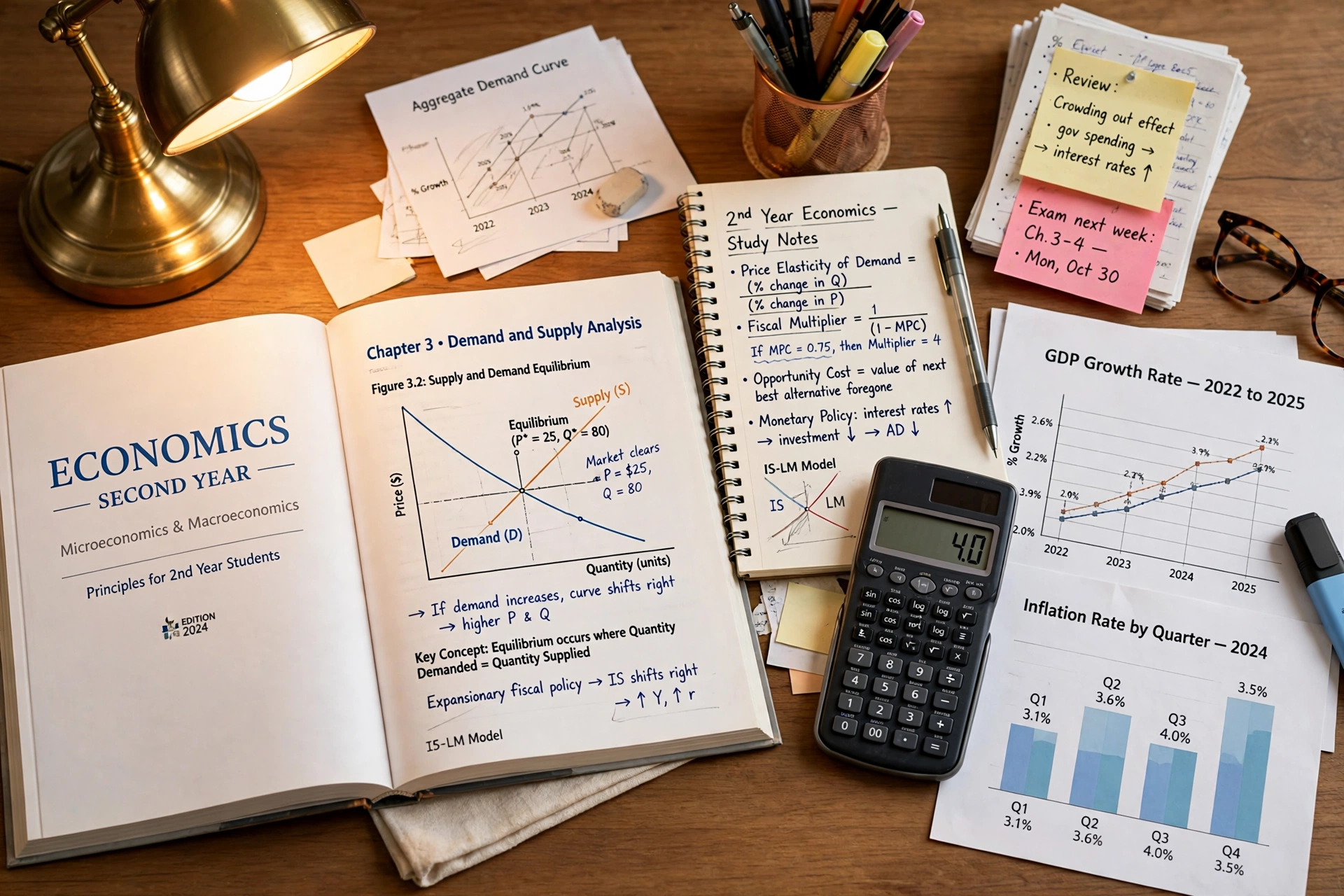
This economics 2nd year guess paper 2027 guide brings together the important questions and revision topics most useful for 2nd year Economics students. The topics are selected from the general trend of past papers from 2020 to 2026, and are written here as new, original Important Questions for focused revision.
This is a revision guide only. It is not an official paper, not a leaked paper, and it does not guarantee any question. Use it with your textbook, class notes, and your teacher’s guidance.
Table of Contents
Important Short Questions
Prepare each topic in your own words, with one clear definition and one short example. Short answers should be precise, not copied at length.
- Define economics and explain the basic economic problem of scarcity, choice, and opportunity cost.
- Distinguish between microeconomics and macroeconomics, with one example of each.
- Define demand and state the law of demand. Explain the main factors that affect demand.
- Define supply and state the law of supply. Explain the main factors that affect supply.
- Explain equilibrium price and quantity, and show how equilibrium changes when demand increases.
- Define price elasticity of demand and explain its main types.
- Distinguish between a movement along a demand curve and a shift of the demand curve.
- Define a market and explain the main features of perfect competition.
- Define gross domestic product (GDP) and distinguish it from gross national product (GNP).
- Explain the main methods used to measure national income.
- Define inflation and explain its main causes and effects on consumers.
- Define money and explain its main functions in a modern economy.
- Explain the main functions of a central bank.
- Define a commercial bank and explain how banks create credit.
- Distinguish between economic growth and economic development, and name its main indicators.
Important Long Questions
For long questions, open with a definition, develop three or four connected points, and close with a short conclusion. Diagrams and examples make demand, supply, and national income answers clearer.
- Discuss demand and supply in detail, including equilibrium price and the effects of shifts in demand and supply.
- Explain price elasticity of demand: its meaning, measurement, types, and importance for business and government.
- Discuss market structures in detail and compare perfect competition, monopoly, monopolistic competition, and oligopoly.
- Explain the concepts of national income and discuss the methods and main difficulties in measuring it.
- Discuss money and banking, including the functions of money, commercial banks, and the role of the central bank.
- Explain inflation: its meaning, causes, effects, and the main measures used to control it.
- Discuss fiscal policy, including government expenditure, taxation, public debt, and the budget deficit.
- Discuss the main problems of economic development in a developing economy, including poverty, unemployment, and population pressure.
MCQ Practice Topics
Use these eight topics for quick daily MCQ practice. Learn the definition first, then test yourself on distinctions, diagrams, and simple calculations.
- Demand and supply: laws, determinants, equilibrium, and shifts in curves.
- Elasticity: price elasticity, income elasticity, and simple numerical interpretation.
- Market structures: features, price determination, and differences between competition and monopoly.
- National income: GDP, GNP, net national product, and per capita income.
- Money: functions, types, and the role of money in exchange and saving.
- Banking: central bank functions, commercial bank functions, and credit creation.
- Monetary policy: interest rates, money supply, and tools used by the central bank.
- Development themes: growth, development, poverty, unemployment, and inflation.
How to Use This Guess Paper
- Start with the short questions, then move to long questions in the same theme.
- Write each answer once from memory before checking your notes.
- Revise one theme each day: demand and supply, market structures, national income, money and banking, then development.
- Practise MCQs in short sets and review only the topics you missed.
- Finish with a timed practice: five short questions and one long question.
Textbook Revision Checklist
Your textbook remains the final source for definitions and wording. Before the exam, revise each chapter carefully and do not rely on this guide alone.
- Revise the definitions of demand, supply, elasticity, market, GDP, money, and inflation.
- Revise the distinctions: microeconomics and macroeconomics, growth and development, and GDP and GNP.
- Revise demand and supply diagrams, including equilibrium, shifts, and price elasticity.
- Revise market structures and match each structure to its price, output, and competition features.
- Revise national income, banking, monetary policy, and development topics with one example for each.
Related 2nd Year Guides
- 2nd Year Notes, Guess Papers, Pairing Schemes and Past Papers
- Education 2nd Year Guess Paper 2027 — Important Questions
- 12th Class Paper Pattern 2027 — Status Guide
Frequently Asked Questions
Is this economics 2nd year guess paper 2027 an official paper?
No. This is an original revision guide prepared from the general trend of past papers from 2020 to 2026. It is not official, leaked, or guaranteed, and no board exam date is stated here.
Should I study only these questions?
No. Use these questions to focus your revision, but also read your full textbook, class notes, and solved examples, especially diagrams and numerical topics.
How should I prepare the long questions?
Learn the definition, plan three or four main points, and practise writing each answer in clear paragraphs. Add a diagram where it fits, and end with a short conclusion.
How can I improve my MCQ score in Economics?
Revise definitions and distinctions daily, practise in small sets, and review your mistakes the same day. Give extra time to elasticity, market structures, national income, and banking terms.
Revise steadily, trust your textbook, and use this guide as a focused checklist for the final weeks before the exam.





1 thought on “Economics 2nd Year Guess Paper 2027 — Important Questions”