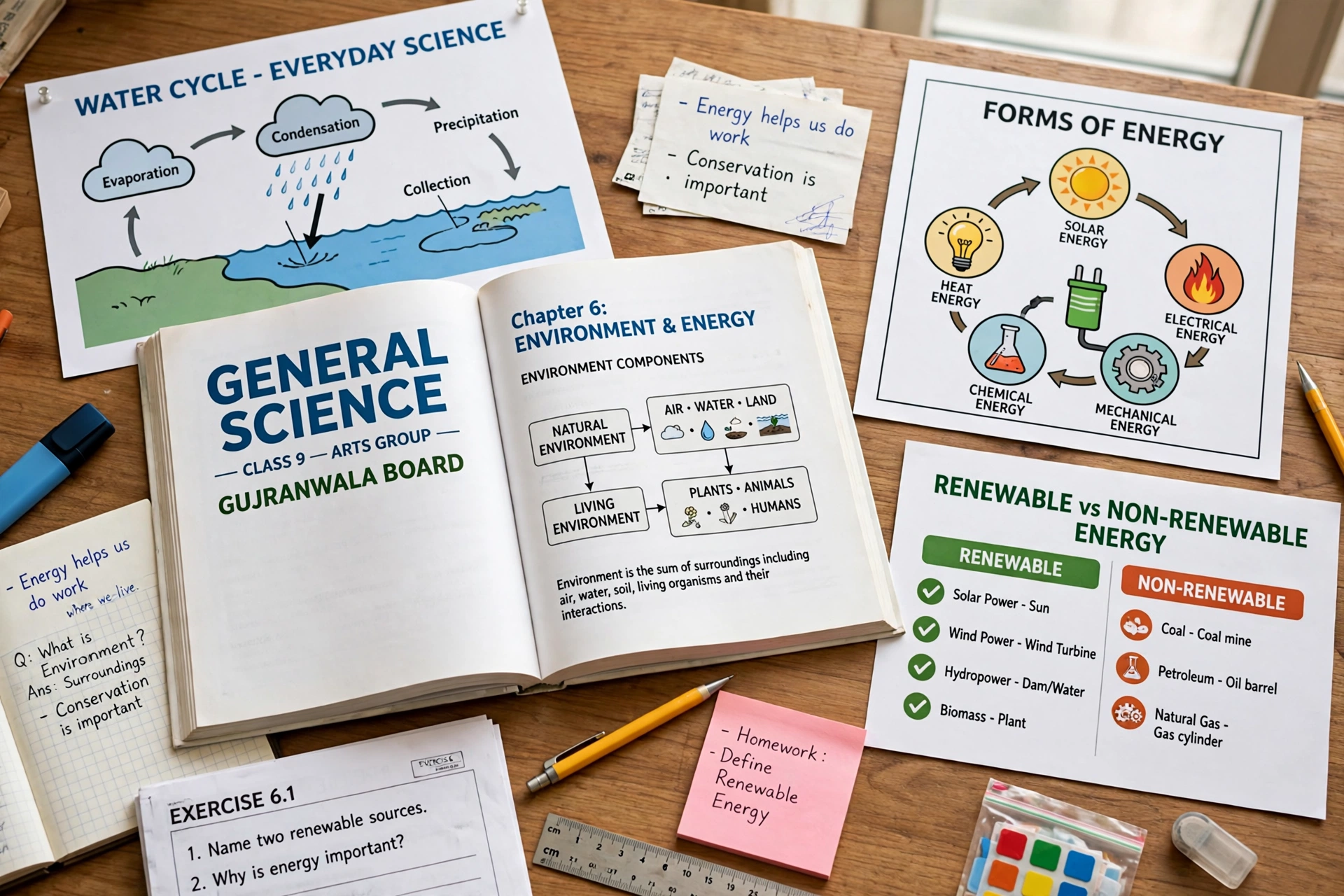
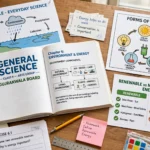
If you are preparing for the BISE Gujranwala Class 9 General Science paper in 2027, this gujranwala board 9th class general science guess paper 2027 guide is made to help you revise in a clear, chapter-wise way. It is written for arts and general-group students, not for the science-group Physics and Chemistry papers, and it follows the themes of the current Punjab General Science textbook: everyday science, energy, the environment and health.
Table of Contents
Honest note: this is an original practice prediction based on general past-paper trends. It is not an official board paper, it is not leaked, and it is not guaranteed. The official 2027 pairing scheme is not presented here as verified, so always check your textbook and your teacher’s guidance alongside this guide.
Gujranwala Board 9th Class General Science Guess Paper 2027: Paper Pattern Overview
General Science for the general group is best revised as a reading and understanding subject. In general, the paper tests recall, explanation and application together: short definitions and facts, brief explanations of everyday processes, and longer answers that link an idea to its effect on health, the home or the environment. Marks are spread across the chapters, so a strong chapter in isolation is not enough.
- Objective questions test key terms, correct examples and simple distinctions, such as a vitamin, a pollutant or a renewable resource.
- Short questions test one idea at a time, so learn definitions, functions and reasons in two or three clear sentences.
- Long questions test a connected explanation, for example how a habit, a disease or a form of pollution affects people and what can reduce that effect.
- Diagrams, labels and examples from daily life help only when they match the question; do not add unrelated science-group material.
Use this guide as a self-test. For each topic below, try to explain it in your own words first, then check the textbook for the exact wording, example or diagram.
Chapter-Wise Important Topics for Class 9 General Science
Work through the chapters in order, but give extra time to the chapters you find hardest. Each section lists short-question topics, long-question topics and MCQ practice topics.
Chapter 1: Introduction and Role of Science
- Short-question topics: meaning of science, branches of science, how science differs from technology, the role of science in daily life, and the contributions of Muslim and Pakistani scientists.
- Long-question topics: how science and technology have changed daily life, transport, communication and health care, and why scientific thinking matters in ordinary decisions.
- MCQ practice topics: names of branches of science, matching a scientist to a field of work, and choosing the branch that studies a given everyday problem.
Chapter 2: Our Life and Chemistry
- Short-question topics: carbon, hydrogen and oxygen as building elements of life, properties of water, water as a universal solvent, the gases in air, and important elements such as iron, calcium and iodine.
- Long-question topics: respiration and photosynthesis in simple terms, the nitrogen and carbon cycles, why water is essential for life, and how the gases in air support living things.
- MCQ practice topics: the main gas used in respiration, the gas released by plants, properties of water, and the role of a named element in the body.
Chapter 3: Biochemistry and Biotechnology
- Short-question topics: metabolism, anabolism and catabolism, the role of enzymes in daily life, the parts of blood, blood groups, and the ABO and Rh systems.
- Long-question topics: how enzymes help digestion and food preparation, how genetic engineering is used in agriculture and livestock, the benefits and limits of high-yield crops, and how antibiotics and vaccines work in general terms.
- MCQ practice topics: functions of red cells, white cells and platelets, blood group matching in simple cases, examples of biotechnology in farming, and safe disposal and recycling of waste.
Chapter 4: Human Health
- Short-question topics: food and its major components, carbohydrates, proteins, fats and oils, fat-soluble and water-soluble vitamins, mineral salts, and the idea of a balanced diet.
- Long-question topics: a balanced diet for infants, young people, older people and pregnant or lactating women, the role of endocrine glands including the pituitary, thyroid, adrenal glands, pancreas and gonads, the benefits of exercise, and first aid for burns, eye injury, animal bite and snake bite.
- MCQ practice topics: sources of vitamins and minerals, deficiency signs in general terms, glands and their hormones in simple matching, and safe first-aid steps.
Chapter 5: Diseases – Cause and Prevention
- Short-question topics: viral diseases including influenza, polio, hepatitis and AIDS, bacterial diseases including tuberculosis, typhoid, tetanus, diphtheria and whooping cough, parasitic diseases including malaria and worm infections, and agents that spread germs.
- Long-question topics: how diseases spread through air, water, touch, food and animals, prevention through hygiene, clean water and vaccination, harmful effects of smoking on lungs, heart and skin, and the effects of narcotics, sedatives and other drugs.
- MCQ practice topics: matching a disease to its cause, the way a disease spreads, prevention steps, and the harm caused by smoking and drug misuse.
Chapter 6: Environment and Natural Resources
- Short-question topics: the ozone layer and its depletion, the greenhouse effect and global warming, air, water and land pollution, smog and acid rain, fossil fuels including coal, petroleum and natural gas, and conservation of natural resources.
- Long-question topics: energy in daily life and why fossil fuels affect the environment, measures to reduce pollution, conservation of wildlife and national parks, agriculture, dairy, poultry and fisheries in Pakistan, and how rising population affects resources and quality of life.
- MCQ practice topics: types and causes of pollution, renewable and non-renewable resources, the effect of a named pollutant, and simple conservation choices for home, school and farming.
How to Use This Gujranwala General Science Guess Paper 2027
- Start with the chapter you find hardest, not the one you already know best.
- For each topic, write the definition or explanation from memory, then check it against the textbook.
- For health and disease topics, practise cause, effect and prevention as one connected answer.
- For environment topics, practise the difference between a cause, an effect and a solution, so you do not mix them up.
- Finish with a timed practice: attempt objective questions quickly, then short questions, then one or two long questions.
Textbook Revision Checklist
- All definitions and key terms from Chapters 1 to 6, in your own short notes.
- Blood parts and blood groups, vitamins and their food sources, and major endocrine glands.
- Common diseases, how they spread, and how they can be prevented.
- Ozone, greenhouse effect, pollution types, fossil fuels and conservation steps.
- At least one long explanation from each chapter, written without looking at the book first.
- A final read of chapter summaries and examples, especially in Chapters 4, 5 and 6.
Related 9th Class Resources
- 9th Class Notes, Guess Papers, Pairing Schemes and Past Papers
- Gujranwala Board 9th Class Physics Guess Paper 2027: Important Questions All Chapters
- 9th Class Pairing Scheme 2027
Frequently Asked Questions
Is this the official Gujranwala Board General Science paper for 2027?
No. This is an original revision guide and practice prediction. It is not an official paper, it is not leaked, and it does not guarantee any question.
Is this guide for science-group students?
No. This guide is for arts and general-group General Science students. Science-group students should revise their separate Physics, Chemistry and Biology books instead.
Which chapters should I revise first?
Do not skip any chapter. Start with health, diseases and environment, because those chapters link facts to everyday causes and effects, then return to the earlier chapters for definitions and terms.
Can I use this guide for other Punjab boards?
The chapter topics follow the Punjab textbook, so the revision themes are useful for other Punjab boards, but always check the paper pattern and guidance for your own board, BISE Gujranwala, before the exam.
Work through one chapter at a time, mark the topics you cannot yet explain, and return to them until you can explain each one in simple, clear words.

1 thought on “Gujranwala Board 9th Class General Science Guess Paper 2027 — Important Questions All Chapters”