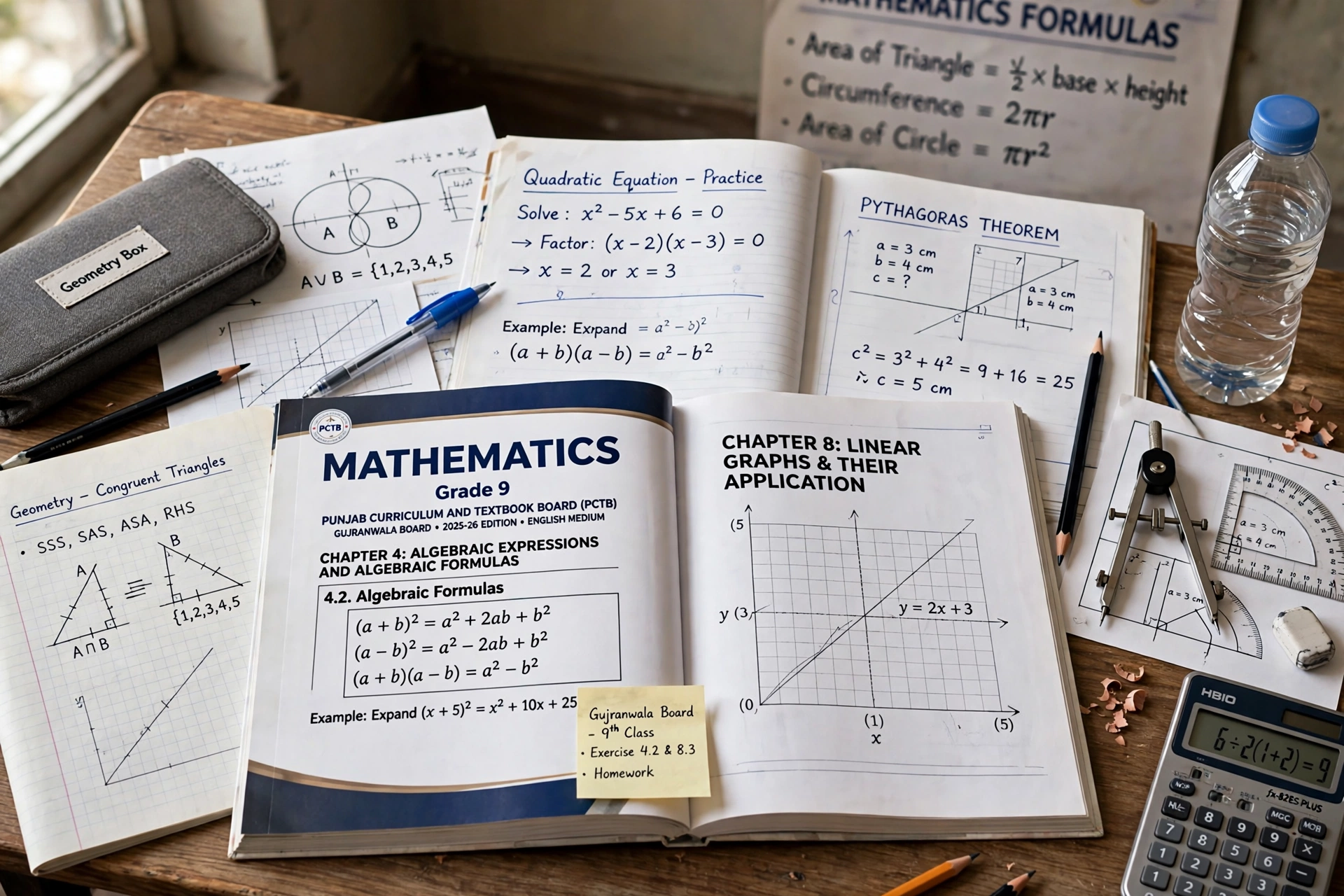
This gujranwala board 9th class math guess paper 2027 guide is written for BISE Gujranwala Class 9 students who want a clear, chapter-by-chapter revision plan. Mathematics rewards steady practice, careful steps, and neat presentation, so this guide organises the Punjab textbook by theme: algebra, matrices, geometry, ratios, and trigonometry basics. Work through the examples first, then try the exercise questions without looking at the solution.
Please note: this is an original practice prediction based on general past-paper trends. It is NOT an official board paper, NOT leaked, and NOT guaranteed. The official 2027 pairing scheme is not presented as verified here.
Table of Contents
Paper Pattern Overview
Use the generally reported totals below only as a planning guide, not as an official Gujranwala notification. The aim is balance: do not spend all your time on one chapter, and do not leave geometry or algebra until the last week.
| Part | What to practise | Generally reported total |
|---|---|---|
| Total marks | The whole Class 9 mathematics syllabus | 75 marks |
| Objective part | Multiple-choice questions from definitions, formulas, and short results | — |
| Short-answer part | Short questions from every chapter, with clear steps | — |
| Long-answer part | Longer algebra, geometry, and proof-style questions | — |
Marks are often lost through sign errors, missing steps, and untidy diagrams. Write each step, label diagrams, and check the answer against the question before moving on.
Gujranwala Board 9th Class Math Guess Paper 2027: Chapter-wise Important Topics
The sections below cover every chapter theme in the current Punjab textbook. For each chapter, revise the short-question topics for quick recall, the long-question topics for full working, and the MCQ topics for speed and accuracy.
Chapter 1: Matrices and Determinants
- Short-question topics: order of a matrix, types of matrices, addition and subtraction of matrices, and scalar multiplication.
- Long-question topics: multiplication of matrices, finding the inverse of a 2 by 2 matrix, and solving a pair of equations with matrices.
- Exercise and MCQ practice topics: determinant of a 2 by 2 matrix, singular and non-singular matrices, and the adjoint of a matrix.
Chapter 2: Real and Complex Numbers
- Short-question topics: rational and irrational numbers, properties of real numbers, and the imaginary unit.
- Long-question topics: addition, subtraction, multiplication, and division of complex numbers, and simplifying expressions with square roots.
- Exercise and MCQ practice topics: conjugate of a complex number, absolute value, and identifying real, imaginary, rational, and irrational numbers.
Chapter 3: Logarithms
- Short-question topics: definition of a logarithm, laws of logarithms, and changing between exponential and logarithmic form.
- Long-question topics: simplifying expressions with the product, quotient, and power laws, and solving simple logarithmic equations.
- Exercise and MCQ practice topics: common logarithms, characteristic and mantissa, and the value of log 1 and log of the base.
Chapter 4: Algebraic Expressions and Algebraic Formulas
- Short-question topics: square of a sum and difference, cube formulas, and the value of an expression for a given value.
- Long-question topics: expanding and simplifying algebraic expressions, and finding a value using a standard formula.
- Exercise and MCQ practice topics: identifying a formula from an expansion, and applying (a + b) squared, (a – b) squared, and (a + b)(a – b).
Chapter 5: Factorization
- Short-question topics: common factors, grouping, difference of squares, and perfect square trinomials.
- Long-question topics: factorising cubic expressions, factorising by grouping, and factorising expressions with two variables.
- Exercise and MCQ practice topics: recognising the correct factorisation, and checking a factorisation by multiplication.
Chapter 6: Algebraic Manipulation
- Short-question topics: highest common factor and lowest common multiple of algebraic expressions, and simplifying a simple fraction.
- Long-question topics: adding, subtracting, multiplying, and dividing algebraic fractions, and simplifying a complex fraction.
- Exercise and MCQ practice topics: cancelling common factors correctly, and finding the HCF and LCM of monomials.
Chapter 7: Linear Equations and Inequalities
- Short-question topics: solving a linear equation in one variable, and the meaning of greater than, less than, and equal to.
- Long-question topics: solving linear equations with fractions and brackets, solving inequalities, and word problems based on linear equations.
- Exercise and MCQ practice topics: checking a solution by substitution, and choosing the correct solution set for an inequality.
Chapter 8: Linear Graphs and Their Application
- Short-question topics: plotting ordered pairs, slope of a line, and the intercept form of a line.
- Long-question topics: drawing the graph of a linear equation, finding the equation of a line from two points, and reading values from a graph.
- Exercise and MCQ practice topics: identifying a slope, an intercept, and a point that lies on a given line.
Chapter 9: Introduction to Coordinate Geometry
- Short-question topics: distance between two points, midpoint of a line segment, and coordinates in the four quadrants.
- Long-question topics: proving a triangle or quadrilateral property with the distance formula, and finding a midpoint or an unknown coordinate.
- Exercise and MCQ practice topics: distance formula results, midpoint results, and the sign of coordinates in each quadrant.
Chapter 10: Congruent Triangles
- Short-question topics: conditions for congruence, corresponding parts of congruent triangles, and the meaning of SSS, SAS, ASA, and RHS.
- Long-question topics: proving two triangles congruent with a clear statement and reason for each step, and finding an unknown side or angle.
- Exercise and MCQ practice topics: choosing the correct congruence condition for a diagram, and matching corresponding sides and angles.
Chapter 11: Parallelograms and Triangles
- Short-question topics: properties of a parallelogram, midpoint theorem, and the relation between a parallelogram and a triangle on the same base.
- Long-question topics: proving a parallelogram property, and proving that triangles on the same base and between the same parallels have equal area.
- Exercise and MCQ practice topics: opposite sides and angles of a parallelogram, and area relations in a diagram.
Chapter 12: Line Bisectors and Angle Bisectors
- Short-question topics: perpendicular bisector of a line segment, bisector of an angle, and points equidistant from the ends of a segment.
- Long-question topics: proving a bisector theorem with a labelled diagram, and using a bisector to find an unknown length or angle.
- Exercise and MCQ practice topics: identifying a bisector in a figure, and applying the equidistant property of a bisector.
Chapter 13: Sides and Angles of a Triangle
- Short-question topics: the angle sum property, exterior angle of a triangle, and the relation between sides and opposite angles.
- Long-question topics: proving that the larger side has the larger opposite angle, and solving a triangle problem with the angle sum property.
- Exercise and MCQ practice topics: finding a missing angle, comparing sides from given angles, and the triangle inequality.
Chapter 14: Ratio and Proportion
- Short-question topics: ratio in simplest form, continued ratio, direct and inverse proportion, and the fourth proportional.
- Long-question topics: dividing a quantity in a given ratio, solving proportion word problems, and proving a proportion property.
- Exercise and MCQ practice topics: simplifying a ratio, finding a missing term in a proportion, and recognising direct or inverse proportion.
Chapter 15: Pythagoras Theorem and Trigonometry Basics
- Short-question topics: identifying the hypotenuse, stating Pythagoras theorem, and naming sine, cosine, and tangent in a right-angled triangle.
- Long-question topics: finding a missing side with Pythagoras theorem, checking whether a triangle is right-angled, and finding a basic trigonometric ratio from given sides.
- Exercise and MCQ practice topics: Pythagorean triples, the converse of Pythagoras theorem, and the ratio of opposite, adjacent, and hypotenuse for a given angle.
Chapter 16: Theorems Related with Area
- Short-question topics: area of a triangle and a parallelogram, and figures on the same base and between the same parallels.
- Long-question topics: proving that parallelograms on the same base and between the same parallels have equal area, and solving area problems step by step.
- Exercise and MCQ practice topics: area formulas, comparing areas in a diagram, and the area of a triangle as half the area of a parallelogram on the same base.
Chapter 17: Practical Geometry – Triangles
- Short-question topics: tools for construction, constructing a triangle from three sides, and constructing an angle bisector.
- Long-question topics: constructing a triangle from two sides and an included angle, constructing a triangle from a perimeter and base angles, and constructing a right-angled triangle.
- Exercise and MCQ practice topics: choosing the correct first step in a construction, and checking a construction against the given measurements.
How to Use This Guide
- Start with the chapter you find hardest, not the one you already know well.
- Read the textbook example first, then solve the exercise questions on your own.
- For algebra, write every step and check signs, brackets, and factors at the end.
- For geometry, draw a neat, labelled diagram before you write the proof.
- For MCQs, practise definitions and formulas daily, and learn to eliminate clearly wrong options.
- Finish each chapter with a short timed test: five short questions, one long question, and five MCQs.
Textbook Revision Checklist
- Can you add, multiply, and find the inverse and determinant of matrices from Chapter 1?
- Can you simplify complex numbers and use the laws of logarithms without a calculator?
- Can you expand, factorise, and simplify algebraic expressions and fractions?
- Can you solve linear equations and inequalities, and draw and read linear graphs?
- Can you use distance and midpoint formulas, and prove basic triangle and parallelogram results?
- Can you apply ratio, proportion, and Pythagoras theorem, and name basic trigonometric ratios?
- Have you constructed triangles from the given sides, angles, and perimeter, with neat diagrams?
Related 9th Class Resources
- 9th Class Notes, Guess Papers, Pairing Schemes and Past Papers
- Gujranwala Board 9th Class English Guess Paper 2027
- 9th Class Pairing Scheme 2027
Frequently Asked Questions
Is this the official Gujranwala Board 9th class math paper for 2027?
No. This is an original revision guide and practice prediction. It is not an official board paper, it is not leaked, and it does not guarantee any question.
Should I study only this guess paper?
No. Use it after reading the textbook and your class notes. It helps you choose what to revise first, but the textbook examples and exercises remain the main preparation.
Which chapters should I revise first?
Start with matrices, algebra, and linear equations, because their methods appear again in later chapters. Then revise geometry and constructions daily, so diagrams and proofs stay fresh.
How can I improve my math score?
Practise a little every day, show full working, label diagrams, and check each answer. Rework your mistakes the next day instead of only reading the correct solution.
Revise steadily, practise answers under time, and keep your textbook open beside this guide.