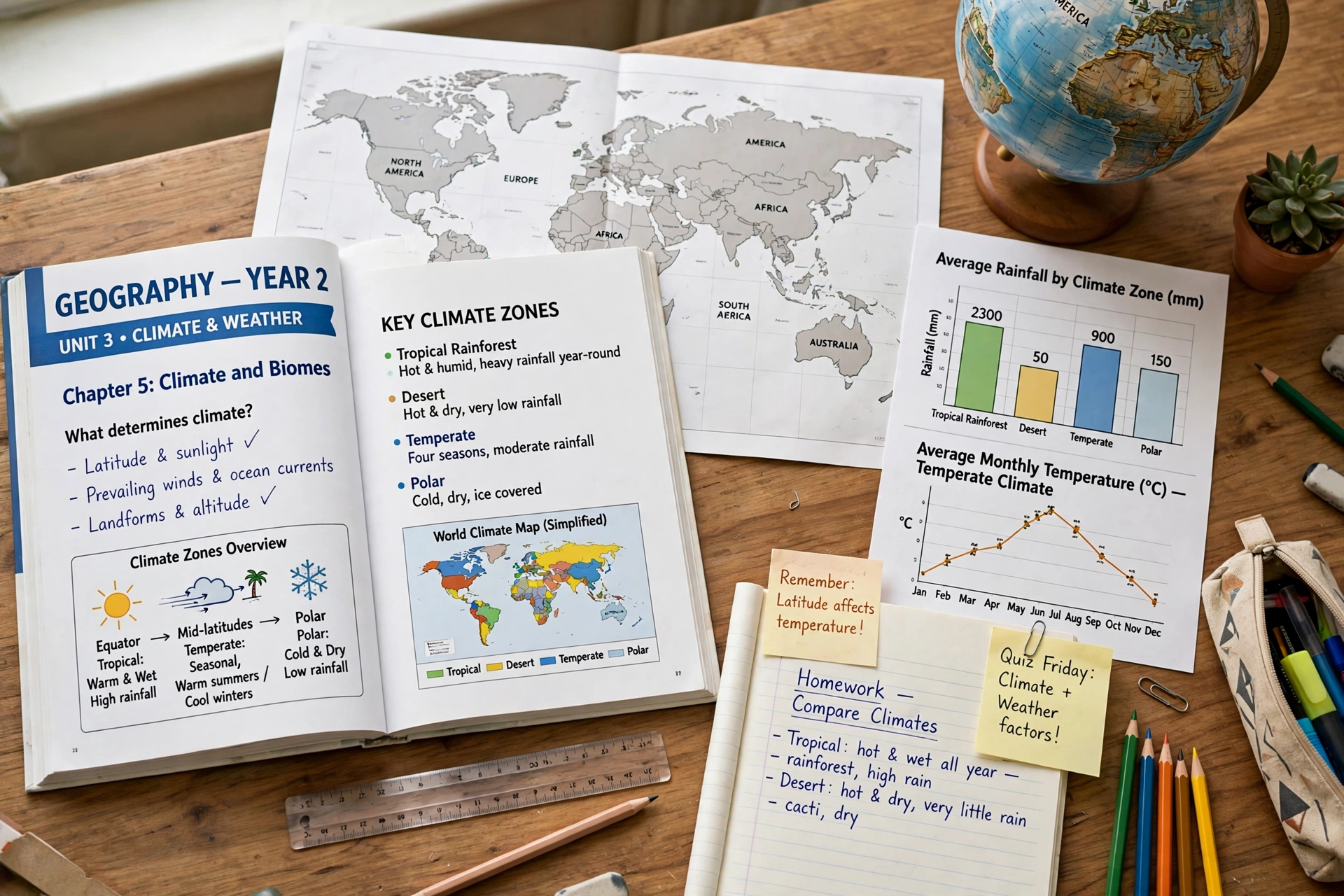
This geography 2nd year guess paper 2027 guide brings together the topics that have come up most often in recent years, so you can revise with a clear plan instead of guessing at random. The lists below are original revision topics chosen from the general trend of past papers from 2020 to 2026. They are not a past-papers collection, and they are not official, leaked or guaranteed questions. Use them to test your textbook understanding, practise definitions, diagrams and reasons, and then check every answer against your own notes.
Geography rewards clear reasons and labelled diagrams. A short answer is strong when it names the process, gives one example, and explains the result. A long answer is strong when it opens with a definition, develops two or three linked points, and ends with a short conclusion about Pakistan or the wider world.
Table of Contents
Short Questions: Important Topics for 2027
Revise each topic in two to four lines first, then add a definition, a cause and an example. Cover the meaning before you try to memorise detail.
- Define physical geography and explain why it is different from human geography.
- What is meant by latitude and longitude, and why are they useful for locating places on a map?
- Explain the difference between weather and climate, with one example of each.
- Describe how latitude, altitude and distance from the sea affect temperature.
- Why do most deserts lie in the subtropical high-pressure belt? Give one reason linked to descending air.
- Explain the formation of rainfall in a simple cycle: evaporation, condensation and precipitation.
- What is a river catchment, and why does deforestation increase flooding in a catchment?
- Describe the main features of a flood plain and explain why people still settle there.
- Define population density and explain why it is high in the Punjab plains and low in western Balochistan.
- What is meant by rural-to-urban migration, and what are two push factors behind it in Pakistan?
- Explain the difference between subsistence farming and commercial farming.
- Why is irrigation important for agriculture in Pakistan, and what is one problem caused by waterlogging?
- Describe two ways in which the Indus River supports farming, transport or power in Pakistan.
- What is meant by a port, and why is Karachi important for Pakistan’s trade?
- Explain one cause and one effect of rapid urban growth in a large Pakistani city.
Long Questions: Important Topics for 2027
For long questions, plan before you write: a short introduction, three developed points with examples, a simple diagram or map sketch where it helps, and a conclusion.
- Describe the factors that control the climate of Pakistan and explain why northern Pakistan is cooler and wetter than the southern plains.
- Explain the causes, effects and control of flooding in Pakistan, with reference to rivers, monsoon rain and human activity.
- Discuss the importance of agriculture in Pakistan and the problems faced by small farmers, including water supply, inputs and markets.
- Describe the distribution of population in Pakistan and explain how relief, water, jobs and transport shape where people live.
- Explain the growth of a major city in Pakistan, covering migration, employment, housing and services.
- Discuss the importance of the Indus River system for irrigation, hydroelectric power and industry in Pakistan.
- Explain how physical factors such as relief, climate and soil affect farming in different parts of Pakistan.
- Describe the main features of the physical landscape of Pakistan, from the northern mountains to the Indus Plain and the coast, and explain how relief affects life and work.
MCQ Practice Topics: Physical Geography, Climate, Population, Agriculture and Pakistan Geography
Use these eight topics for quick objective practice. For each one, write the key term, one fact and one reason before you look at your notes again.
- Physical geography: the difference between a mountain, a plateau and a plain, and one example of each in Pakistan.
- Climate: how latitude and altitude change temperature, and why the same month can feel very different in Murree and Karachi.
- Climate: the main features of the monsoon, and why monsoon rain matters for farming in Pakistan.
- Population: the meaning of birth rate, death rate and population growth, and why growth puts pressure on schools and jobs.
- Population: the difference between population distribution and population density, with one high-density and one low-density area in Pakistan.
- Agriculture: the main crops of the Rabi and Kharif seasons in Pakistan, and the season in which wheat is grown.
- Agriculture: the role of irrigation, fertilisers and improved seeds, and one environmental cost of over-irrigation.
- Pakistan geography: the location and importance of the Indus Plain, the Potwar Plateau and the coastal region.
How to Use This Guess Paper
- Start with the short questions and mark every topic you can explain without looking.
- Turn each long topic into a five-point plan, then write one full answer under timed conditions.
- Practise the MCQ topics by covering the answer and saying the key term aloud.
- Revisit weak topics the next day, and always finish with a map, diagram or worked example.
- Do not leave the textbook: if a topic is unclear, read that chapter first and then return to the list.
Textbook Revision: What to Read Again
Read the textbook chapters on physical geography, climate and weather, population, agriculture and the geography of Pakistan. Focus on definitions in the first pages of each chapter, the worked examples and diagrams, and the summary points at the end. Keep a one-page sheet for each chapter with five terms, three causes and two Pakistan examples. That sheet is more useful than re-reading a whole chapter the night before the paper.
Frequently Asked Questions
Is this geography 2nd year guess paper 2027 an official paper?
No. This is an original revision guide based on general trends in past papers. Always follow your board syllabus and your teacher’s guidance for the final paper.
Should I study only the short questions?
No. Short questions test recall and definitions, while long questions test explanation. Revise both, and use the MCQ topics to check the facts behind your answers.
How can I improve my long answers in geography?
Start with a definition, explain causes in order, give a Pakistan example, and add a labelled diagram where the question allows it. End with one clear conclusion.
What should I revise last before the exam?
Your one-page chapter sheets, the definitions for climate, population and farming, and two diagrams: the water cycle and the main physical regions of Pakistan.
Related 2nd Year Guides
- 2nd Year Notes, Guess Papers, Pairing Schemes and Past Papers
- History 2nd Year Guess Paper 2027: Important Questions
- 12th Class Paper Pattern 2027: Status Guide
Work through the lists in order, check your answers against the textbook, and keep your revision notes short enough to review in one sitting.






1 thought on “Geography 2nd Year Guess Paper 2027 — Important Questions”