This gujranwala board 9th class chemistry guess paper 2027 guide is an original revision plan for BISE Gujranwala Class 9 Chemistry students. It organises the important themes from every chapter of the current Punjab textbook, so you can revise short questions, long questions and MCQ topics in a clear, chapter-wise order instead of guessing at random.
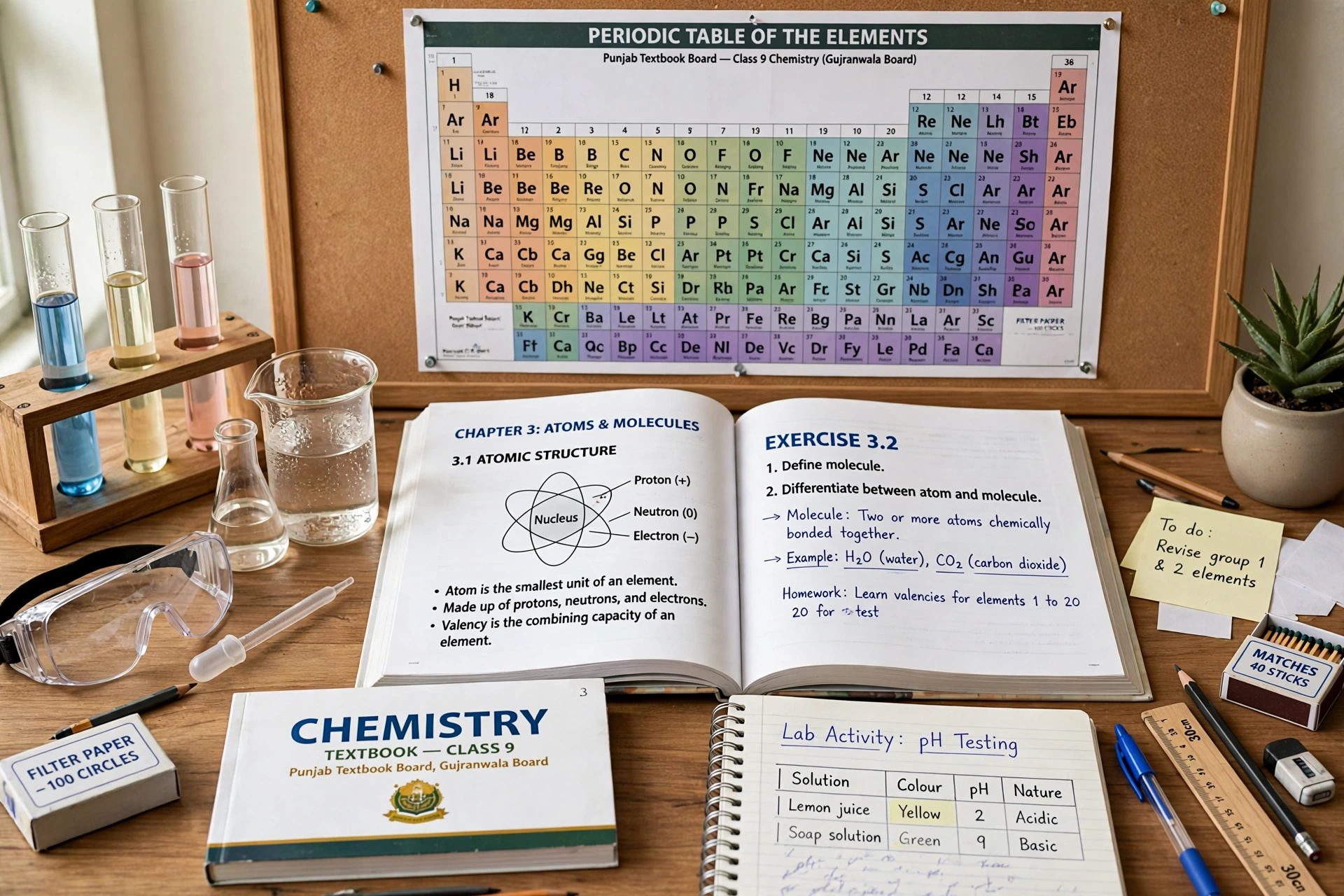
Table of Contents
Honest note: This is an original practice prediction based on general past-paper trends. It is not an official board paper, it is not leaked, and it is not guaranteed. The official 2027 pairing scheme is not presented here as verified.
Paper Pattern Overview
Use the generally reported totals below only as a planning guide. Do not treat them as an official Gujranwala notification, and always check the latest instructions issued for your own examination.
| Part of the paper | Generally reported total |
|---|---|
| Total marks | 60 marks |
| Objective part | 12 MCQs |
| Short-question section | Short questions from across the chapters |
| Long-question section | Long questions, including explanations and numerical practice where relevant |
Because the paper draws on the whole book, a strong plan covers definitions, reasons, differences, diagrams, reactions and numerical steps. The chapter sections below follow that order.
Gujranwala Board 9th Class Chemistry Guess Paper 2027: Chapter-Wise Important Topics
Chapter 1: Fundamentals of Chemistry
Start with the language of chemistry. Learn how matter is described, how elements and compounds differ, and why symbols, formulae and equations must be balanced with care.
- Important short-question topics: branches of chemistry, matter and its states, element, compound and mixture, physical and chemical changes, and the difference between atom and molecule.
- Important long-question topics: explaining states of matter with examples, comparing mixtures and compounds, and writing and balancing simple chemical equations.
- MCQ practice topics: symbols of common elements, formulae of common compounds, states of matter, and identifying a physical change.
Chapter 2: Structure of Atoms
This chapter rewards clear diagrams and careful use of terms. Practise atomic number, mass number and electronic arrangement until you can explain them without looking at the book.
- Important short-question topics: proton, neutron and electron, atomic number and mass number, isotopes, and shells in an atom.
- Important long-question topics: the structure of an atom, how isotopes differ, and electronic configuration for the first twenty elements.
- MCQ practice topics: charges and locations of subatomic particles, isotope identification, and electronic arrangement questions.
Chapter 3: Periodic Table and Periodicity of Properties
Do not try to memorise the whole table at once. Learn groups and periods, then follow the trends across a period and down a group.
- Important short-question topics: periods and groups, metals, non-metals and metalloids, atomic size, ionisation energy and electron affinity.
- Important long-question topics: explaining periodic trends, comparing elements in the same group, and describing why properties repeat.
- MCQ practice topics: group and period numbers, trends in atomic radius, and identifying metals and non-metals.
Chapter 4: Structure of Molecules
Focus on how atoms join together and how the type of bond changes the properties of a substance. Draw simple structures and label them clearly.
- Important short-question topics: ionic and covalent bonds, valency, polar and non-polar bonds, and intermolecular forces.
- Important long-question topics: comparing ionic and covalent compounds, explaining bond formation with examples, and describing forces between molecules.
- MCQ practice topics: bond type from given examples, valency of common elements, and properties linked to bonding.
Chapter 5: Physical States of Matter
Connect particle movement to observable behaviour. Gas laws become much easier when you can state the conditions for each law in your own words.
- Important short-question topics: properties of gases, liquids and solids, diffusion, vapour pressure, boiling point and melting point.
- Important long-question topics: comparing the three states, explaining gas laws with examples, and describing changes of state.
- MCQ practice topics: gas law conditions, boiling and melting points, and identifying the state with the fastest diffusion.
Chapter 6: Solutions
This is a numerical chapter, so practise the steps, not just the answers. Write the given data, the formula and the unit at each step.
- Important short-question topics: solute and solvent, saturated and unsaturated solutions, solubility, concentration, and percentage composition.
- Important long-question topics: explaining factors that affect solubility, comparing solution types, and solving concentration problems step by step.
- MCQ practice topics: solution terms, concentration units, and solubility comparisons.
Chapter 7: Electrochemistry
Learn the direction of current and ion movement, and keep oxidation and reduction clearly separated in your notes.
- Important short-question topics: oxidation and reduction, oxidising and reducing agents, electrolytes, electrolysis, and electrochemical cells.
- Important long-question topics: explaining electrolysis, comparing galvanic and electrolytic cells, and describing oxidation and reduction in a reaction.
- MCQ practice topics: oxidation numbers, electrodes, electrolytes, and identifying oxidation or reduction.
Chapter 8: Chemical Reactivity
Finish with reactivity patterns and everyday applications. Link each metal or reaction to a clear reason, so the facts are easier to recall in the examination.
- Important short-question topics: reactivity of metals, reactions of metals with water and acids, uses of common metals, and corrosion.
- Important long-question topics: explaining the reactivity series, comparing metals, and describing how corrosion can be reduced.
- MCQ practice topics: most and least reactive metals, reaction products, and everyday examples of corrosion.
How to Use This Guess Paper
- Read one chapter, then close the book and write its main definitions from memory.
- Answer the short-question topics in two to four lines each, using the exact scientific term first.
- For long questions, plan three or four points before writing, and add a diagram or equation where it helps.
- Finish each chapter with ten quick MCQ-style questions of your own, based on the practice topics above.
- In the last week, revise weak chapters first, then take one full timed practice attempt.
Textbook Revision Checklist
- All chapter definitions learned and written once from memory.
- Diagrams for atoms, bonding and cells practised with labels.
- Formulae, symbols and valencies for the first twenty elements revised.
- Numerical steps for solutions and gas laws practised with units.
- Short answers checked for missing reasons, not only missing facts.
- One timed practice paper completed before the examination.
Related Guides
- 9th Class Notes, Guess Papers, Pairing Schemes and Past Papers
- 9th Class Pairing Scheme 2027
- 9th Class Paper Pattern 2027
Frequently Asked Questions
Is this the official Gujranwala Board paper for 2027?
No. This is an original practice guide based on general past-paper trends. It is not an official paper, it has not been leaked, and no question here is guaranteed to appear.
Does this guide cover all chapters of Class 9 Chemistry?
Yes. It gives short-question, long-question and MCQ practice topics for all eight chapters of the current Punjab textbook, from fundamentals of chemistry through chemical reactivity.
How should I prepare MCQs from this guide?
Turn each MCQ practice topic into a question with four options. If you cannot explain why the other three options are wrong, revise that topic again before moving on.
What should I do if a topic in this guide is not in my textbook edition?
Follow your current textbook and your teacher first. Use this guide for revision themes, and leave out any topic that does not match the edition you are actually studying.



1 thought on “Gujranwala Board 9th Class Chemistry Guess Paper 2027 — Important Questions All Chapters”