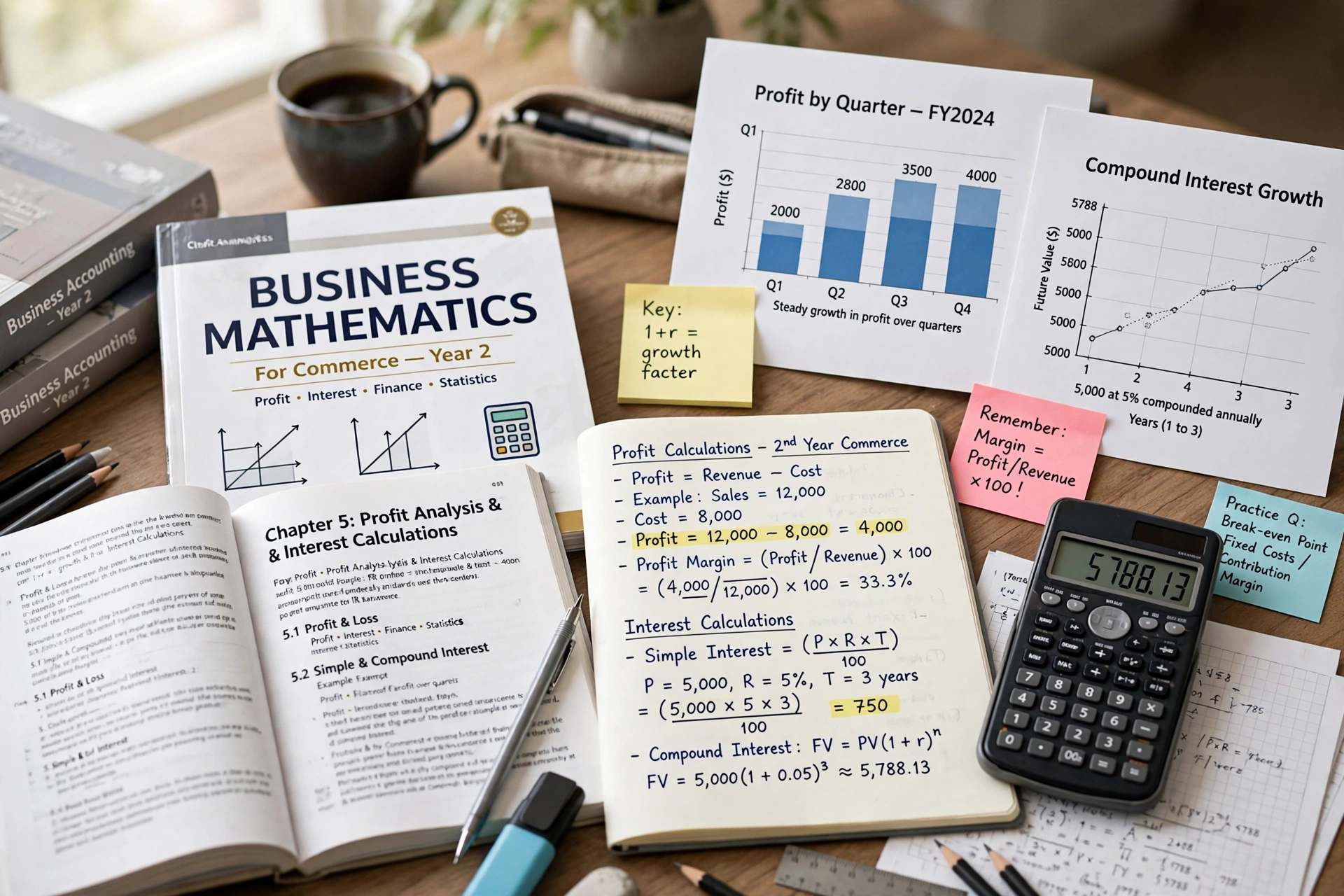
This business math 2nd year guess paper 2027 guide helps second-year commerce students revise the topics that have appeared most often in recent years. It is a new, original revision guide based on the general trend of past papers from 2020 to 2026; it is not a past-papers collection, not an official paper, and not a leaked or guaranteed paper. Use it to plan revision, practise calculations, and check the chapters you still need to strengthen.
Business Mathematics rewards method, accuracy, and practice. Read each question, write the formula first, show every step, and check units and decimal places before moving on. Short questions usually test one idea, while long questions combine a formula, a calculation, and a short interpretation.
Table of Contents
Short Questions: 15 Important Topics
- Simple interest: find interest, amount, rate, or time from the given values.
- Compound interest: calculate amount and compound interest for one or more periods.
- Profit and loss: find profit, loss, profit percentage, or loss percentage on cost price.
- Trade discount and cash discount: distinguish the two and calculate net price after discount.
- Commission and brokerage: calculate commission on sales at a stated rate.
- Ratio and proportion: simplify ratios, divide a quantity in a given ratio, and solve proportions.
- Average: find the average of a set of values and use it to find a missing value.
- Percentage in business: calculate percentage increase, decrease, and marked price.
- Partnership: divide profit or loss among partners according to capital and time.
- Present value and future value: explain the idea and apply a basic present-value or future-value calculation.
- Annuity: identify an ordinary annuity and calculate its basic accumulated value.
- Depreciation: calculate straight-line depreciation and book value for a year.
- Bank discount and true discount: state the difference and solve a short numerical problem.
- Foreign exchange: convert an amount at a given exchange rate.
- Commercial arithmetic problems: solve short mixed problems on cost, selling price, and margin.
Long Questions: 8 Important Topics
- Compound interest over several years: calculate amount and interest step by step and compare them with simple interest.
- Profit and loss with discount: work from marked price to discount, cost price, selling price, and final profit or loss.
- Partnership accounts: prepare a profit-sharing calculation when capitals, time periods, and profit-sharing ratios differ.
- Annuities and instalments: solve a long problem on regular payments, accumulated value, and total interest.
- Depreciation and asset value: calculate annual depreciation, total depreciation, and book value over several years.
- Ratio, proportion, and averages in business decisions: combine ratio division with average cost or average sales in one problem.
- Interest, discount, and present value: solve a combined problem involving bank discount, true discount, and present value.
- Commercial arithmetic case problem: use percentage, ratio, profit, and discount together to check whether a business decision is profitable.
MCQ Practice: 8 Topics
Practise these objective topics quickly, without a calculator first where possible, then check your method:
- Interest: simple interest versus compound interest
- Profit and loss: cost price, selling price, and percentage gain or loss
- Ratios: simplifying ratios and finding a missing term in a proportion
- Averages: average of numbers, average speed, and average price
- Commercial arithmetic: discount, commission, and marked price
- Percentage problems: increase, decrease, and percentage of a quantity
- Partnership and sharing: profit division in a stated ratio
- Depreciation and value: book value after depreciation
How to Use This Guess Paper
- First, revise one chapter fully, then attempt its short questions without looking at the solutions.
- Next, practise one long question daily and write all steps clearly, as marks are given for method as well as answers.
- Then, take a timed MCQ set and review every wrong answer to find whether the error was in the formula, the calculation, or the units.
- Finally, repeat weak topics after two or three days instead of only reading them once.
Textbook Revision Plan
Start with the textbook definitions and worked examples for interest, profit and loss, ratios, and averages. Then solve the textbook exercises in the same order as the topics above, marking questions that need a second attempt. In the last revision round, focus on formulas, common errors, and short questions from chapters you find hardest, rather than starting a new chapter.
Frequently Asked Questions
Is this an official Business Math paper?
No. This is an original revision guide created to help students practise important topics. It is not issued by any board and does not predict the exact paper.
Which topics should I revise first?
Start with interest, profit and loss, ratios, and averages, because these themes appear in short questions, long questions, and MCQs.
How many questions should I practise each day?
A steady plan works well: ten short questions, one long question, and ten MCQs, followed by a short review of mistakes.
Can this guide replace the textbook?
No. Use it alongside the textbook. The textbook gives definitions, worked examples, and exercises, while this guide helps you choose what to revise and practise first.
Related 2nd Year Guides
- 2nd Year Notes, Guess Papers, Pairing Schemes and Past Papers
- Statistics 2nd Year Guess Paper 2027 — Important Questions
- 12th Class Paper Pattern 2027 Status Guide
Revise the formulas daily, practise with neat steps, and keep your textbook beside you for definitions and worked examples.







1 thought on “Business Math 2nd Year Guess Paper 2027 — Important Questions”