Status checked on 27 October 2026: no official 2027 paper pattern for 12th class Punjab boards was verified. That sentence is the whole point of this guide. If you are searching for the 12th class paper pattern 2027, you should not start with a forwarded image, a guess paper cover, or a claim that a new pattern has already been released. Start with what is confirmed, then use the older shape of the papers only as a revision guide.
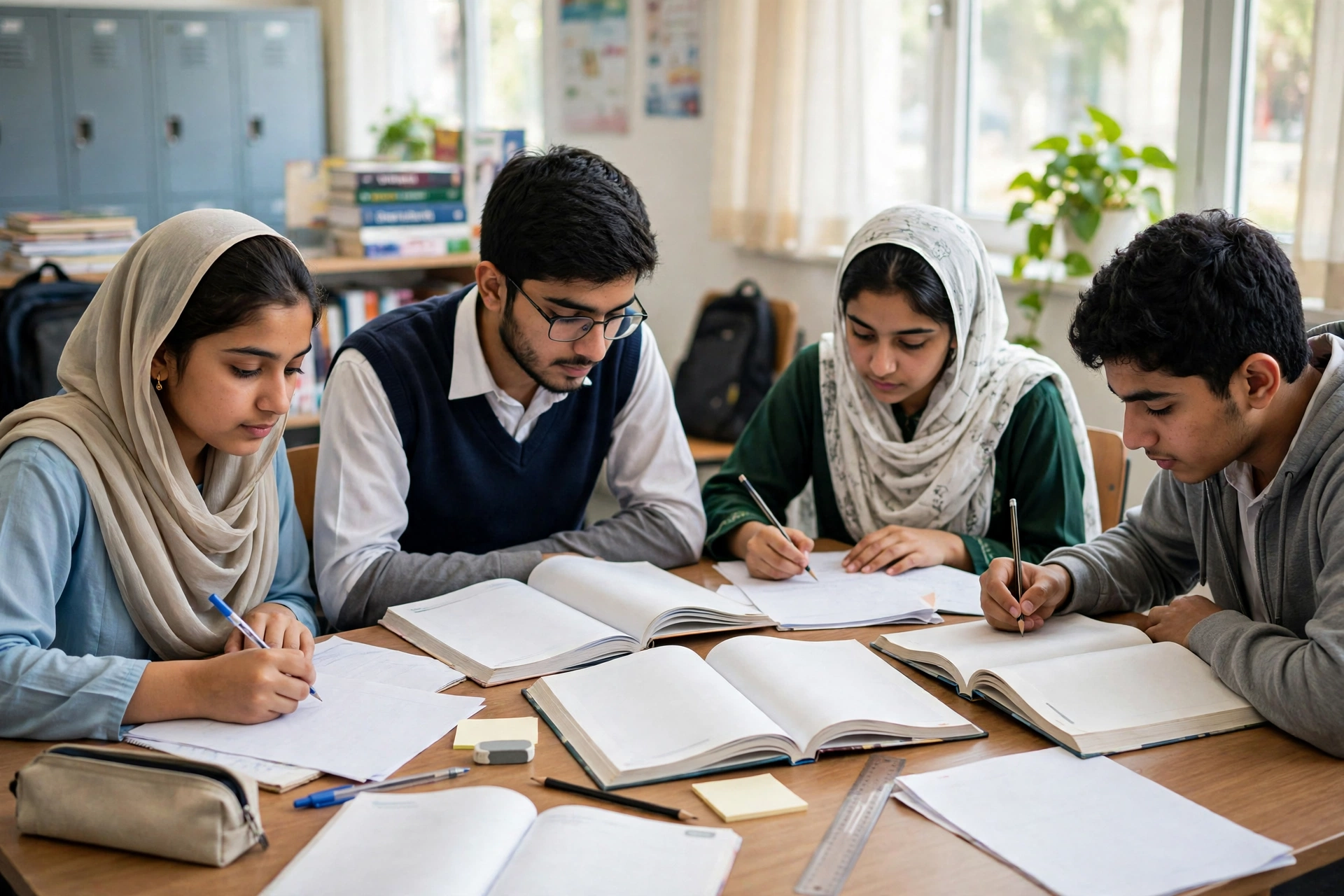
A syllabus tells you what to study. A paper pattern tells you how that study is likely to be tested: the balance between short questions and longer ones, the place of objective questions, and the time you get to show your work. When the pattern is unconfirmed, the safest approach is to learn the syllabus properly and practise in the older shape, without treating any single forwarded pattern as a promise.
This guide therefore keeps two things separate throughout: the checked status for 2027, and the general shape of earlier papers. If an official notice appears later, it should change only what it actually changes. Until then, use the 12th class paper pattern 2027 as a search label for checking updates, not as a settled document.
In this guide
Board split: Punjab boards vs FBISE
The most common mistake in a 12th class paper pattern 2027 search is copying one board system onto another. Punjab boards and the Federal Board (FBISE) are separate systems, and a change announced for one does not automatically become a rule for the other. Read the row that matches your own board, and ignore the rest until your board confirms it.
| Board system | 2027 status for 12th class | What this means for revision |
|---|---|---|
| Punjab boards | No official 2027 paper pattern verified as of 27 October 2026 | Use the previous pattern only as a general revision guide |
| FBISE | Verified 50% MCQ and 50% descriptive pattern for 5 core subjects, from the FBISE notification dated 7 August 2026 | Applies only as explained in the next paragraph; do not copy it onto Punjab boards |
That FBISE arrangement is limited. It applies to HSSC-II only for students who appeared in 2nd Annual 2026 under the new pattern, and for all HSSC-II from 1st Annual 2028. It does not make the 50/50 split a Punjab 12th class rule for 2027, and it should not be quoted as one. For the board’s own announcements, see the FBISE official website, which is the board’s own website.
Previous pattern at a glance: a revision guide, not a 2027 promise
The table below describes earlier papers in broad, general terms only. It gives no chapter-wise marks for 2027, because none have been verified. Use it to plan revision time, not to predict the next paper question by question.
| Subject | General previous shape | Revision focus |
|---|---|---|
| English | Reading, writing and language work in separate parts | Comprehension, essays, letters and grammar practice |
| Urdu | Prose, poetry and language questions with written answers | Lesson understanding, explanation and writing practice |
| Pakistan Studies | Short and longer written questions on history and civic topics | Key events, causes and clear short answers |
| Mathematics | Step-by-step problem solving across the syllabus | Methods, practice sets and checking answers |
| Physics | Concept questions, numerical problems and practical understanding | Formulas, units and worked examples |
| Chemistry | Concept, reaction and numerical questions with practical links | Equations, definitions and balanced explanations |
| Biology | Diagrams, definitions and process-based written answers | Labelled diagrams and process order |
| Computer Science | Concept questions, short answers and practical or program-based work | Definitions, logic and hands-on practice |
| Elective subjects | Written questions shaped by each subject’s own syllabus | Subject notes, past-style questions and teacher guidance |
Subject-by-subject guidance for 12th class
Each section below uses the older general shape of the paper. Nothing here should be read as a confirmed 2027 division of marks. The value is in how you practise: what kind of answer each subject rewards, and where students usually lose marks even when they know the topic. Use this section with the 12th class paper pattern 2027 status in mind, not as a replacement for an official notice.
English
Earlier English papers rewarded reading with care, writing with a clear plan, and language accuracy. Practise short comprehension answers in your own words, plan an essay before you write it, and revise common grammar points through short exercises rather than by memorising rules alone. In letters and applications, keep the format simple and the purpose clear.
Urdu
Urdu papers have generally asked for understanding of prose and poetry, together with written expression. Read each lesson for its central idea, practise explaining a verse or passage briefly, and write short pieces regularly so that spelling and sentence flow improve. A short, accurate answer is usually stronger than a long answer that drifts away from the question.
Pakistan Studies
Pakistan Studies rewards connected facts, not isolated dates. For each topic, learn what happened, why it mattered, and what followed from it. Practise turning a paragraph of notes into three or four clear points, because that habit helps in both short and longer questions.
Mathematics
Mathematics is a method subject. Work through problems in full, show each step, and check the final answer against the question. A correct method with a small slip is easier to rescue than a memorised final answer, so practise the same type of question more than once, with different numbers, until the steps feel automatic.
Physics
Physics questions usually test whether you can link a concept to a calculation. Start from the idea in words, choose the right relation, keep the units consistent, and explain the result in one short sentence. Practise diagrams and simple derivations, because they show understanding even when a final number is close but not exact.
Chemistry
Chemistry rewards clear definitions, balanced equations and careful reasoning about reactions. Learn why a reaction happens, not only what the products are, and practise writing equations from memory before checking them. For numerical work, write the given data first, then the method, so a small error stays easy to find.
Biology
Biology answers should follow the order of the process. Learn each process as a sequence, draw and label diagrams from practice rather than copying them at the last minute, and use the correct terms for structures and functions. A diagram with clear labels often explains more than a long paragraph without one.
Computer Science
Computer Science combines definitions with logical thinking. Learn what each term really means, practise tracing short programs step by step, and test small examples yourself instead of only reading them. If a question asks for a program or a logic step, write it in an orderly way and check it with a simple input.
Elective subjects
Elective subjects do not share one paper shape, so do not force a science pattern onto a humanities subject, or the other way round. Follow your subject’s syllabus, use your teacher’s guidance for the kind of answers it rewards, and practise with older papers from that subject only. The shared rule is the same: understand first, then practise in the older format, and wait for an official update before changing your plan.
How to use a paper pattern without being misled by it
Use an older pattern as a practice map. First, cover the full syllabus. Then, answer older questions under time limits, and mark your answers honestly. Notice which question types cost you time, and which ones you answer well. That information is useful even if the next paper changes its balance, because the syllabus and the skills stay largely the same.
Do not build your whole plan around a single leaked-looking image. If a claim has no board name, no date, no class and no subject list, treat it as unconfirmed. A real pattern notice should be checkable: it names the board, the class, the year and the subjects it covers.
How to revise when the 2027 pattern is still unconfirmed
Revise in layers. First, build short notes for every chapter, with definitions, key points and one worked example where it fits. Second, practise short answers daily, so you learn to be clear in few lines. Third, practise longer answers weekly, with a plan, an order and a conclusion. Fourth, sit one full older paper under timed conditions, and review it the same day.
Keep a small error book. Each time you lose marks in practice, write the topic, the mistake and the correct approach in one line. That book becomes your final revision list, and it does not depend on whether the 12th class paper pattern 2027 later changes its question balance. That list stays useful whatever the 12th class paper pattern 2027 finally becomes.
What could change in 2027
Nothing in this section is a prediction, and no new mark or date is claimed here. In general, a board could change the balance between objective and written questions, the number of choices in a section, the wording of instructions, or the weight given to practical work. Any such change would need to be stated in a dated official notice for the right class, board and subjects before it should be treated as real.
That is why strong syllabus knowledge is the safest preparation. If the balance shifts a little, a student who understands the topics can still adapt. A student who only memorised an old pattern, without understanding, has less room to adjust.
Check your own board
Use this short routine before you trust any new pattern claim. First, confirm your board from your registration or roll-number record, not from a social media post. Second, look for a dated official notice from that board, and check that it names your class, year and subjects. Third, compare the claim with the notice: if the notice says something different, follow the notice. Fourth, treat undated or cropped images as unconfirmed, even if they are shared widely. Fifth, if a notice is unclear, ask a teacher or your board office about that specific notice, and keep the notice date and title with your notes. That routine is the safest way to check any new 12th class paper pattern 2027 claim.
Related 2nd Year guides
- 2nd Year (12th Class) Notes, Guess Papers, Pairing Schemes and Past Papers
- 12th Class Pairing Scheme 2027 — Status Guide
- 11th Class Paper Pattern 2027 — Status Guide
- FBISE HSSC 2nd Annual 2026 — Written vs Practical Guide
Frequently asked questions
Has an official Punjab 2027 pattern been released?
No official 2027 paper pattern for 12th class Punjab boards was verified as of 27 October 2026. Any post that presents a new pattern without a dated board notice should be treated as unconfirmed, not as an official release.
Can last year’s pattern be used for preparation?
Yes, as a revision guide. It helps you practise question types, timing and answer style, but it does not guarantee the same balance in the next paper. Cover the full syllabus first, and keep checking for an official update.
Does the FBISE 50/50 split apply to Punjab boards?
No. The verified FBISE 50% MCQ and 50% descriptive pattern is limited to the HSSC-II cases explained above, and it should not be applied to all Punjab 12th class students in 2027. Punjab boards and FBISE must be checked separately.
What should I do first if a board changes the pattern late?
First, confirm the change in a dated notice from your own board. Then, change only the part of your practice that the notice actually changes, such as the balance of question types, and keep your syllabus notes and error book as they are. Ask a teacher if the notice leaves anything unclear.
This guide will need updating when an official 2027 pattern is published. Until then, the previous pattern is a revision guide only, and the status above is the honest starting point for the 12th class paper pattern 2027.










1 thought on “12th Class Paper Pattern 2027 — Status Guide”