If you are starting class 9 under a Punjab board, one question comes before notes, pairing schemes and guess papers: what is the class 9 total marks figure you should plan around? This guide gives a clear, honest answer. It explains the generally reported total, lists the subjects in the science group and in the arts and general group, shows how a total is calculated, and explains how class 9 differs from class 10.
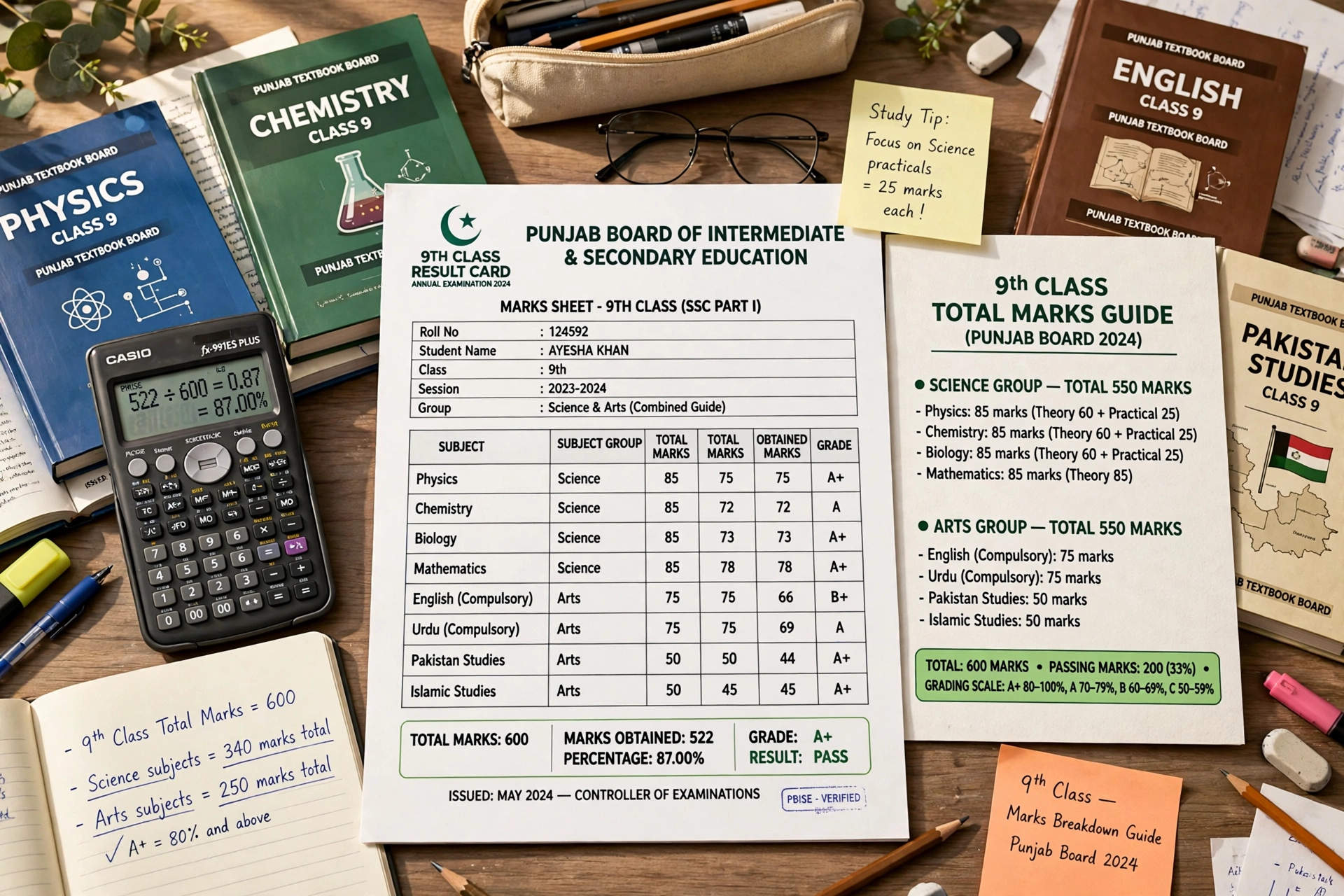
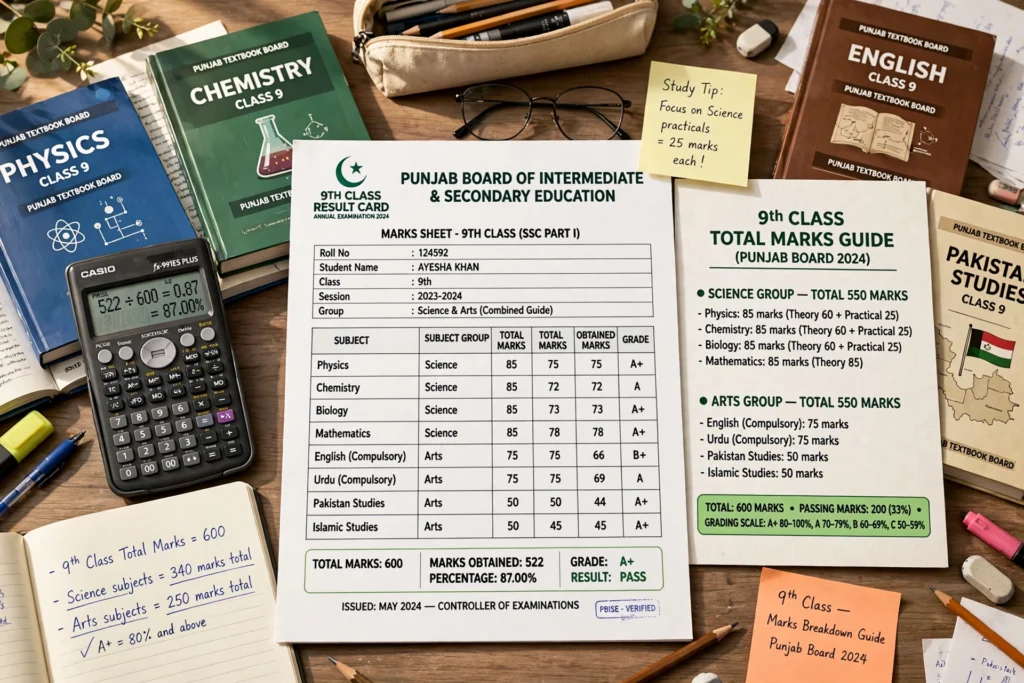
The image above is illustrative. It shows class 9 textbooks, notes and a calculator, which fits the study and marks theme of this guide. The text printed inside an illustration is not a board notice, so this guide does not use it as proof of any subject-wise breakdown.
Table of Contents
Class 9 Total Marks Overview
The generally reported class 9 total marks figure for Punjab boards is 550 marks. That figure appears in more than one independent education guide checked for this post, including Ilmkidunya and 9thClassResult, and it is reported for both the science group and the arts group. This guide labels 550 as generally reported, not official, because no Punjab board notice was verified during the research for this post that confirmed a current, board-by-board subject-wise breakdown.
That distinction matters. A total can be widely reported while the way it is split across subjects is still disputed. Some listings include Tarjuma-tul-Quran as a separate subject, while others present an eight-subject list without it. Some listings show science practical marks inside the subject total, while others show theory and practical marks separately. Because those choices change the subject-wise numbers, this guide presents the generally reported total and the subject lists, and it does not present an invented or copied subject-wise marks table as if it were verified.
Use 550 as a planning figure, and use your own board notice, date sheet or result card as the final check for your school and session. If your result card shows a different total because of an extra subject or a different board rule, your result card is the document that applies to you.
Science Group Subjects
Science group students in class 9 generally study a mix of compulsory subjects and science electives. The usual subject list is:
- English
- Urdu, or Geography of Pakistan for foreign students where that option applies
- Islamiat, or Ethics for non-Muslim students
- Pakistan Studies
- Mathematics
- Physics
- Chemistry
- Biology or Computer Science
Physics, Chemistry and Biology or Computer Science are the subjects that make the science group different from the general group. Practical work is also important for science students. Practical assessment may be included inside a subject total in one listing and shown as a separate practical component in another, so do not assume a single theory-only number for a science paper until your board paper scheme confirms it.
Arts and General Group Subjects
The arts group is also called the general group in many school and board listings. Its core subjects are usually:
- English
- Urdu, or Geography of Pakistan for foreign students where that option applies
- Islamiat, or Ethics for non-Muslim students
- Pakistan Studies
- General Mathematics
- General Science
Arts and general group students also choose elective subjects offered by their school. Common electives named in Punjab board subject lists include Civics, Education, Economics, Geography, History of Pakistan, Computer Science, Islamiat Elective, and languages or literature options. The exact electives available depend on the school and the board, so a student should confirm the elective combination on the admission or registration form rather than copying another student’s combination.
Tarjuma-tul-Quran is sometimes listed as an additional subject. Because sources differ on whether it is counted inside the generally reported 550 total or shown separately, this guide does not add it into a subject-wise total. If your school teaches it, ask your teacher how it appears on your result card.
How the Class 9 Total Is Calculated
A class total is not a guess. It is the sum of the maximum marks for every subject a student actually takes in that class. The steps are simple, and they also show why a breakdown must be checked before it is quoted:
- List every subject on your own registration or result card, including any elective choice.
- Write the maximum marks for each subject from your board paper scheme, not from a general website summary.
- Add those maximum marks together. That sum is your class total.
- To find a percentage, divide the marks obtained by the total marks and multiply by 100.
For example, using only the generally reported total as the denominator, 440 marks out of 550 marks is 80 percent, because 440 divided by 550 and multiplied by 100 equals 80. That example is arithmetic only. It is not a claim about a passing mark, a grade boundary or a particular student’s result. Passing rules are set subject by subject, so a good overall percentage does not replace the rule for each paper.
Difference From the 10th Class Total
Class 9 is SSC Part I and class 10 is SSC Part II. They are two parts of the same matriculation stage, but they are examined separately and reported separately. That is why students should not quote a class 9 total as if it were the whole matric total, and should not quote a class 10 total as if it were the class 9 total.
Many general guides also report class 10 total marks as 550. If both parts are counted on that generally reported basis, the simple combined arithmetic is 550 plus 550, which equals 1,100. This guide presents that combined figure only as arithmetic based on the generally reported part totals, not as an official matric total, because some other guides report a different matric total when extra subjects are counted. The safe check is the same in every case: add the totals shown on the two result cards for the student’s own board and session.
The practical difference for planning is also clear. Class 9 results show where a student stands after the first year of matric, while class 10 results complete the matric picture used for admission to the next stage. A student who plans revision around the class 9 total alone should still keep the full two-year picture in mind, because weak subjects in class 9 often return in a harder form in class 10.
Related 9th Class Guides
- 9th Class Notes, Guess Papers, Pairing Schemes and Past Papers – the 9th class hub on this site.
- 9th Class Pairing Scheme 2027 – how chapters are grouped for class 9 papers.
- 9th Class Paper Pattern 2027 – the shape of class 9 papers and what to check before the exam.
Frequently Asked Questions
What is the class 9 total marks figure for Punjab boards?
The generally reported class 9 total marks figure is 550 marks. This guide calls it generally reported, not official, because the subject-wise breakdown behind it could not be verified from a single consistent board source during research.
Is the class 9 total marks figure the same for science and arts students?
The guides checked for this post generally report the same 550 total for both groups, but the subjects that make up that total are different. Science students take Physics, Chemistry and Biology or Computer Science, while arts and general group students take General Mathematics, General Science and their chosen electives.
Why do different websites show different subject-wise marks for class 9?
They differ on items such as Tarjuma-tul-Quran, the split between theory and practical marks, and the elective combinations available at a school. When two summaries use different rules, their subject-wise numbers will not match even if they quote the same overall total. That is why this guide does not publish one of those tables as verified.
How do I calculate my class 9 percentage?
Divide your total marks obtained by your total maximum marks and multiply by 100. Always use the total shown on your own result card, not a total copied from a general guide, because an extra subject or a different board rule will change the denominator.
A Final Note on Class 9 Total Marks
The number to remember for planning is the generally reported class 9 total marks figure of 550. The number to trust for your own record is the total on your board notice or result card. Keep the subject lists in this guide for planning, check the pairing scheme and paper pattern guides linked above for revision, and confirm any subject-wise figure with your school before you use it to set a target.