These 1st year FBISE notes all subjects are original study and revision notes only, written in plain language for first-year students. They are not official FBISE material, not leaked papers, and not a guarantee of marks. Use them alongside your own class work and textbooks, and check the official FBISE syllabus and paper pattern for the final requirements.
FBISE-first note: Start with the Federal Board syllabus for your subject combination, then use these notes for revision. FBISE papers test understanding, not memorised answers, so practise writing short answers in your own words and solving MCQs without looking at the answers first.
Table of Contents
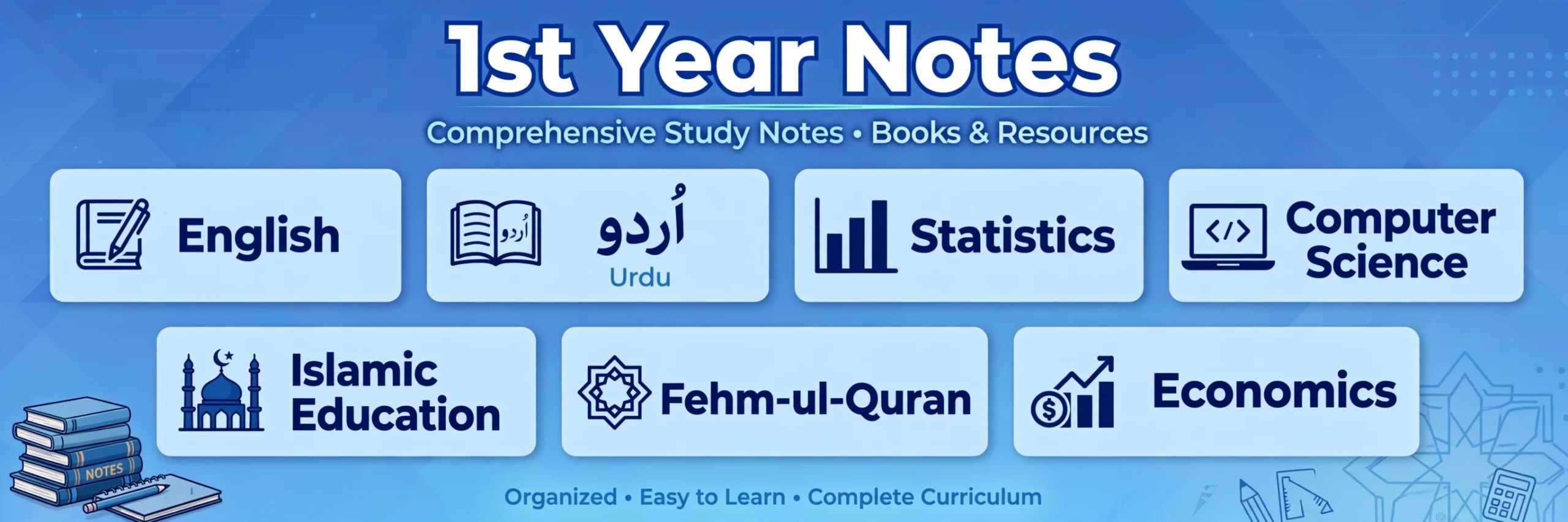
All Subjects at a Glance
This collection covers seven first-year subjects: English Compulsory, Urdu Compulsory, Statistics, Computer Science, Islamic Education, Fehm ul Quran and Economics. Each section below gives a short summary, important topics, sample short and long question-answers, sample MCQs, and a clearly labelled PDF download for that subject.
Related Notes
For a deeper computer science revision, see https://www.zahidenotes.com/2026/10/1st-year-computer-science-notes-all-chapters-short-long-questions-mcqs.html. For the wider first-year collection, see https://www.zahidenotes.com/1st-year-11th-class-notes-guess-papers-pairing-schemes-and-past-papers.
English Compulsory
First-year English builds reading, grammar, vocabulary and writing. Read each lesson for its main idea first, then note new words, sentence patterns and the writer’s message in your own words. Regular short writing practice helps more than reading notes once.
Important Topics
- Reading comprehension: main idea, supporting details and inference
- Grammar: tenses, active and passive voice, direct and indirect speech
- Vocabulary in context, synonyms, antonyms and word formation
- Writing: paragraphs, letters, applications and story writing
Short Questions and Answers
Q: What is the first step in answering a comprehension question?
A: Read the passage for its main idea, then re-read the part that relates to the question before writing a short, direct answer.
Q: Why is tense accuracy important in English writing?
A: Correct tense shows when an action happened and keeps the meaning clear, so the reader does not confuse past, present and future events.
Long Question and Answer
Q: How should a student plan a paragraph answer in an examination?
A: Start with a clear topic sentence, add two or three supporting points in simple sentences, give one short example where it fits, and finish with a closing sentence that repeats the main point. Check grammar, spelling and punctuation before moving on.
MCQs
1. Which sentence is in the present perfect tense? (a) She goes to school. (b) She has gone to school. (c) She went to school. (d) She will go to school. — Answer: (b) She has gone to school.
2. The synonym of “brave” is: (a) timid (b) courageous (c) weak (d) slow. — Answer: (b) courageous.
Download English PDF: Download 1st Year English Compulsory Notes PDF
Urdu Compulsory
Urdu Compulsory develops reading, understanding and clear written expression. Focus on the central idea of each lesson, the meaning of difficult words in context, and the ability to explain a passage in simple Urdu. Practise short answers daily, rather than memorising long paragraphs.
Important Topics
- Lesson summaries and central ideas in your own words
- Word meanings, synonyms, antonyms and sentence use
- Grammar: sentences, verbs, tenses and punctuation in Urdu writing
- Writing: letters, applications, paragraphs and summaries
Short Questions and Answers
Q: How can a student write a good summary of a lesson?
A: Read the lesson fully, pick out its main points, leave out examples and extra detail, and rewrite those points in short, clear sentences.
Q: Why should word meanings be learned in sentences?
A: A word can change meaning with context, so using it in a sentence shows that the student understands it, not only its dictionary meaning.
Long Question and Answer
Q: Explain how to answer a lesson-based long question.
A: Begin with the main idea of the lesson, explain it in two or three connected points, support it with a brief reference to the lesson, and end with a clear conclusion. Keep the language simple and check that every sentence stays on the question.
MCQs
1. A summary should mainly contain: (a) every detail (b) the main points (c) only examples (d) only difficult words. — Answer: (b) the main points.
2. Learning a word in a sentence mainly helps with: (a) spelling only (b) meaning in context (c) handwriting (d) reading speed only. — Answer: (b) meaning in context.
Download Urdu PDF: Download 1st Year Urdu Compulsory Notes PDF
Statistics
Statistics is about collecting, organising and interpreting data. First-year students should learn definitions clearly, then practise calculations step by step. Always write the formula, show the working, and check whether the answer makes sense for the data given.
Important Topics
- Data, variables, frequency distribution and class intervals
- Mean, median and mode for grouped and ungrouped data
- Range, variance and standard deviation in simple terms
- Graphs: histograms, frequency polygons and pie charts
Short Questions and Answers
Q: What is the mean of a set of numbers?
A: The mean is found by adding all the values and dividing the total by the number of values.
Q: What does a frequency distribution show?
A: It shows how often each value, or each class of values, occurs in a set of data.
Long Question and Answer
Q: Explain how to find the mean from grouped data.
A: Find the midpoint of each class, multiply each midpoint by its frequency, add those products, and divide by the total frequency. Label each step clearly so a small calculation error can be found quickly.
MCQs
1. The mean of 4, 6 and 8 is: (a) 4 (b) 6 (c) 8 (d) 18. — Answer: (b) 6.
2. In a frequency table, “frequency” means: (a) the largest value (b) the number of times a value occurs (c) the average (d) the range. — Answer: (b) the number of times a value occurs.
Download Statistics PDF: Download 1st Year Statistics Notes PDF
Computer Science
Computer science in first year explains how computers store, process and share information. Learn each term with a simple example, and practise drawing or labelling diagrams from memory. For chapter-by-chapter revision, the related post linked above is a useful companion to this section.
Important Topics
- Computer systems: input, processing, output and storage
- Memory: RAM, ROM, cache and secondary storage
- CPU parts and the fetch-decode-execute cycle
- Networks, protocols, databases, tables and queries
Short Questions and Answers
Q: What is the difference between hardware and software?
A: Hardware is the physical part of a computer, while software is the set of instructions that tells the hardware what to do.
Q: What is a primary key in a database table?
A: A primary key is a field that uniquely identifies each record in a table, so no two records share the same key value.
Long Question and Answer
Q: Explain how data moves from input to output in a computer system.
A: Input devices collect data, memory holds it while the CPU processes it, and output devices present the result. Storage keeps data for later use. Each stage depends on the others, so a clear answer should follow this order and name one example for each stage.
MCQs
1. Which memory loses its contents when power is off? (a) ROM (b) RAM (c) Hard drive (d) Flash drive. — Answer: (b) RAM.
2. A row in a database table is called: (a) field (b) record (c) key (d) query. — Answer: (b) record.
Download Computer Science PDF: Download 1st Year Computer Science Notes PDF
Islamic Education
Islamic Education focuses on beliefs, worship, character and everyday conduct. Study each topic by understanding its meaning first, then learning how it guides daily life. Write answers in respectful, simple language and avoid adding claims that you cannot explain.
Important Topics
- Beliefs, worship and their purpose in daily life
- Honesty, patience, kindness and respect for others
- Rights of parents, neighbours and fellow students
- Cleanliness, responsibility and good conduct
Short Questions and Answers
Q: Why is honesty important in student life?
A: Honesty builds trust, keeps learning fair, and helps a student take responsibility for both success and mistakes.
Q: How does good conduct show in daily life?
A: It shows in polite speech, respect for others, care for shared spaces, and keeping promises.
Long Question and Answer
Q: Explain how Islamic teachings guide a student’s character.
A: They encourage truthfulness, patience and kindness, and link worship with good behaviour towards family, teachers and society. A strong answer gives one clear point at a time and ends with a practical example, such as helping a classmate or respecting a teacher.
MCQs
1. Which quality builds trust most directly? (a) dishonesty (b) honesty (c) carelessness (d) rudeness. — Answer: (b) honesty.
2. Respect for parents and teachers is an example of: (a) good conduct (b) carelessness (c) pride (d) selfishness. — Answer: (a) good conduct.
Download Islamic Education PDF: Download 1st Year Islamic Education Notes PDF
Fehm ul Quran
Fehm ul Quran means understanding the message of the Quran. Read each selected passage slowly, learn its central teaching, and think about how it applies to honesty, patience, gratitude and care for others. Avoid rushing through translation without understanding the main idea.
Important Topics
- Central message and main teaching of each selected passage
- Key words and their meanings in context
- Lessons on character, patience, gratitude and responsibility
- Applying the teaching in family, school and community life
Short Questions and Answers
Q: What does “fehm” mean in Fehm ul Quran?
A: Fehm means understanding, so the subject focuses on understanding the message, not only reading the words.
Q: How should a student revise a passage for an examination?
A: Read the passage, note its central teaching in one sentence, learn key words, and practise explaining the lesson in simple words.
Long Question and Answer
Q: Explain how understanding a passage helps a student more than memorising it.
A: Understanding helps a student answer different questions about the same passage, explain its lesson in new words, and apply it to daily life. Memorising alone may fail if the question is asked in a different way.
MCQs
1. Fehm ul Quran mainly focuses on: (a) reading speed only (b) understanding the message (c) handwriting (d) memorising numbers. — Answer: (b) understanding the message.
2. A good revision note for a passage should start with: (a) its central teaching (b) an unrelated example (c) a long quotation (d) a difficult word only. — Answer: (a) its central teaching.
Download Fehm ul Quran PDF: Download 1st Year Fehm ul Quran Notes PDF
Economics
Economics studies how people, businesses and governments make choices with limited resources. Learn each concept with a daily-life example, draw simple demand and supply diagrams carefully, and practise explaining causes and effects in short, logical steps.
Important Topics
- Scarcity, choice, needs and wants
- Demand, supply and market equilibrium in simple terms
- Types of markets and the role of price
- National income, money and basic economic problems
Short Questions and Answers
Q: What is scarcity in economics?
A: Scarcity means resources are limited while human wants are unlimited, so choices must be made.
Q: What happens to demand when price rises, other things being equal?
A: Demand usually falls, because buyers are less willing or able to buy the good at the higher price.
Long Question and Answer
Q: Explain the basic economic problem and how it affects choices.
A: People face unlimited wants but limited income, time and resources. This forces choices: what to produce, how to produce it, and for whom. Every choice has an opportunity cost, which is the next best alternative given up. A clear answer should define scarcity, give a daily example, and explain opportunity cost.
MCQs
1. Scarcity arises because: (a) wants are limited (b) resources are limited and wants are unlimited (c) money is unlimited (d) prices never change. — Answer: (b) resources are limited and wants are unlimited.
2. Other things being equal, a rise in price usually: (a) increases demand (b) decreases demand (c) leaves demand unchanged (d) removes supply. — Answer: (b) decreases demand.
Download Economics PDF: Download 1st Year Economics Notes PDF
Revision Checklist
- Read the FBISE syllabus for each subject and tick off the topics you have revised.
- Write one short answer for each subject from memory, then check it against the notes.
- Practise one long answer per subject with a clear introduction, points and conclusion.
- Attempt the MCQs in each section without looking, then review only the ones you missed.
- Solve one Statistics calculation and one Economics diagram each day in the final week.
- Re-read the English and Urdu important topics and write two paragraphs without notes.
- Download the subject PDFs above for offline revision and keep them with your class notes.
- Remember: these are original study and revision notes only. They are not official, not leaked, and not guaranteed.
For the wider first-year collection, return to https://www.zahidenotes.com/1st-year-11th-class-notes-guess-papers-pairing-schemes-and-past-papers, and for detailed computer science chapters, use https://www.zahidenotes.com/2026/10/1st-year-computer-science-notes-all-chapters-short-long-questions-mcqs.html.


2 thoughts on “1st Year FBISE Notes All Subjects – English Urdu Statistics Computer Science Islamic Education Fehm ul Quran Economics”