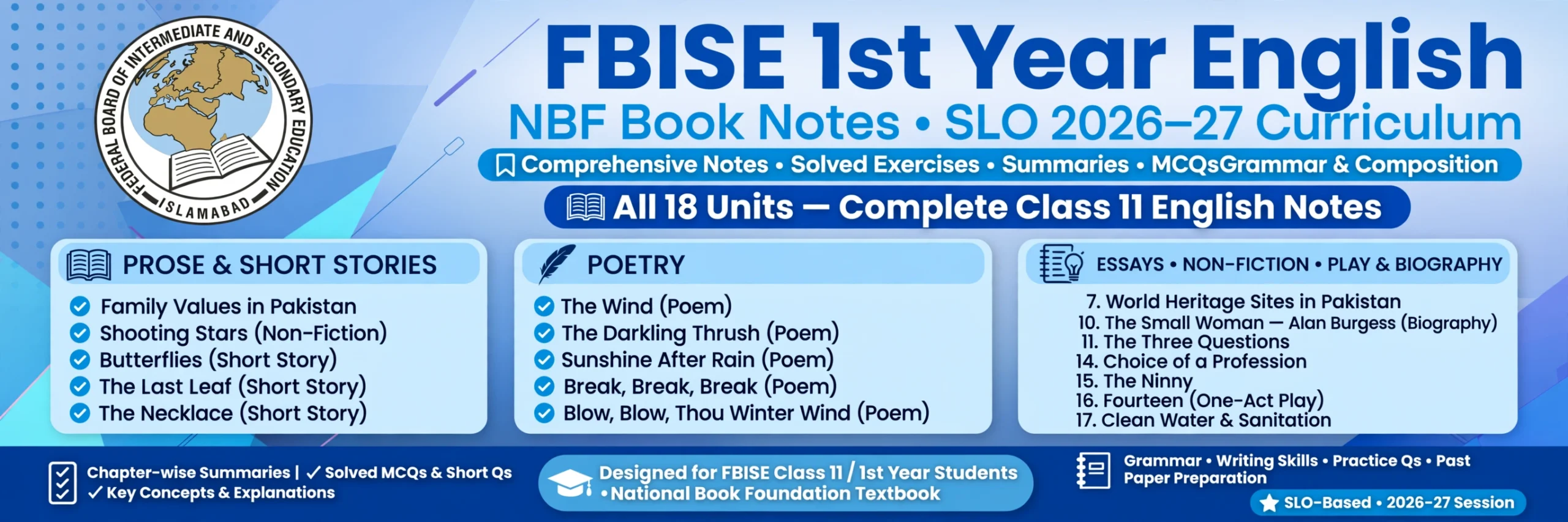
These fbise 1st year english notes are original study and revision notes only for Class 11 students using the FBISE National Book Foundation (NBF) English book. They are not official FBISE notes, not the textbook, not leaked papers, and they do not guarantee exam questions. Every summary below is written in plain, original words, with themes, important points, short and long question-answers, and practice MCQs to help you revise one unit at a time.
Table of Contents
Download the PDF
PDF download: Download FBISE 1st Year English NBF Book Notes All 18 Units PDF. Save it for offline revision and use it beside your class notes and the FBISE syllabus.
Related Notes
For notes in other first-year subjects, see https://www.zahidenotes.com/2026/10/1st-year-fbise-notes-all-subjects.html. For the wider first-year collection, including guess papers, pairing schemes and past papers, see https://www.zahidenotes.com/1st-year-11th-class-notes-guess-papers-pairing-schemes-and-past-papers.
How to Use These Notes
- Read one unit, then close the notes and write its theme in one sentence from memory.
- Answer the short questions first, then expand one answer into a long answer.
- Attempt the MCQs without looking, then review only the ones you missed.
- For poems and stories, focus on the central idea and message, not on memorising long passages.
- Always check the FBISE syllabus and your teacher’s guidance for the final exam pattern.
Unit 1: Family Values in Pakistan
Summary: This unit presents the family as the first place where a person learns manners, language and values. In Pakistani families, elders guide younger members, members share work, and problems are handled through talk and patience. The unit stresses polite speech, respect for elders, care for children, and shared responsibility at home.
Theme: Communication and collaboration within the family build trust, discipline and a peaceful home.
Important Points
- The family is the first school of manners, language and values.
- Listening fully before replying prevents misunderstanding.
- Collaboration means sharing household responsibilities fairly.
- Respect for elders and kindness to younger members strengthen trust.
- Strong families help young people face pressure and make good decisions.
Short Question-Answers
Q: What is the main idea of this unit? A: Good communication and teamwork make a family strong and peaceful. Q: Why is listening important in a family? A: It shows respect, prevents misunderstanding, and helps solve problems early. Q: Give one example of collaboration at home. A: Family members sharing household work, study help, or care of elders according to ability and time.
Long Question-Answer
Q: How do family values help a student in life? A: Family values teach discipline, honesty and patience. A student who learns to listen, share and respect others can work better in class, handle disagreement calmly, and take responsibility for study and behaviour. These habits support learning at school and good conduct in the wider community.
MCQs
1. The first school of manners is: (a) the market (b) the family (c) the playground (d) the office. — Answer: (b) the family. 2. Good communication mainly requires: (a) speaking loudly (b) listening fully (c) avoiding others (d) giving orders. — Answer: (b) listening fully.
Unit 2: Shooting Stars
Summary: This non-fiction unit looks at the lives of famous people who reached a high position but then faced a sudden fall. It explains that fame, wealth and public praise can change quickly, and that character is tested more by setbacks than by success. The lesson encourages humility, steady effort and learning from mistakes.
Theme: Fame is uncertain; lasting value comes from character, honest work and resilience after failure.
Important Points
- Success can be brief, and public attention can fade.
- Pride and careless habits can damage a promising career.
- Failure can teach self-control, if a person accepts it honestly.
- Steady work matters more than sudden praise.
- Character, not popularity, is the safer measure of a person.
Short Question-Answers
Q: What does the title suggest? A: It suggests people who rise quickly like stars and may fall just as quickly. Q: What is a safer goal than fame? A: Good character and honest, steady work. Q: How should a person respond to failure? A: By learning from it, correcting mistakes, and continuing with patience.
Long Question-Answer
Q: What lesson can students learn from the rise and fall of famous people? A: Students should not judge success by applause alone. Talent needs discipline, humility and regular practice. When results are poor, a student should review the cause, change the method, and keep working, instead of blaming others or giving up. In this way, a setback becomes a lesson rather than an end.
MCQs
1. A shooting star mainly suggests: (a) lasting fame (b) a brief, bright rise (c) slow growth (d) hidden talent. — Answer: (b) a brief, bright rise. 2. The best response to failure is: (a) pride (b) blame (c) learning and steady effort (d) quitting. — Answer: (c) learning and steady effort.
Unit 3: The Wind
Summary: In this poem, the wind is shown as a strong, restless force that moves through the world and tests everything in its path. Weak things are shaken, while strong things stand firm. The poem uses the wind as a picture of hardship: it does not spare anyone, but it also teaches strength and readiness.
Theme: Hardship tests strength; people should build inner strength instead of expecting life to be gentle.
Important Points
- The wind stands for difficulty, change and challenge.
- Weak structures fall, while strong ones survive.
- The poem advises preparation rather than complaint.
- Strength here means courage, patience and firm purpose.
- Nature is used as a teacher for human life.
Short Question-Answers
Q: What does the wind symbolise? A: Hardship and challenge in life. Q: Why do weak things fall before the wind? A: Because they lack firmness and preparation. Q: What advice does the poem give? A: Build strength of mind and character so difficulties cannot easily break you.
Long Question-Answer
Q: How does the poem use nature to teach a lesson about life? A: The poem turns the wind into a test. It shakes weak doors and roofs but cannot destroy what is firmly built. In the same way, problems test students, workers and families. A person who prepares, stays calm and keeps a clear purpose can face trouble without losing hope. The lesson is not to fear difficulty, but to grow strong enough to meet it.
MCQs
1. The wind in the poem mainly represents: (a) kindness (b) hardship (c) silence (d) sleep. — Answer: (b) hardship. 2. The poem advises: (a) complaint (b) escape (c) inner strength (d) pride. — Answer: (c) inner strength.
Unit 4: Butterflies
Summary: This story follows a change from a small, limited stage of life to a freer and more colourful one. The butterfly begins in a closed form and, after a period of struggle, emerges able to move in the open air. The change is slow and not without risk, but it brings new freedom and responsibility.
Theme: Growth requires patience and struggle; real change comes from within and takes time.
Important Points
- Change is gradual, not instant.
- Struggle is part of growth, not a sign of failure.
- Freedom brings new choices and new responsibility.
- Beauty in the story stands for maturity and confidence.
- Each stage of life prepares the next one.
Short Question-Answers
Q: What does the butterfly’s change represent? A: Personal growth from a limited stage to a freer, mature stage. Q: Why is struggle important in the story? A: Because it builds the strength needed for the next stage. Q: What should a student learn from this change? A: To be patient, keep learning, and accept that growth takes time.
Long Question-Answer
Q: Explain the message of growth in this story. A: Growth does not happen by wishing alone. A learner must pass through study, practice and difficulty, much as a butterfly passes through its early stages. If the struggle is avoided, the result is weak. If it is faced with patience, the learner gains confidence, independence and a better understanding of responsibility. The story therefore teaches steady effort and hope during slow progress.
MCQs
1. The butterfly mainly symbolises: (a) fear (b) growth and change (c) danger (d) wealth. — Answer: (b) growth and change. 2. Growth in the story is: (a) instant (b) gradual (c) impossible (d) painful only. — Answer: (b) gradual.
Unit 5: Clean Water and Sanitation
Summary: This unit explains why clean water and safe sanitation are basic needs for health, dignity and learning. Dirty water spreads disease, wastes study time, and harms families. The unit calls for careful use of water, safe disposal of waste, hand hygiene, and community responsibility for clean surroundings.
Theme: Clean water and sanitation protect health and support a fair, dignified life for all.
Important Points
- Safe water prevents many common diseases.
- Sanitation means safe toilets, waste disposal and clean surroundings.
- Handwashing is a simple and powerful health habit.
- Water should not be wasted or polluted.
- Clean surroundings are a shared duty, not only a government duty.
Short Question-Answers
Q: Why is clean water important? A: It protects health, prevents disease, and supports daily life and study. Q: What is sanitation? A: The safe handling of human waste, clean toilets, and clean surroundings. Q: Name one daily habit that protects health. A: Washing hands with soap, especially before eating and after using the toilet.
Long Question-Answer
Q: How can students help improve water and sanitation in their community? A: Students can save water, avoid throwing waste into drains, keep school and home surroundings clean, and encourage handwashing. They can also share correct information with family members and report broken taps or unsafe waste to responsible adults. Small, regular actions, repeated by many people, make a community healthier and protect learning time.
MCQs
1. Clean water mainly helps by: (a) increasing disease (b) preventing disease (c) wasting time (d) polluting soil. — Answer: (b) preventing disease. 2. A key sanitation habit is: (a) littering (b) handwashing with soap (c) wasting water (d) blocking drains. — Answer: (b) handwashing with soap.
Unit 6: The Darkling Thrush
Summary: In this poem, a speaker looks at a cold, fading landscape at the end of the year and feels gloom. Then a small thrush sings with surprising joy in the bleak evening. The bird’s song does not change the season, but it changes the speaker’s feeling, suggesting that hope can appear even when the surroundings look hopeless.
Theme: Hope can survive in dark times, often in small and unexpected forms.
Important Points
- The winter setting creates a mood of loss and endings.
- The thrush is small, yet its song is full and hopeful.
- Contrast between gloom and song is the poem’s central device.
- Hope here is quiet, not loud or certain.
- The speaker learns from nature rather than from argument.
Short Question-Answers
Q: Why is the landscape gloomy? A: It is winter, cold and fading, which matches the speaker’s low mood. Q: What surprises the speaker? A: The thrush sings joyfully despite the bleak evening. Q: What does the thrush symbolise? A: Hope that remains even in difficult conditions.
Long Question-Answer
Q: How does the poem move from gloom to hope? A: The poem begins with cold, empty images that suggest endings. The thrush then enters as a contrast: a frail bird singing with full heart in the same cold air. The song does not remove winter, but it offers a new way of seeing it. The speaker ends with the thought that hope may exist even when its reason is not clear. That quiet shift is the poem’s main power.
MCQs
1. The thrush mainly represents: (a) despair (b) hope (c) wealth (d) fear. — Answer: (b) hope. 2. The poem’s setting is: (a) spring morning (b) winter evening (c) summer noon (d) autumn fair. — Answer: (b) winter evening.
Unit 7: World Heritage Sites in Pakistan
Summary: This unit introduces Pakistan’s world heritage sites as places of history, art and natural beauty that belong to all people. Old forts, tombs, ruins and landscapes tell the story of earlier civilisations, trade and faith. Protecting these sites matters because once they are damaged, their history cannot be rebuilt in the same way.
Theme: Heritage is a shared trust; preserving it protects identity, learning and future tourism.
Important Points
- Heritage sites record history, architecture and cultural life.
- They attract study, tourism and local income.
- Pollution, neglect and careless visitors can damage them.
- Protection needs laws, care and public awareness.
- Visitors should respect rules, signs and local communities.
Short Question-Answers
Q: Why are heritage sites important? A: They preserve history and culture for future generations. Q: How can visitors harm a site? A: By littering, touching fragile surfaces, or ignoring rules. Q: Who should protect heritage? A: Government, local communities and visitors together.
Long Question-Answer
Q: Why should Pakistan protect its world heritage sites? A: These sites are evidence of past art, building skill and social life. They help students understand history in a real place, not only in a book. They also support tourism and local work. If they are lost to neglect or damage, that evidence and income are lost too. Protection therefore needs repair, clean surroundings, trained guides and visitors who act with respect.
MCQs
1. A heritage site mainly preserves: (a) new buildings (b) history and culture (c) shopping (d) traffic. — Answer: (b) history and culture. 2. The best visitor habit is: (a) littering (b) following site rules (c) breaking signs (d) touching fragile art. — Answer: (b) following site rules.
Unit 8: Social Media: A Blessing or a Curse?
Summary: This unit weighs the benefits and harms of social media. It connects people, spreads news and helps learning, but it can also waste time, spread false information, harm privacy and affect mental health. The unit argues that the result depends on how wisely people use it, not on the technology alone.
Theme: Social media is a tool; balanced, honest and careful use makes it helpful, while careless use makes it harmful.
Important Points
- Benefits include fast communication, learning and business.
- Harms include misinformation, addiction and privacy loss.
- Time limits protect study, sleep and family life.
- Users should check facts before sharing.
- Polite, truthful online behaviour protects others.
Short Question-Answers
Q: Give one benefit of social media. A: It allows fast communication and access to learning material. Q: Give one harm of social media. A: It can spread false news quickly. Q: How can a student use it safely? A: By setting time limits, checking sources, and protecting personal information.
Long Question-Answer
Q: Is social media a blessing or a curse? Discuss. A: It is both, depending on use. Used for study, family contact and useful information, it saves time and widens learning. Used without limits, it distracts students, spreads rumours and harms privacy and sleep. The wise answer is balance: use it with a purpose, verify news, respect others, and keep study and rest first. Then it becomes a blessing rather than a curse.
MCQs
1. A main benefit of social media is: (a) slow news (b) fast communication (c) less learning (d) no contact. — Answer: (b) fast communication. 2. Before sharing news, a user should: (a) share at once (b) check the source (c) add rumour (d) hide it. — Answer: (b) check the source.
Unit 9: Sunshine After Rain
Summary: This poem describes rain followed by bright sunshine, using weather as a picture of life after difficulty. The storm passes, light returns, and the world looks fresh again. The poem encourages the reader to wait through trouble with patience, because better days can follow.
Theme: After hardship comes relief; patience and hope carry a person through dark periods.
Important Points
- Rain stands for trouble, sorrow or failure.
- Sunshine stands for relief, joy and new hope.
- The change from rain to sun is the poem’s central contrast.
- Nature’s cycle teaches patience.
- The mood moves from gloom to calm and brightness.
Short Question-Answers
Q: What does rain represent? A: Difficulty or sorrow. Q: What does sunshine represent? A: Relief and hope after difficulty. Q: What lesson does the poem teach? A: To remain patient, because trouble is often followed by better days.
Long Question-Answer
Q: How does the poem use weather to give hope? A: The poem first shows rain and darkness, then sunshine after the storm. That natural order becomes a lesson: no trouble lasts forever. Just as the sky clears, a student’s failure, a family’s problem or a period of sadness can be followed by a calmer time. The poem does not promise instant success, but it encourages steady hope and patient effort until conditions improve.
MCQs
1. Sunshine after rain mainly symbolises: (a) permanent trouble (b) hope after hardship (c) fear (d) laziness. — Answer: (b) hope after hardship. 2. The poem teaches: (a) impatience (b) patience (c) complaint (d) escape. — Answer: (b) patience.
Unit 10: The Small Woman
Summary: This biography presents a woman of small physical size but great courage and determination. Despite illness, hardship and low expectations from others, she works steadily, helps her community and earns respect through service. Her life shows that worth is measured by character and action, not by appearance or size.
Theme: True greatness lies in courage, service and persistence, not in physical strength or status.
Important Points
- The woman faces physical and social difficulties.
- She refuses to accept low expectations.
- Her work serves others, not only herself.
- Respect comes gradually through consistent action.
- Her story challenges judging people by appearance.
Short Question-Answers
Q: Why is the woman called small? A: Because of her small physical size, in contrast to her great courage. Q: How does she earn respect? A: Through steady work and service to others. Q: What should readers learn from her? A: Not to judge a person by appearance or physical strength.
Long Question-Answer
Q: What does this biography teach about success? A: Success is not only wealth, fame or physical power. This woman succeeds by facing hardship with patience, working for others, and refusing to give up. Her life shows students that limited resources or a difficult start need not decide the future. Consistent effort, kindness and courage can build a respected life, even when others expect little.
MCQs
1. The woman’s greatness lies in: (a) size (b) wealth (c) courage and service (d) fame. — Answer: (c) courage and service. 2. The biography warns against: (a) hard work (b) judging by appearance (c) helping others (d) patience. — Answer: (b) judging by appearance.
Unit 11: The Three Questions
Summary: A king wants to know the right time for every action, the right people to listen to, and the most important work to do. He seeks answers from wise men, but finds them through a simple experience: helping a wounded man in the present moment. The story concludes that the present time, the person beside you, and doing good are the answers.
Theme: The most important time is now, the most important person is the one with you, and the most important work is to do good to that person.
Important Points
- The king’s three questions concern time, people and work.
- Book learning alone does not give him a clear answer.
- Helping the wounded man teaches him through action.
- The present moment is the only time we truly control.
- Kindness is presented as the highest practical wisdom.
Short Question-Answers
Q: What were the king’s three questions? A: The right time, the right people, and the most important work. Q: How does he learn the answers? A: By helping a wounded man in the present moment. Q: What is the most important time? A: Now, because it is the only time we can act.
Long Question-Answer
Q: Explain the moral of The Three Questions. A: The story teaches that wisdom is not only found in books or councils. A person should act well in the present, care for the person beside them, and do good without delay. Waiting for a perfect time or a more important person wastes the chance to help. For students, the lesson is clear: study now, help classmates now, and treat present duties as the most important work.
MCQs
1. The most important time is: (a) yesterday (b) tomorrow (c) now (d) next year. — Answer: (c) now. 2. The most important work is: (a) doing good to the person with you (b) collecting wealth (c) seeking fame (d) waiting. — Answer: (a) doing good to the person with you.
Unit 12: Break, Break, Break
Summary: In this poem, the speaker stands by the sea and watches waves break on the shore. The sea’s endless movement contrasts with the speaker’s grief for a lost friend. The waves continue, children play, and boats sail, while the speaker feels that a voice he once knew will never return. The poem expresses sorrow in a quiet, restrained way.
Theme: Grief continues even as life and nature move on; loss leaves a lasting, quiet pain.
Important Points
- The sea stands for time and nature’s endless movement.
- Everyday life continues around the grieving speaker.
- Contrast between the busy shore and silent grief is central.
- The poem’s tone is calm, not loud or angry.
- Loss is shown through absence, not through long description.
Short Question-Answers
Q: What does the sea represent? A: The endless movement of time and nature. Q: Why is the speaker sad? A: Because a dear friend has died and will not return. Q: How does the poem show grief? A: Through quiet contrast between lively nature and the speaker’s inner silence.
Long Question-Answer
Q: How does nature increase the speaker’s sense of loss? A: The waves keep breaking, boats keep sailing, and children keep playing. That continuity makes the speaker’s loss feel sharper, because the world does not pause for grief. Yet the poem does not blame nature. It shows grief as a personal, lasting feeling within a world that moves on. That honest contrast gives the poem its emotional power.
MCQs
1. The speaker is grieving for: (a) a lost friend (b) a lost boat (c) a lost job (d) a lost home. — Answer: (a) a lost friend. 2. The tone of the poem is: (a) joyful (b) angry (c) quiet and sorrowful (d) humorous. — Answer: (c) quiet and sorrowful.
Unit 13: Blow, Blow, Thou Winter Wind
Summary: This poem compares the cold winter wind with the colder pain caused by ungrateful people. The wind bites the skin, but it is honest and open. Human ingratitude, by contrast, hurts more deeply because it breaks trust. The poem therefore prefers nature’s open harshness to hidden human cruelty.
Theme: Open hardship is easier to bear than betrayal and ingratitude from people we trust.
Important Points
- The winter wind is cold, but it does not pretend to be kind.
- Ingratitude is presented as more painful than cold weather.
- The poem contrasts nature’s honesty with human falseness.
- Trust, once broken, leaves a lasting wound.
- The tone is bitter, yet controlled.
Short Question-Answers
Q: Why does the speaker prefer the winter wind? A: Because the wind is openly harsh, while ingratitude is hidden and hurtful. Q: What hurts more than cold? A: Betrayal and ingratitude from trusted people. Q: What is the poem’s main contrast? A: Nature’s honest cold against human falseness.
Long Question-Answer
Q: How does the poem compare nature and human behaviour? A: The wind can freeze the body, but it does not deceive. A friend who forgets kindness, however, wounds the heart. The poem argues that physical pain passes, while broken trust stays in memory. Students can learn to value honesty, gratitude and loyalty, because those qualities protect relationships better than polite words alone.
MCQs
1. The winter wind is described as: (a) deceitful (b) openly harsh (c) warm (d) silent. — Answer: (b) openly harsh. 2. The poem says ingratitude is: (a) harmless (b) more painful than cold (c) funny (d) useful. — Answer: (b) more painful than cold.
Unit 14: Choice of a Profession
Summary: This unit advises students to choose a profession with care, not by fashion, pressure or money alone. A good choice matches interest, ability, values and available opportunities. It also needs honest self-assessment, advice from trusted people, and a plan for study and training.
Theme: A wise career choice balances interest, ability, values and realistic opportunity.
Important Points
- Interest keeps a person motivated over a long career.
- Ability and training must match the work.
- Money alone is a poor reason for a lifelong choice.
- Family and peer pressure should not decide the choice alone.
- A plan for study, practice and experience makes the choice workable.
Short Question-Answers
Q: What should a student consider first? A: Interest, ability and values, together with real opportunities. Q: Why is money alone a weak reason? A: Because a job without interest becomes tiring and unsatisfying over time. Q: Whose advice is useful? A: Teachers, parents and experienced workers who know the student and the field.
Long Question-Answer
Q: How should a student choose a profession? A: First, list interests and strengths honestly. Then learn what each profession needs in study, training and daily work. Compare those needs with personal values, health and family duties. Seek advice, but make the final choice yourself. Finally, set a study plan and gain experience step by step. A choice made this way is more likely to bring satisfaction and steady progress.
MCQs
1. A good career choice balances: (a) money only (b) fashion only (c) interest, ability and opportunity (d) pressure only. — Answer: (c) interest, ability and opportunity. 2. The best advice comes from: (a) strangers only (b) trusted, experienced people (c) rumours (d) advertisements only. — Answer: (b) trusted, experienced people.
Unit 15: The Ninny
Summary: This story shows an employer who unfairly deducts money from a governess’s wages, then tests whether she will accept the injustice. The governess, who is timid and in need of the job, at first accepts the wrong amounts. When the employer reveals the trick and pays her fairly, the story exposes both his cruelty and her lack of courage to claim her rights.
Theme: People must learn to claim their rights politely but firmly; silence can allow injustice to continue.
Important Points
- The governess is timid and afraid of losing her job.
- The employer uses false deductions to test her.
- Accepting injustice does not make a person noble.
- Fair pay is a right, not a favour.
- The story criticises both exploitation and excessive meekness.
Short Question-Answers
Q: Why does the governess accept unfair deductions? A: Because she is timid and afraid of losing her job. Q: What does the employer do at the end? A: He reveals the trick and pays her fairly. Q: What is the story’s lesson? A: Claim your rights politely but firmly, instead of accepting injustice in silence.
Long Question-Answer
Q: What does The Ninny teach about rights and courage? A: The story shows that meekness can become a weakness when it allows unfair treatment. The governess deserves fair pay, but she does not ask for it. The employer is wrong to exploit her fear, yet the story also asks readers to be brave enough to speak for themselves. True goodness includes self-respect: asking fairly, keeping records, and refusing to accept what is unjust.
MCQs
1. The governess accepts unfair pay because she is: (a) rich (b) timid and afraid (c) dishonest (d) careless. — Answer: (b) timid and afraid. 2. The story teaches that rights should be: (a) ignored (b) claimed politely but firmly (c) sold (d) feared. — Answer: (b) claimed politely but firmly.
Unit 16: Fourteen
Summary: This one-act play presents a tense household situation in which a young woman’s future, family honour and social pressure meet in a single evening. Characters argue, hide feelings and reveal their motives through dialogue. The play’s short form makes every line important, and the ending leaves the reader to think about choice, duty and freedom.
Theme: Social pressure and family duty can limit a young person’s freedom, and choices made under pressure need courage and honesty.
Important Points
- A one-act play has one main situation and a short time span.
- Character is revealed mainly through dialogue.
- Family honour and social custom create conflict.
- Silence and hesitation can be as meaningful as speech.
- The ending invites reflection rather than giving a simple answer.
Short Question-Answers
Q: What is a one-act play? A: A short play with one main situation, usually in one setting. Q: How is character shown in this play? A: Mainly through dialogue, tone and action. Q: What creates the main conflict? A: The clash between family duty, social pressure and personal choice.
Long Question-Answer
Q: How does the play form suit its theme? A: The short form forces the conflict into one evening, so tension stays high. There is no time for long explanations, so each dialogue line must reveal motive, fear or hope. That compression suits a theme about pressure: the characters, like the audience, feel that a decision cannot be delayed. The play therefore teaches students to read dialogue closely and to notice what is left unsaid.
MCQs
1. A one-act play usually has: (a) many acts (b) one main situation (c) no dialogue (d) no characters. — Answer: (b) one main situation. 2. Character in a play is mainly shown by: (a) stage size (b) dialogue and action (c) ticket price (d) lighting only. — Answer: (b) dialogue and action.
Unit 17: The Last Leaf
Summary: This story follows a young artist who falls ill and loses hope, believing she will die when the last leaf falls from a vine outside her window. An older artist, who has long dreamed of painting a masterpiece, secretly paints a leaf on the wall during a storm. The painted leaf gives her hope, she recovers, and the older artist’s sacrifice becomes his true masterpiece.
Theme: Hope, kindness and sacrifice can save a life; true art serves others.
Important Points
- The falling leaves mirror the sick girl’s fading hope.
- The last leaf is a painted leaf, not a real one.
- Hope helps recovery, along with care and treatment.
- The older artist’s sacrifice is quiet and unselfish.
- The story links art with compassion, not fame.
Short Question-Answers
Q: Why does the girl watch the leaves? A: She believes she will die when the last leaf falls. Q: What is the last leaf really? A: A leaf painted on the wall by the older artist. Q: What is the older artist’s masterpiece? A: The painted leaf that gives the girl hope and helps her recover.
Long Question-Answer
Q: Explain the irony and message of The Last Leaf. A: The irony is that a painted leaf, which is not alive, keeps a living person alive. The girl gains hope from what she thinks is nature’s endurance, but it is really human kindness. The older artist, who never painted a famous work, creates his masterpiece by serving another person. The message is that hope and selfless help can change a life, and that true greatness is measured by service, not by fame.
MCQs
1. The last leaf is: (a) real (b) painted (c) golden (d) fallen. — Answer: (b) painted. 2. The story’s main message is: (a) fame (b) hope and sacrifice (c) wealth (d) fear. — Answer: (b) hope and sacrifice.
Unit 18: The Necklace
Summary: This story follows a woman who longs for wealth and beauty but lives a modest life. She borrows a necklace for a ball, loses it, and spends years in hard work to repay a replacement. At the end, she learns that the borrowed necklace was not valuable. Her desire for appearance, not the necklace itself, caused her long suffering.
Theme: Vanity and the desire to appear rich can lead to real hardship; honesty and contentment protect a person from needless suffering.
Important Points
- The woman values appearance more than her real life.
- Borrowing without care creates a long debt.
- Years of hard work follow one night of pleasure.
- The ending reveals the necklace was imitation.
- The story warns against pride, envy and dishonesty.
Short Question-Answers
Q: Why does the woman borrow the necklace? A: To look rich and beautiful at the ball. Q: What happens after the ball? A: She loses the necklace and works for years to repay a replacement. Q: What does she learn at the end? A: That the necklace was imitation, so her suffering came from vanity, not from real loss.
Long Question-Answer
Q: What is the moral of The Necklace? A: The story teaches contentment and honesty. The woman is unhappy because she compares her life with richer people. One careless night leads to years of poverty, yet the loss was never real. If she had been honest about losing the necklace at once, or content with her modest life, she could have avoided that suffering. Appearance is a poor guide for happiness.
MCQs
1. The borrowed necklace was: (a) diamond (b) imitation (c) gold (d) stolen. — Answer: (b) imitation. 2. The main cause of her suffering was: (a) poverty alone (b) vanity and pride (c) bad luck only (d) her husband. — Answer: (b) vanity and pride.
Grammar and Writing Revision
Use these short grammar notes with every unit above. They support reading, short answers and paragraph writing in the FBISE English paper.
Tenses
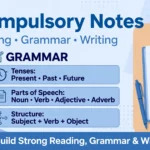
Q: When do we use the present perfect tense? A: For an action completed in the past with a result in the present, for example, she has finished her work. Q: What is the difference between past simple and past continuous? A: Past simple shows a completed action, while past continuous shows an action in progress at a past time.
Active and Passive Voice
Q: Change to passive: The teacher praised the student. A: The student was praised by the teacher. Q: When is passive voice useful? A: When the action matters more than who did it, or when the doer is unknown.
Direct and Indirect Speech
Q: Change to indirect speech: She said, I am busy today. A: She said that she was busy that day. Q: What usually changes in indirect speech? A: Tense, pronouns and time words, such as today becoming that day.
Vocabulary and Sentence Skills
- Learn new words in sentences, not in isolation.
- Check whether a word is a noun, verb or adjective before using it.
- Keep sentences short and clear in examination answers.
- Use one main idea per paragraph, with a clear opening sentence.
- Read your answer once for spelling, tense and punctuation.
Grammar MCQs
1. Which sentence is in the present perfect tense? (a) She goes to school. (b) She has gone to school. (c) She went to school. (d) She will go to school. — Answer: (b) She has gone to school. 2. The synonym of brave is: (a) timid (b) courageous (c) weak (d) slow. — Answer: (b) courageous. 3. Passive of They wrote a letter is: (a) A letter is written by them. (b) A letter was written by them. (c) A letter writes them. (d) They write a letter. — Answer: (b) A letter was written by them.
Revision Checklist
- Read the FBISE syllabus for English and tick off each of the 18 units.
- Write the theme of each unit in one sentence from memory.
- Answer two short questions from each unit without looking, then check them.
- Practise one long answer per week with a clear introduction, points and conclusion.
- Attempt all MCQs in this post again after one week and review only the missed ones.
- Revise tenses, active and passive voice, and direct and indirect speech each week.
- Write one paragraph daily on a unit theme, in your own words.
- Download the PDF above for offline revision and keep it with your class notes.
- Remember: these are original study and revision notes only. They are not official, not leaked, and not guaranteed.
For other subjects, return to https://www.zahidenotes.com/2026/10/1st-year-fbise-notes-all-subjects.html, and for the wider first-year hub, see https://www.zahidenotes.com/1st-year-11th-class-notes-guess-papers-pairing-schemes-and-past-papers. To revise offline, use the PDF download again: Download FBISE 1st Year English NBF Book Notes All 18 Units PDF.