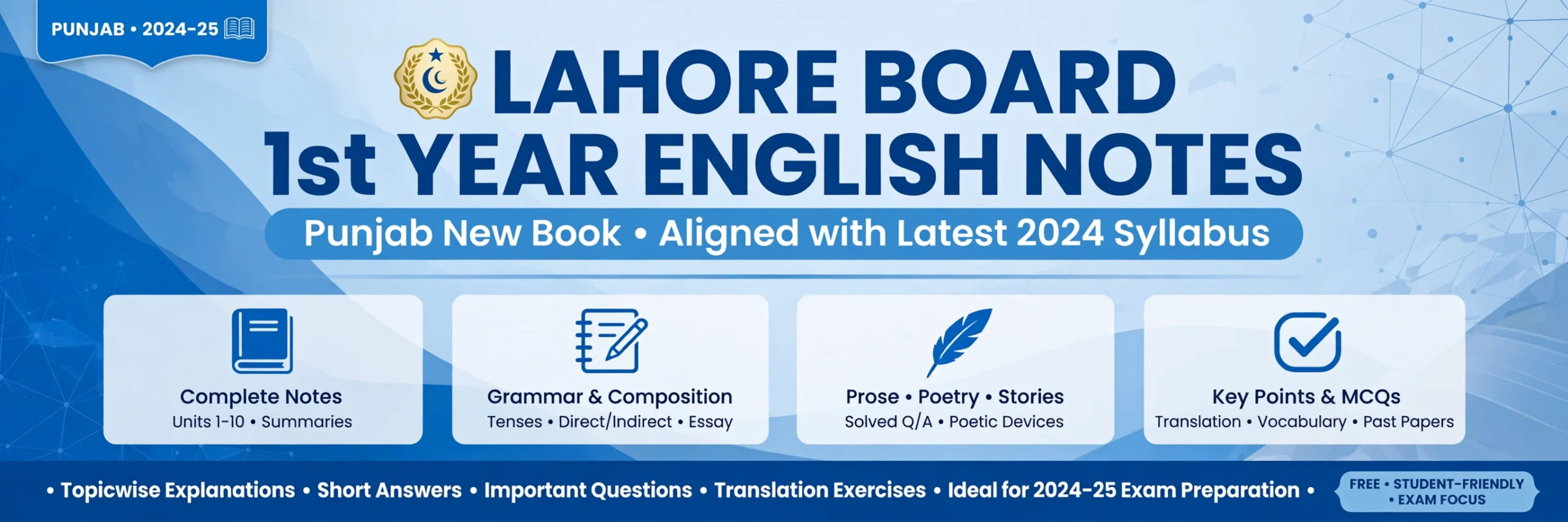
These lahore board 1st year english notes are original study and revision notes for students following the Punjab new book. They cover all 14 chapters in order, with a short summary in simple words, the theme, important points, short questions with answers, long questions with answers, and practice MCQs with an answer key for every chapter.
Please read this labelling carefully: these are original study and revision notes only. They are not official BISE Lahore notes, not the textbook, not leaked material, and nothing here is guaranteed for any exam. Always study from your prescribed textbook and follow your teacher’s guidance, and use these notes only for revision and practice.
Poems in this post are explained by summary and theme only. No long poem passages are quoted.
Download the PDF
Download the Lahore Board 1st Year English Notes PDF (Punjab New Book) — use the PDF for offline revision alongside the chapter notes below.
Related notes
For the wider 1st Year collection, see 1st Year notes, guess papers, pairing schemes and past papers. The Punjab book covered here differs from the FBISE book, so do not mix the two lists; the FBISE version is at FBISE 1st Year English Notes.
All 14 chapters in order
- Chapter 1: Khatam-un-Nabiyeen Hazrat Muhammad
- Chapter 2: Responsibility of the Youth in Nation-Building
- Chapter 3: A Bird Came Down the Walk (Poem)
- Chapter 4: Team Moon
- Chapter 5: Impact of Global Warming on Pakistan
- Chapter 6: The Echoing Green (Poem)
- Chapter 7: What You Do is What You are
- Chapter 8: Clean Water
- Chapter 9: Freedom (Poem)
- Chapter 10: The Punishment of Shahpesh, the Persian, on Khipil, the Builder
- Chapter 11: Those Winter Sundays (Poem)
- Chapter 12: The Impact of AI on Society, Human Relationships, and Ethics
- Chapter 13: Ruba’iyat (Poem)
- Chapter 14: The End of the Beginning
How to use these notes: read the summary first, learn the theme and important points, practise the short answers in your own words, then write the long answers with an introduction, clear points and a short conclusion. Attempt the MCQs without looking at the key, then check your answers.
Table of Contents
Chapter 1: Khatam-un-Nabiyeen Hazrat Muhammad
Summary: This chapter presents, in respectful general terms, the finality of prophethood and the character of Hazrat Muhammad as a model of honesty, kindness, patience and care for others. It stresses truthfulness in speech, fairness in dealing, mercy toward the weak, and steadiness in difficulty. Readers are invited to learn from these qualities in daily conduct, rather than only remembering facts.
Theme: Truth, mercy and good character as a guide for personal and public life.
Important points: Finality of prophethood is the central idea; honesty and trustworthiness shape reputation; patience helps a person respond calmly under pressure; kindness should extend to family, neighbours and strangers.
Short questions with answers:
- What is the central idea of this chapter? — The finality of prophethood and the example of a life guided by honesty, mercy and good character.
- Why is honesty emphasised? — Because honesty builds trust, and trust makes family, trade and community life work well.
- How should a student practise patience? — By thinking before replying, accepting correction calmly, and continuing steady work instead of reacting in anger.
- What does mercy mean in daily life? — It means speaking gently, helping those in need, and forgiving small faults where possible.
Long questions with answers:
1. Explain how good character affects a person’s life and community. Good character affects both private choices and public trust. An honest person is believed, a patient person avoids needless conflict, and a kind person strengthens relationships. In a community, these habits reduce quarrels, make cooperation easier, and give younger people a clear example to follow. The chapter therefore treats character not as a slogan, but as practical conduct: keeping promises, dealing fairly, and helping others without expecting praise.
2. What lessons can students take from this chapter for study and behaviour? Students can take three lessons. First, be truthful in work and avoid copying or pretending to know. Second, be regular and patient, because steady effort matters more than a single burst of work. Third, be respectful to teachers, classmates and family, and help others learn. These lessons link belief with behaviour, so study becomes part of a wider effort to become a responsible person.
MCQs with answer key:
- The central idea of the chapter is: (a) trade (b) finality of prophethood (c) travel (d) farming — Answer: (b)
- Honesty mainly builds: (a) fear (b) wealth (c) trust (d) noise — Answer: (c)
- Patience helps a person to: (a) react angrily (b) respond calmly (c) avoid work (d) blame others — Answer: (b)
- Mercy in daily life includes: (a) harsh speech (b) helping those in need (c) breaking promises (d) ignoring others — Answer: (b)
- The chapter links belief most closely with: (a) dress only (b) good conduct (c) speed (d) silence — Answer: (b)
Chapter 2: Responsibility of the Youth in Nation-Building
Summary: This chapter argues that young people are not only future citizens but present builders of a nation. It connects education, discipline, honesty and service: students who study sincerely, respect rules, protect public property and help their communities are already taking part in nation-building. It also warns against wasted time, careless habits and selfish behaviour.
Theme: Youth, responsibility and active citizenship.
Important points: Education is preparation for service, not only for a job; discipline turns talent into useful work; honesty in small matters prepares a person for larger trust; voluntary service teaches teamwork and empathy.
Short questions with answers:
- Why are young people called nation-builders? — Because their learning, habits and service today shape the society of tomorrow.
- How does discipline help a student? — It creates regular study, respect for time, and the ability to finish difficult tasks.
- What is one practical form of service? — Helping classmates, keeping the school clean, or taking part in a community activity.
- Why should youth protect public property? — Because public property belongs to everyone, and damaging it harms the whole community.
Long questions with answers:
1. How can students contribute to nation-building while still studying? Students can contribute by studying honestly, using time well, and behaving responsibly at home and school. They can respect teachers and classmates, avoid cheating, care for books and buildings, and help others who struggle. They can also take part in cleanliness, tree-planting or awareness activities. These small, regular actions build the habits a nation needs: skill, trust, cooperation and care for shared resources.
2. Discuss the link between education and responsibility. Education gives knowledge, but responsibility gives that knowledge a direction. A skilled person who is dishonest can harm others, while a responsible person uses skill to solve problems and serve others. The chapter therefore presents education as more than marks: it should produce citizens who think clearly, act fairly, respect law, and consider the effect of their choices on others.
MCQs with answer key:
- The chapter mainly addresses: (a) only elders (b) the youth (c) visitors (d) traders — Answer: (b)
- Discipline mainly produces: (a) confusion (b) regular work (c) laziness (d) fear — Answer: (b)
- Public property should be: (a) damaged (b) ignored (c) protected (d) sold privately — Answer: (c)
- Honest study prepares a student for: (a) larger trust (b) cheating (c) idleness (d) quarrels — Answer: (a)
- Service teaches mainly: (a) selfishness (b) teamwork (c) pride (d) waste — Answer: (b)
Chapter 3: A Bird Came Down the Walk (Poem)
Summary: In this poem, the speaker watches a bird in a garden walk. The bird eats, drinks, looks about cautiously, and then flies away. The poem follows a small, ordinary moment closely and shows how nature can appear both gentle and alert. The ending, with flight, leaves a sense of lightness and distance.
Theme: Close observation of nature, freedom, and the delicate balance between trust and caution.
Important points: The poem is built on a single observed scene; the bird is both graceful and watchful; movement from ground to air gives the poem its closing lift; imagery of eating, drinking and looking helps the reader picture the scene.
Short questions with answers:
- What scene does the poem describe? — A speaker watching a bird as it eats, drinks and moves along a garden walk.
- Why does the bird seem cautious? — Because it keeps looking around, as wild creatures stay alert to danger.
- What does the flight at the end suggest? — Freedom and a return to the bird’s own world, beyond human reach.
- Why is close observation important in the poem? — Because small details make an ordinary moment vivid and meaningful.
Long questions with answers:
1. How does the poem turn an ordinary moment into a memorable picture? The poem slows down a brief visit by a bird and records its actions in order: eating, drinking, glancing about, and flying. Each detail adds to the picture, so the reader sees the bird rather than only hearing about it. The contrast between the bird’s calm feeding and its alert glances creates interest, and the sudden flight gives the poem a light, open ending. The poem therefore shows that careful attention can make everyday nature feel fresh.
2. Discuss the theme of freedom in the poem. Freedom appears in the bird’s ability to arrive, feed and leave on its own terms. The speaker watches but does not control it, and the final flight underlines that wild life belongs to itself. At the same time, the bird’s caution shows that freedom is not carelessness: it is joined with awareness. The poem invites readers to enjoy nature with respect, rather than trying to possess it.
MCQs with answer key:
- The poem mainly describes: (a) a storm (b) a bird in a garden (c) a train (d) a market — Answer: (b)
- The bird is shown as: (a) careless only (b) graceful and alert (c) angry (d) asleep — Answer: (b)
- The poem ends with: (a) rain (b) flight (c) night (d) a song contest — Answer: (b)
- Close observation in the poem makes the scene: (a) dull (b) vivid (c) confusing (d) silent — Answer: (b)
- The theme includes: (a) freedom (b) war (c) trade (d) cooking — Answer: (a)
Chapter 4: Team Moon
Summary: This chapter looks at the teamwork behind a Moon mission. It shows that a famous landing depends not only on astronauts, but on engineers, planners, communicators and many others working together. Careful planning, clear roles, calm problem-solving and trust in each member’s work are presented as the real strength of the team.
Theme: Teamwork, planning and shared responsibility.
Important points: No large mission succeeds through one person alone; clear communication prevents small errors becoming large problems; practice and checking reduce risk; credit should be shared fairly.
Short questions with answers:
- Why is the chapter called Team Moon? — Because it stresses the whole team behind the Moon mission, not only the astronauts.
- What role does planning play? — Planning sets clear steps, checks risks, and helps the team respond to problems in an orderly way.
- How does communication help a team? — It keeps everyone informed, avoids misunderstandings, and allows quick, correct decisions.
- Why should credit be shared? — Because success depends on many jobs, and fair credit keeps morale and cooperation strong.
Long questions with answers:
1. Why is teamwork more important than individual talent in a large mission? Individual talent is useful, but a large mission joins many different skills: design, navigation, medicine, communication and safety. If one part fails, the whole mission can fail. Teamwork links these parts through shared goals, clear roles and mutual trust. Members check each other’s work, solve problems together, and keep going when one part becomes difficult. The chapter therefore presents success as a collective result, not a single performance.
2. What lessons can students learn from Team Moon for group work? Students can learn to divide work fairly, set deadlines, and communicate problems early instead of hiding them. They should listen to others, respect different skills, and check work before submitting it. They should also accept shared credit and shared responsibility. These habits make school projects stronger and prepare students for workplaces where cooperation matters as much as knowledge.
MCQs with answer key:
- Team Moon stresses mainly: (a) one hero (b) teamwork (c) luck (d) speed alone — Answer: (b)
- Clear communication mainly prevents: (a) success (b) small errors growing (c) learning (d) travel — Answer: (b)
- Checking and practice mainly reduce: (a) risk (b) fun (c) cost of books (d) time for study — Answer: (a)
- A large mission needs: (a) one skill only (b) many skills together (c) no planning (d) no trust — Answer: (b)
- Fair credit helps to keep: (a) quarrels (b) morale and cooperation (c) secrecy (d) delay — Answer: (b)
Chapter 5: Impact of Global Warming on Pakistan
Summary: This chapter explains, in general terms, how rising global temperatures affect Pakistan through hotter weather, changing rainfall, melting glaciers, floods and pressure on farming and water. It links everyday choices, such as energy use and tree loss, with wider climate patterns, and argues for careful water use, planting, and public awareness.
Theme: Climate change, responsibility and protection of the environment.
Important points: Warmer weather can increase heat stress and water demand; changing rain can bring both drought and floods; glaciers and rivers affect farming and drinking water; local action and planning both matter.
Short questions with answers:
- What is global warming in simple terms? — A long-term rise in average temperatures linked to heat-trapping gases and human activity.
- How can it affect farming in Pakistan? — Through heat, uncertain rain, floods and water shortage, which can damage crops.
- Why are glaciers important? — Because their meltwater feeds rivers that support farming, drinking water and power in many areas.
- What can students do locally? — Save water and electricity, plant trees, reduce waste, and spread simple climate awareness.
Long questions with answers:
1. Explain the main impacts of global warming on Pakistan. The main impacts include hotter summers, which increase health risks and water use; less predictable rainfall, which makes farming harder; and a higher risk of floods in some areas and drought in others. Melting glaciers change river flows over time, while rising demand for water puts pressure on households and farms. Cities also face heat, poor air and strain on services. The chapter presents these effects as connected, so one problem, such as water shortage, can worsen others, such as food prices and health.
2. What practical steps can reduce harm from climate change? Practical steps include using water carefully, saving electricity, planting and protecting trees, reducing plastic waste, and preparing for floods and heatwaves. Schools and families can teach simple habits, such as turning off unused lights, carrying reusable bottles, and keeping drains clear. Governments and communities also need better planning for water, farming and housing. The chapter stresses that small daily habits and larger planning work together.
MCQs with answer key:
- Global warming means mainly: (a) colder winters only (b) long-term warming (c) more snowfall everywhere (d) no change — Answer: (b)
- Uncertain rainfall mainly harms: (a) farming (b) reading (c) singing (d) painting — Answer: (a)
- Glacier meltwater feeds mainly: (a) deserts only (b) rivers (c) oceans only (d) clouds only — Answer: (b)
- Planting trees helps by: (a) increasing waste (b) absorbing carbon and cooling surroundings (c) drying rivers (d) blocking rain — Answer: (b)
- A useful student habit is: (a) wasting water (b) saving water and electricity (c) burning waste (d) cutting trees — Answer: (b)
Chapter 6: The Echoing Green (Poem)
Summary: This poem describes a village green in spring, where children play, older people watch, and birds sing. The scene moves from morning joy to evening quiet, when play ends and the green becomes still. The poem uses this day to suggest the passing of time and the cycle of youth and age.
Theme: Joy, the cycle of life, and the passing of time.
Important points: The green is a shared, happy place; children and elders are contrasted gently; sound and silence mark the change from day to evening; spring suggests new life, while evening suggests rest and age.
Short questions with answers:
- What place does the poem describe? — A village green in spring, where children play and elders watch.
- How does the mood change? — From bright, noisy joy in the day to quiet stillness in the evening.
- What do the elders suggest? — Memory, experience, and the later stage of life.
- Why is spring important in the poem? — Because it suggests youth, growth and fresh energy.
Long questions with answers:
1. How does the poem use the day to show the cycle of life? The poem follows one day on the green: morning brings play and song, while evening brings tiredness and quiet. Children stand for youth and energy, and older watchers stand for age and memory. As the day closes, the green empties, just as life moves from activity to rest. This gentle pattern helps readers see time not as sudden loss, but as a natural cycle in which each stage has its own mood.
2. Discuss the contrast between joy and quiet in the poem. Joy is shown through play, laughter and birdsong, which fill the green with sound. Quiet arrives when games end and people go home, leaving the green empty. The contrast does not make the poem sad in a harsh way; instead, it gives the joy more value, because it is brief. Readers are left with both warmth for the happy scene and a quiet awareness that moments pass.
MCQs with answer key:
- The poem is set on: (a) a village green (b) a ship (c) a mountain (d) a factory — Answer: (a)
- Spring in the poem suggests: (a) old age (b) youth and growth (c) war (d) winter — Answer: (b)
- Evening brings mainly: (a) more games (b) quiet and rest (c) a storm (d) a fair — Answer: (b)
- The elders mainly suggest: (a) anger (b) memory and age (c) wealth (d) travel — Answer: (b)
- The main theme is: (a) trade (b) the cycle of life (c) science (d) law — Answer: (b)
Chapter 7: What You Do is What You are
Summary: This chapter argues that character is shown by actions, not by claims. A person who speaks kindly but acts selfishly is judged by the selfish act, while quiet, helpful actions build a strong reputation over time. It encourages readers to match words with deeds in study, family life and friendship.
Theme: Character, action and consistency.
Important points: Words alone do not prove character; repeated actions form habits; small daily choices matter more than occasional grand gestures; self-respect grows when actions match values.
Short questions with answers:
- What is the main message? — That a person is known by what they do, not only by what they say.
- Why do small actions matter? — Because repeated small actions form habits and a lasting reputation.
- How can a student match words with deeds? — By studying as promised, helping as offered, and keeping small commitments.
- What happens when words and actions differ? — Trust falls, because others learn to judge the actions, not the promises.
Long questions with answers:
1. Explain why actions are a better test of character than words. Words are easy to produce and can be used to impress others, while actions cost time, effort and sometimes comfort. A person who promises help but never arrives shows the real priority, while a person who quietly helps shows care without seeking praise. Over time, patterns of action reveal values more honestly than single statements. The chapter therefore advises readers to watch their own daily conduct and to judge others fairly, but mainly by consistent behaviour.
2. How can students apply this idea in school life? Students can apply it by doing homework honestly, preparing on time, and treating classmates fairly even when no teacher is watching. They can keep promises to group members, admit mistakes, and help others without expecting a reward. When their actions match their words, teachers and friends trust them more, and they also feel more confident, because their self-image is based on real effort rather than empty claims.
MCQs with answer key:
- The chapter says character is shown by: (a) clothes (b) actions (c) wealth (d) age — Answer: (b)
- Repeated small actions form: (a) habits (b) noise (c) fear (d) luck — Answer: (a)
- When words and actions differ, trust: (a) rises (b) falls (c) stays same (d) disappears instantly for all — Answer: (b)
- A quiet helpful act mainly shows: (a) pride (b) care (c) weakness (d) anger — Answer: (b)
- Self-respect grows when actions match: (a) fashion (b) values (c) gossip (d) speed — Answer: (b)
Chapter 8: Clean Water
Summary: This chapter explains why clean water matters for health, farming and daily life, and why polluted water causes disease and hardship. It describes common sources of pollution, such as waste, chemicals and careless disposal, and argues for protecting rivers, wells and taps, using water wisely, and keeping surroundings clean.
Theme: Health, hygiene and care for water resources.
Important points: Clean water prevents many water-borne diseases; pollution can come from homes, farms and factories; boiling or safe storage helps in some cases, but source protection is best; saving water protects supply for everyone.
Short questions with answers:
- Why is clean water important? — Because it protects health, supports farming, and is needed for cooking, washing and drinking.
- What are common causes of water pollution? — Waste, sewage, chemicals, and careless disposal near rivers and wells.
- How does polluted water harm people? — It can spread disease, especially among children, and increase medical costs and lost school days.
- What is one way to save water at home? — Turn off taps while brushing, fix leaks promptly, and use only the water needed.
Long questions with answers:
1. Discuss the effects of water pollution on health and community life. Polluted water can carry germs and chemicals that cause stomach illness, skin problems and other diseases. Children and older people are often most at risk. When many people fall ill, families face medical costs and children miss school, while workers lose income. Polluted rivers and wells also harm crops, animals and fishing, so the whole community suffers. Clean water, by contrast, supports health, learning and work, which is why protecting it is a shared responsibility.
2. What steps can families and communities take to keep water clean? Families can keep waste away from water sources, store drinking water in clean covered containers, and repair leaking taps. Communities can keep drains and streets clean, dispose of waste properly, and protect wells and rivers from dumping. Schools can teach handwashing and safe storage. These steps are simple, but when many people follow them, they reduce disease and protect supply for future use.
MCQs with answer key:
- Clean water mainly protects: (a) health (b) noise (c) speed (d) fashion — Answer: (a)
- A common source of pollution is: (a) clean rain (b) waste near rivers (c) fresh air (d) sunlight — Answer: (b)
- Polluted water can spread mainly: (a) disease (b) wealth (c) books (d) music — Answer: (a)
- Safe storage means water kept in: (a) open dirty pots (b) clean covered containers (c) drains (d) streets — Answer: (b)
- Saving water helps: (a) only one house (b) the whole supply (c) nobody (d) factories only — Answer: (b)
Chapter 9: Freedom (Poem)
Summary: This poem reflects on freedom as more than the absence of chains. It presents freedom as the ability to think, speak, choose and live with dignity, while also respecting the freedom of others. The poem’s tone is hopeful but serious: freedom must be valued, protected and used wisely.
Theme: Freedom, dignity and responsibility.
Important points: Freedom includes thought and expression, not only movement; dignity is central to the poem; freedom without responsibility can harm others; gratitude and care are needed to keep freedom meaningful.
Short questions with answers:
- What does freedom mean in this poem? — The ability to think, speak, choose and live with dignity.
- Why is responsibility linked to freedom? — Because one person’s freedom should not remove another person’s freedom or safety.
- How should freedom be protected? — By valuing it, using it wisely, and respecting law and the rights of others.
- Why is the poem’s tone both hopeful and serious? — Because freedom brings joy, but losing or misusing it has real costs.
Long questions with answers:
1. Explain the poem’s idea of freedom. The poem treats freedom as a broad human need, not a single privilege. It includes freedom of thought, so a person can form honest opinions; freedom of expression, so ideas can be shared; and freedom to live without fear or humiliation. Dignity runs through all of these: a free person is treated as a person, not as a tool. The poem therefore presents freedom as valuable in itself, and as a condition for learning, creativity and a fair society.
2. Discuss why freedom needs responsibility. Freedom without responsibility can turn into selfishness, where strong voices silence weaker ones or careless actions harm others. Responsibility means using freedom with respect for truth, law and other people’s rights. It also means protecting freedom for others, not only enjoying it oneself. In this way, the poem links personal liberty with public duty: a society stays free when its members defend both their own dignity and the dignity of others.
MCQs with answer key:
- Freedom in the poem includes: (a) thought and expression (b) wealth only (c) travel only (d) silence only — Answer: (a)
- Dignity in the poem is: (a) unimportant (b) central (c) harmful (d) rare — Answer: (b)
- Freedom without responsibility can: (a) help everyone (b) harm others (c) end learning (d) create peace always — Answer: (b)
- Protecting freedom requires: (a) ignoring rights (b) respecting others’ rights (c) fear (d) secrecy — Answer: (b)
- The poem’s tone is: (a) hopeful and serious (b) angry only (c) comic (d) indifferent — Answer: (a)
Chapter 10: The Punishment of Shahpesh, the Persian, on Khipil, the Builder
Summary: This story describes a builder, Khipil, who is punished by a ruler, Shahpesh, in a cruel and unjust way. The account is used to show how unchecked power can turn a small fault or a ruler’s anger into severe suffering. It invites readers to think about justice, mercy and the duty of those in power to act fairly.
Theme: Justice, mercy and the abuse of power.
Important points: Power without restraint can harm innocent people; punishment should fit the fault; mercy and fairness protect both rulers and subjects; a story of cruelty can teach the value of just rule.
Short questions with answers:
- Who are the two main figures? — Shahpesh, the ruler, and Khipil, the builder.
- What is the story mainly about? — An unjust, cruel punishment imposed by a powerful ruler on a builder.
- Why is the punishment called unjust? — Because it is severe, lacks fair proportion, and shows anger rather than careful judgement.
- What lesson does the story teach rulers? — That power must be used with justice and mercy, not with cruelty.
Long questions with answers:
1. What does the story say about justice and power? The story shows that power alone does not make a decision just. When a ruler punishes without fair hearing, proportion or mercy, the result is fear rather than respect. Justice requires checking facts, considering the fault, and choosing a penalty that fits it. The story therefore warns that unchecked power damages the ruler’s own standing as well as the victim, because people lose trust in rule that is based on anger.
2. Why is mercy important alongside justice? Mercy does not mean ignoring wrongdoing; it means avoiding needless cruelty and allowing room for correction. A just ruler can punish a fault while still treating the person as human. Mercy also prevents a cycle of resentment and fear. In the story, its absence makes the punishment memorable for the wrong reason: readers remember cruelty, not wisdom. The lesson is that strength is shown by restraint as much as by authority.
MCQs with answer key:
- Khipil is a: (a) ruler (b) builder (c) trader (d) soldier — Answer: (b)
- Shahpesh is presented as: (a) a builder (b) a ruler (c) a farmer (d) a student — Answer: (b)
- The punishment is mainly described as: (a) just and mild (b) cruel and unjust (c) praised (d) unnoticed — Answer: (b)
- Just punishment should: (a) fit the fault (b) follow anger (c) ignore facts (d) cause fear only — Answer: (a)
- The main theme is: (a) justice and mercy (b) farming (c) travel (d) trade — Answer: (a)
Chapter 11: Those Winter Sundays (Poem)
Summary: This poem recalls a father who, on cold winter Sundays, rises early, warms the house, and prepares for the day, while the child, now grown, looks back with regret at not noticing this quiet care. The poem’s power lies in its simple domestic scene and its late understanding: love is often shown in unspoken work, not in grand words.
Theme: Parental love, sacrifice and late gratitude.
Important points: The father’s early rising and work show care; the child’s indifference shows how love can be missed; the adult speaker’s regret gives the poem its emotional weight; cold and warmth contrast outer weather with inner feeling.
Short questions with answers:
- What does the father do on winter Sundays? — He rises early, warms the house, and quietly prepares for the family’s day.
- Why does the speaker feel regret? — Because, as a child, he did not notice or thank his father for this care.
- What kind of love does the poem show? — Quiet, practical love expressed through daily work rather than words.
- Why is the cold important? — It stresses the father’s effort: he works in discomfort so others can be warm.
Long questions with answers:
1. How does the poem show love through ordinary work? The poem avoids grand declarations and instead records small, repeated actions: rising in cold, making the house warm, and carrying on without complaint. These actions are easy to overlook, which is the poem’s point. By looking back, the adult speaker understands that care was present all along, in labour rather than praise. The poem therefore teaches readers to notice quiet sacrifice in their own homes before it is too late to thank the person.
2. Discuss the speaker’s change from childhood indifference to adult understanding. As a child, the speaker takes warmth and care for granted and may even resent authority or distance. As an adult, memory reframes those same actions: the early rising becomes devotion, and the silence becomes endurance. This change is not presented as blame alone, but as growth. The speaker learns that gratitude requires attention, and that love is often recognised only when we learn to look past our own comfort.
MCQs with answer key:
- The father rises early on: (a) summer nights (b) winter Sundays (c) holidays only (d) school days only — Answer: (b)
- His work mainly shows: (a) anger (b) quiet care (c) pride (d) fear — Answer: (b)
- The speaker as an adult feels: (a) regret (b) indifference (c) amusement (d) anger — Answer: (a)
- Cold in the poem stresses: (a) comfort (b) the father’s effort (c) travel (d) wealth — Answer: (b)
- The main theme is: (a) war (b) parental love and gratitude (c) trade (d) sport — Answer: (b)
Chapter 12: The Impact of AI on Society, Human Relationships, and Ethics
Summary: This chapter discusses how artificial intelligence affects work, learning, communication and daily decisions. It notes benefits, such as faster information, medical and educational tools, and easier communication, alongside risks, such as job change, privacy loss, false information, and reduced face-to-face contact. It argues for wise, ethical use.
Theme: Technology, human relationships and ethical responsibility.
Important points: AI can help learning and services, but it also changes jobs; online contact is not a full replacement for personal relationships; privacy and truth need protection; users should check AI output instead of accepting it blindly.
Short questions with answers:
- What is one benefit of AI? — Faster access to information and useful tools for learning, health and work.
- What is one risk for relationships? — Too much screen contact can reduce real conversation and personal attention.
- Why is privacy a concern? — Because AI systems often use personal data, which can be misused if not protected.
- Why should AI answers be checked? — Because AI can be wrong, biased or out of date, so users must verify important facts.
Long questions with answers:
1. Discuss both the benefits and risks of AI for society. AI benefits society by handling large amounts of information quickly, helping doctors, teachers and workers, and making services more available. It can translate, summarise and support people with disabilities. The risks include job disruption, as some routine work changes; privacy problems, as data is collected and shared; and the spread of false or biased content. The chapter’s balanced view is that AI is a tool: its effect depends on how people design, regulate and use it.
2. How can students use AI ethically? Students can use AI as a study helper, not as a replacement for thinking. They should use it to explain ideas, practise questions and organise notes, while doing their own writing and checking facts from textbooks and teachers. They should not submit AI work as their own, share private data carelessly, or spread unchecked information. They should also protect real relationships by spending time in conversation and group work, rather than only online.
MCQs with answer key:
- A benefit of AI is: (a) slower information (b) faster information tools (c) less learning (d) no communication — Answer: (b)
- A relationship risk is: (a) more conversation always (b) less face-to-face contact (c) better listening always (d) no screens — Answer: (b)
- Privacy matters because AI uses: (a) personal data (b) only paper (c) no data (d) only voices — Answer: (a)
- AI output should be: (a) accepted blindly (b) checked (c) hidden (d) copied always — Answer: (b)
- Ethical student use means AI as: (a) a replacement for thinking (b) a study helper (c) a source of copied work (d) a private diary — Answer: (b)
Chapter 13: Ruba’iyat (Poem)
Summary: The Ruba’iyat are short four-line poems that offer brief reflections on life, time, choice and human nature. Each quatrain stands on its own, yet together they suggest a calm, thoughtful view: life is short, actions matter, and wisdom often comes in small, clear observations rather than long speeches.
Theme: Reflection on life, time and wise living.
Important points: Each poem is short and complete; imagery is simple and direct; the poems invite readers to pause and think; themes repeat with different examples, so comparison helps understanding.
Short questions with answers:
- What is a Ruba’i? — A short poem of four lines that gives one complete thought or reflection.
- What do the poems mainly reflect on? — Life, time, choice, and how people should live wisely.
- Why are short poems effective here? — Because a brief, clear image can stay in memory and invite thought.
- How should a reader approach them? — Read slowly, note the main idea of each quatrain, and compare similar themes.
Long questions with answers:
1. How do short quatrains convey deep ideas? A quatrain must choose every word carefully, so it often uses one strong image or contrast to carry its meaning. For example, a reference to passing time can suggest both urgency and calm acceptance, without long explanation. Because each poem is complete, readers can return to it, think about it, and apply it to their own lives. The depth comes not from length, but from focus: one idea, clearly seen, is easier to remember than many ideas loosely joined.
2. Discuss the view of life presented in the Ruba’iyat. The view is reflective rather than hurried. Life is shown as brief, so time should not be wasted on empty pride or careless choices. At the same time, the poems do not urge despair; they encourage awareness, honesty and simple wisdom. Readers are invited to value the present, learn from experience, and act with thought. This balance between accepting life’s limits and using time well is the poems’ central lesson.
MCQs with answer key:
- A Ruba’i has: (a) two lines (b) four lines (c) ten lines (d) one word — Answer: (b)
- The poems mainly reflect on: (a) trade routes (b) life and time (c) cooking (d) war plans — Answer: (b)
- Short poems work mainly through: (a) length (b) focused imagery (c) noise (d) repetition only — Answer: (b)
- The view of life is mainly: (a) careless (b) reflective and wise (c) angry (d) fearful only — Answer: (b)
- Readers should approach quatrains: (a) quickly and carelessly (b) slowly, noting each main idea (c) by skipping (d) by memorising titles only — Answer: (b)
Chapter 14: The End of the Beginning
Summary: This final chapter reflects on endings that are also beginnings. It suggests that finishing a stage, such as a school year or a first book, does not close learning; it prepares the reader for the next stage. The chapter encourages review, gratitude for progress, and a confident, honest start to what comes next.
Theme: Growth, reflection and new beginnings.
Important points: Endings can be useful pauses for review; progress should be recognised, not only faults; new stages need the same habits of honesty, patience and steady work; learning is continuous.
Short questions with answers:
- What does the title mean? — That an ending can also be the start of a new stage of learning.
- Why is review useful at the end? — Because it shows what has been learned and what still needs practice.
- How should a student start a new stage? — With the same steady habits: regular study, honesty and patience.
- Why recognise progress? — Because noticing progress builds confidence and motivation for harder work.
Long questions with answers:
1. Explain why the end of a first stage can be called a beginning. A first stage gives basic knowledge, habits and confidence. When it ends, the learner is not finished, but ready for more difficult work. The end is therefore a doorway: earlier lessons become tools for new subjects, questions and responsibilities. Calling it a beginning avoids two mistakes: thinking that learning is over, and thinking that earlier work was wasted. Instead, the chapter presents growth as a chain, where each stage prepares the next.
2. What should students carry forward from 1st Year English? Students should carry forward clear reading, careful writing, and the habit of explaining ideas in their own words. They should also carry the themes of the book: honesty, responsibility, care for nature, respect for others, and thoughtful use of technology. These are not only exam topics; they are habits for study and life. If students keep practising them, the end of this book becomes a strong beginning for the next class.
MCQs with answer key:
- The title suggests an ending is also a: (a) failure (b) beginning (c) holiday (d) punishment — Answer: (b)
- Review at the end mainly shows: (a) only faults (b) learning and gaps (c) other students (d) prices — Answer: (b)
- A new stage needs: (a) steady habits (b) copying (c) haste (d) silence — Answer: (a)
- Recognising progress builds: (a) pride only (b) confidence (c) fear (d) laziness — Answer: (b)
- Learning in the chapter is presented as: (a) finished (b) continuous (c) useless (d) only for exams — Answer: (b)
Grammar and Writing
Use this section for quick revision. Tenses: match the verb time with the sentence time, and check singular and plural subjects. Active and passive voice: in passive sentences, the object of the active sentence becomes the subject, and the verb uses a form of “be” plus the past participle. Direct and indirect speech: change pronouns and verb time when reporting speech, and remove quotation marks in indirect speech. Prepositions: learn common pairs by use, not by guessing, and read the full sentence before choosing. Letter and application: begin with the address and date, state the purpose in the first paragraph, give necessary details in the middle, and end politely with a clear request. Essay: plan an introduction, three or four connected points, and a short conclusion that answers the title. Paragraph: keep one main idea, support it with two or three clear sentences, and end with a linking or closing sentence.
Revision Checklist
- Can I summarise each of the 14 chapters in my own words?
- Can I state each chapter’s theme in one sentence?
- Have I practised all short questions without looking at the answers first?
- Have I written at least one long answer per chapter with an introduction, points and conclusion?
- Have I attempted the MCQs, checked the key, and relearned the ones I missed?
- Have I revised tenses, voice, narration, prepositions, letter, essay and paragraph writing?
- Have I used the PDF for offline revision and checked my answers against my textbook and teacher’s guidance?
- Have I avoided copying, and can I explain each answer in my own words?
These notes are original study and revision notes only, not official BISE Lahore notes, not the textbook, not leaked material, and not a guarantee for any exam. Use them with your prescribed textbook and your teacher’s guidance.