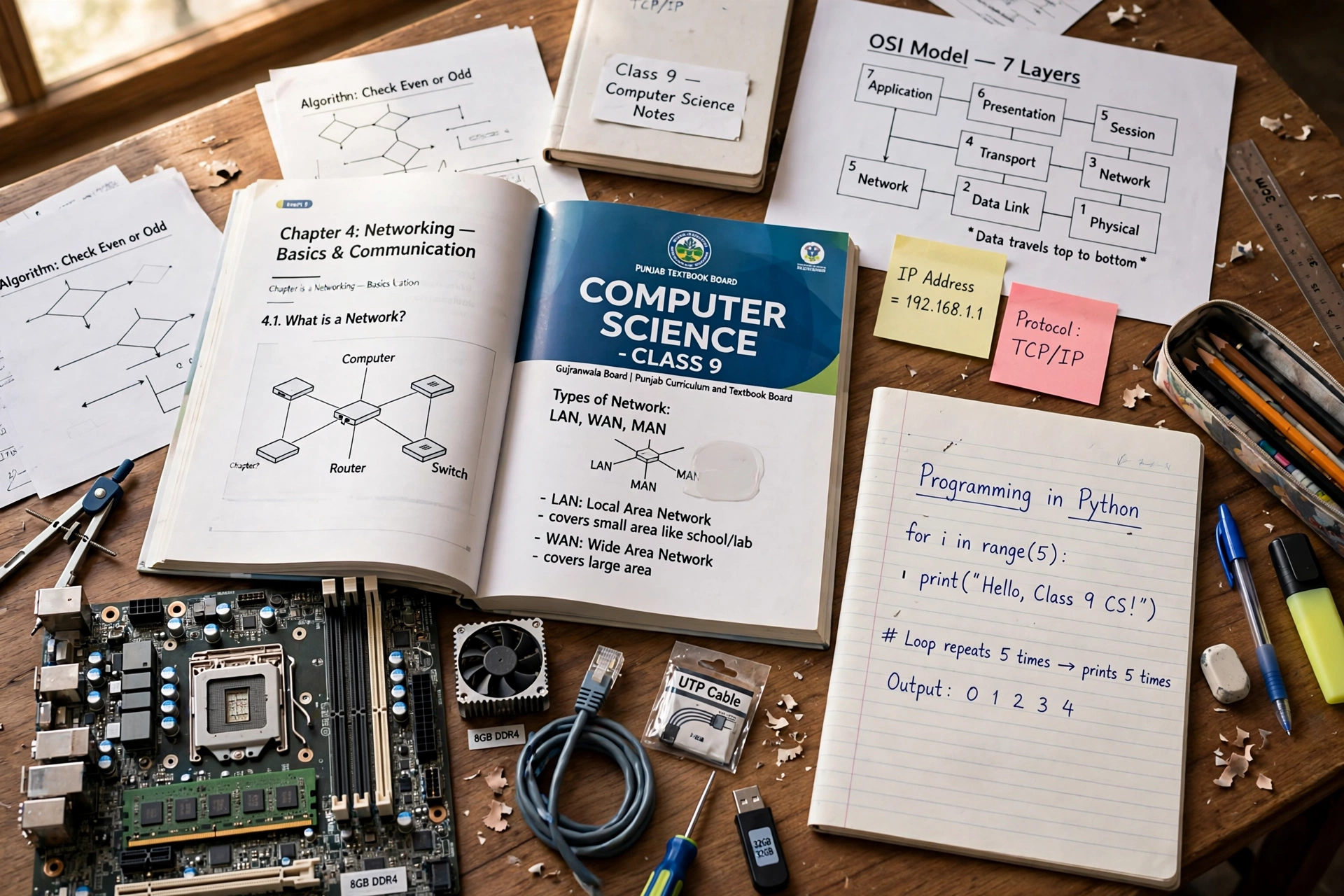
This gujranwala board 9th class computer science guess paper 2027 guide is written for BISE Gujranwala Class 9 students who want a clear, chapter-wise revision plan. It groups the most useful topics from computer systems, hardware, software, programming basics and networks, so revision stays focused instead of turning into random reading. Work through one chapter at a time, practise the short questions in your own words, and then test yourself on the long questions and MCQs.
Honest note: This is an original practice prediction based on general past-paper trends. It is not an official board paper, it is not leaked, and it is not guaranteed. The official 2027 pairing scheme is not presented here as verified.
Table of Contents
Paper Pattern Overview
Use the generally reported totals below only as a planning guide, not as an official Gujranwala notification. Always check the paper you receive on the day for its actual instructions.
| Part | Generally reported total |
|---|---|
| Total marks | 50 marks |
| Multiple-choice questions | 10 MCQs |
| Short questions | Short-answer section |
| Long questions | Long-answer section |
That structure is why short, precise answers matter so much. A student who can define a term in two clear lines, give one correct example, and explain one difference will usually score better than a student who writes a long, unfocused paragraph.
Chapter-wise Important Topics
The sections below cover every chapter theme in the current Punjab textbook. Revise the definitions first, then the working of each idea, and finally the differences and examples that examiners often ask about.
Chapter 1: Introduction to Computers and Computer Systems
Short-question topics: meaning of a computer, characteristics of a computer, computer system and its parts, data and information, and uses of computers in education, health and business. Long-question topics: explain a computer system with its input, processing, storage and output stages, and describe how computers help in daily life. MCQ practice topics: data versus information, types of computers, and basic computer characteristics.
Chapter 2: Computer Hardware and the Central Processing Unit
Short-question topics: hardware, CPU, control unit, arithmetic and logic unit, registers, memory, and the difference between primary and secondary memory. Long-question topics: explain the working of the CPU and the role of memory in processing. MCQ practice topics: parts of the CPU, RAM versus ROM, and units of memory.
Chapter 3: Input, Output and Storage Devices
Short-question topics: keyboard, mouse, scanner, monitor, printer, speaker, hard disk, USB drive, and optical storage. Long-question topics: compare input and output devices, and explain storage devices with examples. MCQ practice topics: identifying input and output devices, printer types, and storage capacity terms.
Chapter 4: System Software and Operating Systems
Short-question topics: software, system software, operating system, functions of an operating system, and file management. Long-question topics: explain the functions of an operating system and the difference between system software and application software. MCQ practice topics: examples of operating systems, system software, and utility programs.
Chapter 5: Application Software and Productivity Tools
Short-question topics: application software, word processor, spreadsheet, presentation software, and database basics. Long-question topics: explain how word processing, spreadsheets and presentations are used for school and office work, with suitable examples. MCQ practice topics: examples of application software, spreadsheet terms such as cell and worksheet, and presentation terms.
Chapter 6: Number Systems and Data Representation
Short-question topics: binary, decimal and hexadecimal numbers, bit and byte, and simple conversions. Long-question topics: convert numbers between binary and decimal systems step by step, and explain how computers store data. MCQ practice topics: binary values, place values, bits and bytes, and common number-system conversions.
Chapter 7: Boolean Logic, Logic Gates and Circuits
Short-question topics: Boolean values, AND, OR and NOT gates, truth tables, and simple logic expressions. Long-question topics: draw and explain basic logic gates with truth tables, and show how a simple combination of gates works. MCQ practice topics: gate symbols, truth-table outputs, and Boolean terms.
Chapter 8: Problem Solving, Algorithms and Flowcharts
Short-question topics: problem solving steps, algorithm, flowchart, flowchart symbols, and pseudocode. Long-question topics: write an algorithm and draw a flowchart for a simple everyday task, such as finding the larger of two numbers. MCQ practice topics: flowchart symbols, algorithm steps, and the order of problem-solving stages.
Chapter 9: Programming Basics and Language Concepts
Short-question topics: program, programming language, low-level and high-level languages, compiler, interpreter, and syntax. Long-question topics: explain the difference between low-level and high-level languages, and describe the roles of a compiler and an interpreter. MCQ practice topics: language types, translator programs, and basic programming terms.
Chapter 10: Computer Networks and the Internet
Short-question topics: network, LAN, WAN, internet, intranet, modem, router, and web browser. Long-question topics: explain types of computer networks and the main uses and risks of the internet for students. MCQ practice topics: LAN versus WAN, network devices, internet services, and browser terms.
Chapter 11: Computer Security, Ethics and Responsible Use
Short-question topics: computer virus, antivirus, password safety, hacking, piracy, and digital ethics. Long-question topics: explain how students can protect data and use computers responsibly, including strong passwords and safe downloading. MCQ practice topics: virus types, security tools, copyright, and safe online behaviour.
Chapter 12: Entrepreneurship, Digital Skills and ICT in Work
Short-question topics: entrepreneur, entrepreneurship, business idea, customer, basic business plan, and digital tools for small work. Long-question topics: explain how a student can turn a simple skill into a small, honest business idea, and describe the main parts of a basic business plan. MCQ practice topics: entrepreneur terms, business-plan parts, and ICT uses in work and trade.
How to Use This Gujranwala Board 9th Class Computer Science Guess Paper 2027 Guide
- Start with the chapter you find hardest, not the chapter you already know well.
- Read the textbook section first, then close the book and write the short answers from memory.
- For long questions, plan three or four points before writing, and add one clear example.
- For MCQs, practise by covering the options, recalling the answer, and only then checking it.
- Finish each chapter with a five-minute oral revision: define, explain, compare, and give an example.
Textbook Revision Checklist
- Can you define every key term in Chapters 1 to 4 without looking?
- Can you name input, output and storage devices and explain one use for each?
- Can you convert a small binary number to decimal, and explain a truth table?
- Can you write an algorithm and a flowchart for a simple task?
- Can you explain LAN and WAN, and list safe internet habits?
- Have you revised at least one long-question plan from each chapter group?
Related 9th Class Resources
- 9th Class Notes, Guess Papers, Pairing Schemes and Past Papers
- Gujranwala Board 9th Class General Science Guess Paper 2027
- 9th Class Pairing Scheme 2027
Frequently Asked Questions
Is this the official Gujranwala Board 9th class computer science paper for 2027?
No. This is an original revision guide and practice prediction. It is not an official board paper, it is not leaked, and it does not guarantee any question.
Should I study only this guess paper?
No. Use it after reading the textbook and your class notes. The guess paper helps you choose what to revise first, but it cannot replace the full syllabus.
Which chapters should I revise first?
Start with computer systems, hardware, software, number systems, programming basics and networks, because those ideas appear in short questions, long questions and MCQs in different forms.
How can I improve my MCQ score in computer science?
Learn definitions exactly, practise identifying devices and terms, and revise conversions, gates and network terms little and often instead of only on the last day.
Revise steadily, practise writing answers under time, and keep your textbook open beside this guide until the main ideas feel familiar. That habit, more than any single list, is what turns a guess paper into real preparation.




1 thought on “Gujranwala Board 9th Class Computer Science Guess Paper 2027 — Important Questions All Chapters”