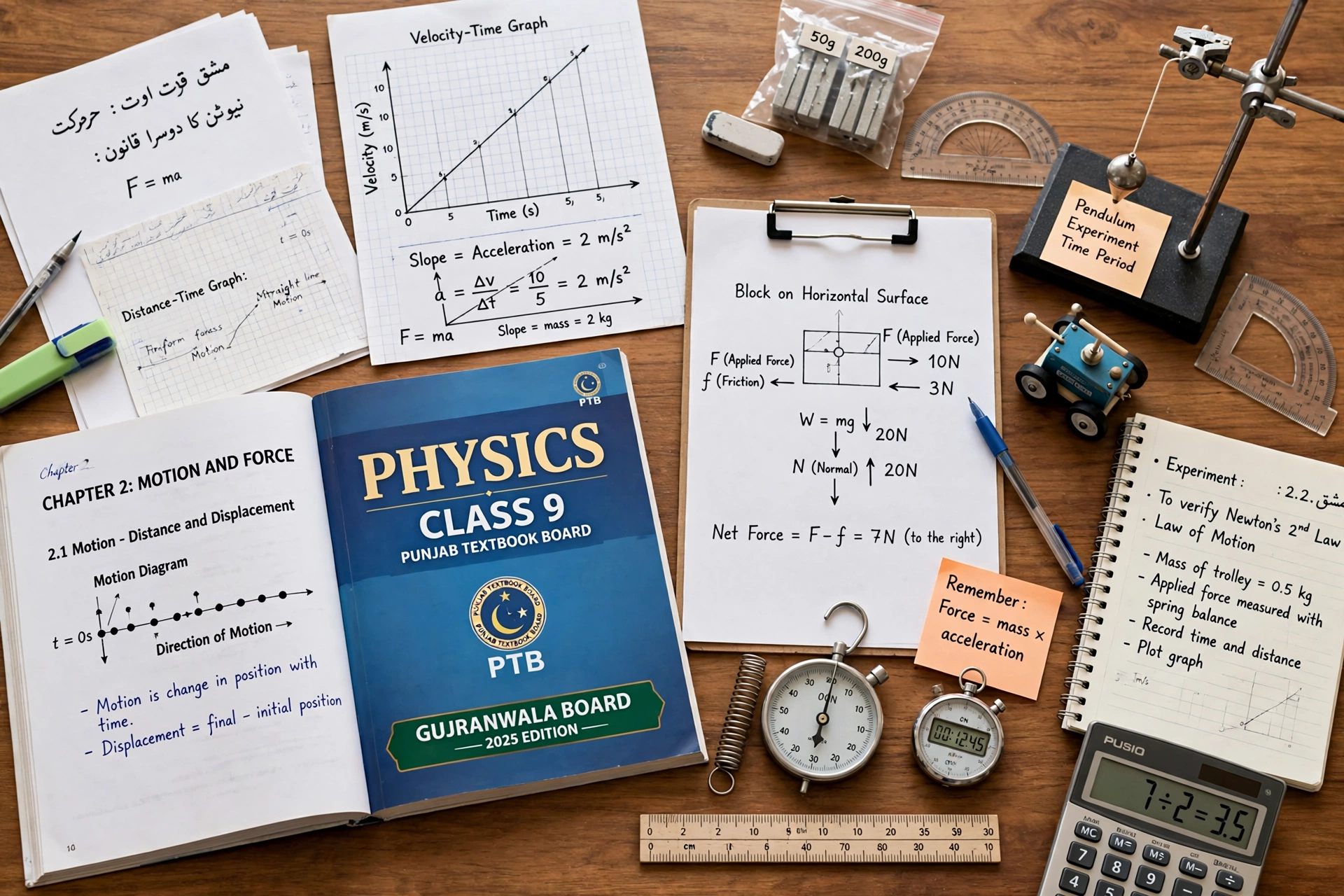
If you are preparing for the BISE Gujranwala Class 9 Physics paper in 2027, this gujranwala board 9th class physics guess paper 2027 guide is made to help you revise in a focused way. It covers every chapter of the current Punjab textbook, chapter by chapter, so you can check what you know, find weak topics quickly, and practise the kinds of questions that usually carry weight: short questions, long questions, numerical problems and MCQs.
Table of Contents
Honest note: this is an original practice prediction based on general past-paper trends. It is not an official board paper, it is not leaked, and it is not guaranteed. The official 2027 pairing scheme is not presented here as verified.
Gujranwala Board 9th Class Physics Guess Paper 2027: Paper Pattern Overview
Physics is a subject where definitions, units, diagrams and steps in a numerical all matter. A short answer that gives the right idea but misses the unit, or a numerical that skips the formula, can lose marks even when the student understands the topic. Use the pattern below only as a general guide to time and effort, and confirm the final paper details with your teacher or school.
| Part of the paper | What to expect in general |
|---|---|
| Total marks | 60 marks in total, as generally reported |
| Objective part | 12 MCQs |
| Short-question part | Short-answer questions from across the chapters |
| Long-question part | Long-answer questions, including explanation and numerical work |
That is why this guide does not ask you to learn only one chapter well. It spreads revision across all nine chapters, while giving extra time to the chapters that combine definitions, laws, diagrams and numerical practice.
Chapter-Wise Important Topics for Class 9 Physics
For each chapter, read the textbook first, then use the lists below as a self-test. If you cannot explain a short-question topic in two or three clear lines, write its formula or draw its diagram from memory, that topic needs another round of revision.
Chapter 1: Physical Quantities and Measurement
- Short-question topics: physics and its branches, physical quantities, base and derived quantities, SI units, prefixes, scientific notation, significant figures, and the difference between a physical quantity and its unit.
- Long-question topics: how a vernier caliper and a screw gauge are used, how zero error affects a reading, and how to find the volume of a small irregular object from measured length, width and thickness.
- Numerical practice topics: converting units with prefixes, finding least count, correcting a reading for zero error, and calculating area and volume from measured values.
- MCQ practice topics: SI units, symbols for quantities, least count values, and choosing the correct prefix for a given power of ten.
Chapter 2: Kinematics
- Short-question topics: rest and motion, distance and displacement, speed and velocity, acceleration, uniform and non-uniform motion, and the meaning of a straight-line graph.
- Long-question topics: the three equations of motion and what each symbol means, distance-time and velocity-time graphs, and how acceleration can be read from the slope of a graph.
- Numerical practice topics: finding speed, velocity, acceleration and distance using the equations of motion, and finding distance from the area under a velocity-time graph.
- MCQ practice topics: units of speed and acceleration, the shape of a graph for uniform motion, and the difference between scalar and vector quantities in motion.
Chapter 3: Dynamics
- Short-question topics: force, inertia, mass and weight, momentum, friction, Newton’s three laws in simple words, and the difference between mass and weight.
- Long-question topics: Newton’s second law with everyday examples, the law of conservation of momentum, friction and its advantages and disadvantages, and why a seat belt or a helmet reduces injury.
- Numerical practice topics: force from mass and acceleration, weight from mass and gravity, momentum, and change in momentum when speed or mass changes.
- MCQ practice topics: units of force and momentum, the direction of friction, and which law explains a rocket, a falling object or a collision.
Chapter 4: Turning Effect of Forces
- Short-question topics: turning effect, moment of a force, centre of mass, centre of gravity, stable and unstable equilibrium, and the conditions for equilibrium.
- Long-question topics: how moment depends on force and distance, why a long spanner is easier to use, equilibrium of a body under parallel forces, and the difference between stable, unstable and neutral equilibrium with examples.
- Numerical practice topics: moment of a force, clockwise and anticlockwise moments, and simple equilibrium problems using the principle of moments.
- MCQ practice topics: unit of moment, the point where weight acts, and examples of equilibrium in daily life.
Chapter 5: Gravitation
- Short-question topics: gravitation, gravity, mass of Earth, variation of g with height and depth, satellites, and the difference between g and G.
- Long-question topics: Newton’s law of gravitation, why g changes from place to place, how a satellite stays in orbit, and the motion of the Moon and artificial satellites.
- Numerical practice topics: weight on Earth and on the Moon, gravitational force between two masses, and finding g from mass and radius values.
- MCQ practice topics: value and unit of G, the direction of gravitational force, and why weight changes while mass stays the same.
Chapter 6: Work and Energy
- Short-question topics: work, energy, kinetic energy, potential energy, power, efficiency, and the forms of energy used in daily life.
- Long-question topics: work done by a force, the relation between work and energy, energy conversion in a falling object or a simple machine, and how efficiency is calculated and why it is less than perfect in practice.
- Numerical practice topics: work from force and distance, kinetic and potential energy, power from work and time, and efficiency from useful output and input.
- MCQ practice topics: units of work, energy and power, which activity counts as work in physics, and examples of energy conversion.
Chapter 7: Properties of Matter
- Short-question topics: density, pressure, Pascal’s law, Archimedes’ principle, elasticity, stress and strain, and why pressure changes with depth.
- Long-question topics: how pressure in a liquid is calculated, how a hydraulic press or brake uses Pascal’s law, why objects float or sink, and the difference between elastic and plastic behaviour.
- Numerical practice topics: density from mass and volume, pressure from force and area, pressure in a liquid from depth and density, and upthrust problems.
- MCQ practice topics: units of density and pressure, which material floats, and the effect of increasing area or depth on pressure.
Chapter 8: Thermal Properties of Matter
- Short-question topics: temperature and heat, thermal expansion, specific heat capacity, latent heat, evaporation, and the difference between heat and temperature.
- Long-question topics: why solids, liquids and gases expand differently, how specific heat capacity explains heating and cooling, and how latent heat works during melting and boiling without a temperature change.
- Numerical practice topics: heat absorbed or released from mass, specific heat capacity and temperature change, and simple latent heat calculations.
- MCQ practice topics: units of heat and specific heat capacity, which material heats faster, and the temperature at which a change of state occurs.
Chapter 9: Transfer of Heat
- Short-question topics: conduction, convection and radiation, conductors and insulators, thermos flask, sea breeze and land breeze, and the greenhouse effect in simple terms.
- Long-question topics: how heat moves in each method, why a metal spoon heats faster than a wooden one, how a thermos flask reduces heat loss, and how convection creates sea and land breezes.
- Numerical practice topics: comparing heat flow in different materials, and simple problems based on temperature difference and the rate of heat transfer described in the textbook.
- MCQ practice topics: which method needs no medium, examples of conductors and insulators, and which surface absorbs or reflects more heat.
How to Use This Gujranwala Physics Guess Paper 2027
- Start with the chapter you find hardest, not the one you already know best.
- For each topic, first write the definition, formula or diagram from memory, then check it against the textbook.
- Do numericals with full steps: given data, formula, substitution, answer and unit.
- Keep a short list of mistakes, such as missing units or wrong unit conversions, and review it before a test.
- Finish with a timed practice: attempt MCQs quickly, then short questions, then one or two long questions.
Textbook Revision Checklist
- All definitions, symbols and SI units from Chapters 1 to 9.
- Graphs for motion, and diagrams for forces, moments, pressure and heat transfer.
- Newton’s laws, the law of gravitation, Pascal’s law and Archimedes’ principle.
- Formulas for motion, force, momentum, moment, gravitation, work, energy, power, density, pressure, heat and specific heat capacity.
- At least one solved numerical from each chapter, done without looking at the solution first.
- A final read of chapter summaries and examples, especially in Chapters 2, 3, 6 and 7.
Related 9th Class Resources
- 9th Class Notes, Guess Papers, Pairing Schemes and Past Papers
- Gujranwala Board 9th Class Chemistry Guess Paper 2027: Important Questions All Chapters
- 9th Class Pairing Scheme 2027
Frequently Asked Questions
Is this the official Gujranwala Board Physics paper for 2027?
No. This is an original revision guide and practice prediction. It is not an official paper, it is not leaked, and it cannot guarantee any question. Use it alongside your textbook, class notes and teacher guidance.
Which chapters should I revise first?
Do not skip any chapter. Start with motion, forces and energy, because those chapters link definitions, laws and numericals together, then cover measurement, gravitation, matter and heat in full.
How important are numericals in Class 9 Physics?
Very important. Many students lose marks not because they do not know the idea, but because they skip the formula, use the wrong unit, or leave out the final unit. Practise every numerical type listed in each chapter with full steps.
Can I use this guide for other Punjab boards?
The chapter topics are based on the Punjab textbook, so the revision themes are useful for other Punjab board students too. However, the guide is written for Gujranwala Board students, and paper details can differ, so always follow your own board and teacher.
Work through one chapter at a time, mark the topics you cannot yet explain or solve, and return to those topics before you move on. Steady textbook revision, rather than memorising a short list on the last day, is the safest way to prepare for the 2027 Physics paper.





1 thought on “Gujranwala Board 9th Class Physics Guess Paper 2027 — Important Questions All Chapters”