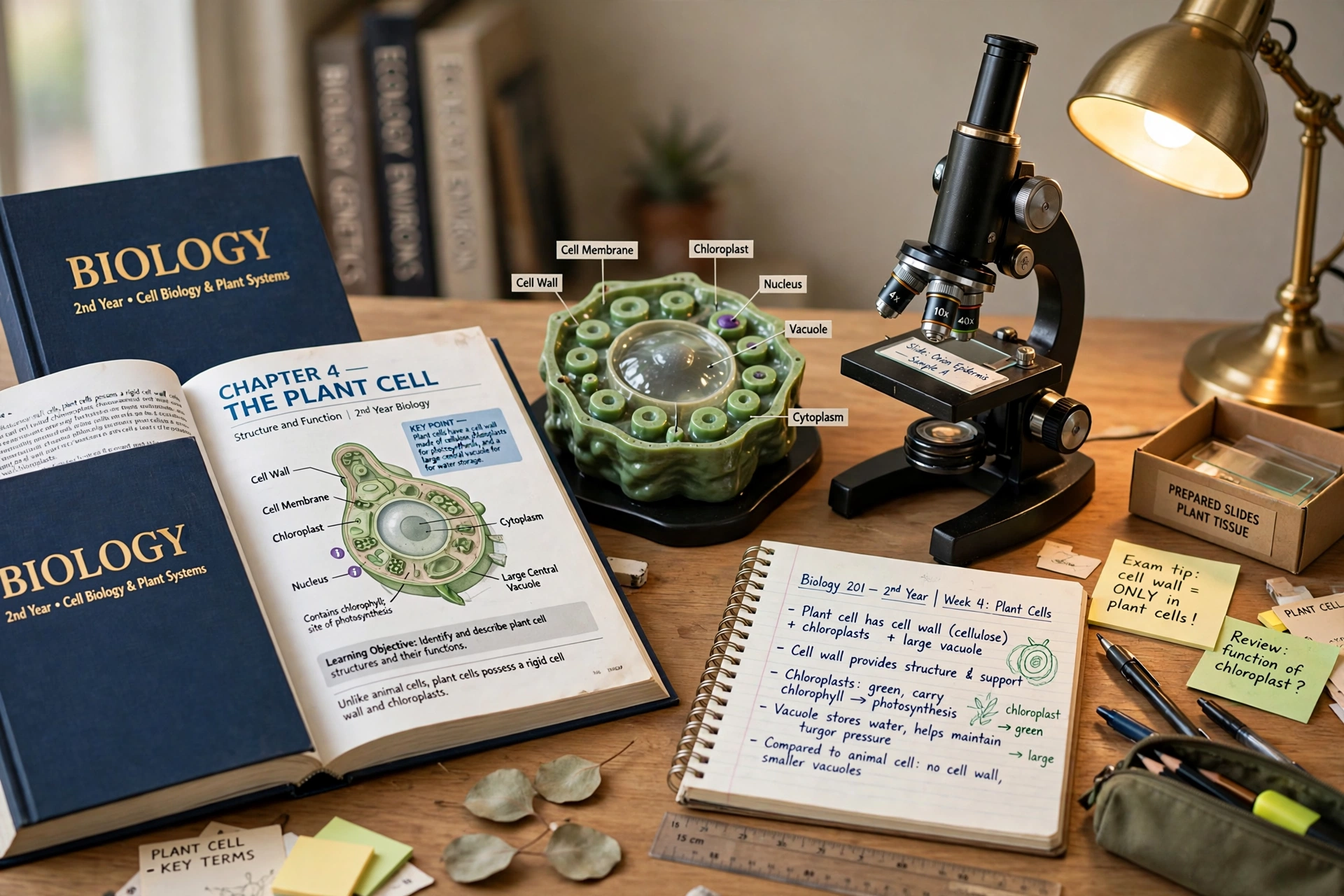
This biology 2nd year guess paper 2027 guide is a focused revision plan for 12th class students. It brings together the kinds of short questions, long questions and MCQ topics that have recurred in the general trend of past papers from 2020 to 2026, and turns them into original practice topics for your next round of study. Use it to check what you already know, find weak chapters, and revise with your textbook open beside you.
A short honest note: this is a student revision guide, not an official paper, not a leaked paper, and not a guarantee of any question. No board date is claimed here. Your textbook and your teacher’s guidance remain the final authority for the syllabus and paper pattern.
Table of Contents
Short Questions: 15 Important Topics
Revise each topic in two or three clear lines, with one definition, one example and one reason or function. Short questions reward precise terms, not long paragraphs.
- Homeostasis: how the internal environment is kept steady, with the roles of the liver and kidney in outline.
- Movement and locomotion: the difference between movement in plants and animals, and the main types of movement in a human skeleton joint.
- Muscle contraction: the sliding filament idea in simple steps, including the roles of actin, myosin and calcium ions.
- Human heart and double circulation: why blood passes through the heart twice, and how oxygenated and deoxygenated blood stay separate.
- Transport in plants: transpiration pull, root pressure and the function of xylem and phloem in one connected explanation.
- Photosynthesis: the light-dependent and light-independent stages, where each stage happens, and what each stage produces.
- Respiration: aerobic and anaerobic respiration compared, with energy yield, end products and one example of each.
- Excretion in humans: the main steps in urine formation in the nephron, including filtration, reabsorption and secretion.
- Coordination: the difference between nervous and chemical coordination, with one clear example of each in humans.
- Endocrine glands: the main hormones of the pituitary, thyroid and pancreas, and one function of each hormone.
- Mendelian inheritance: dominant and recessive traits, genotype and phenotype, and how a monohybrid cross is worked out.
- DNA and RNA: the structural differences between DNA and RNA, and the basic idea of transcription and translation.
- Evolution: natural selection explained with variation, survival and reproduction, using one simple, original example.
- Ecosystem: food chains, food webs and trophic levels, and why energy decreases from one level to the next.
- Population and community: the difference between a population and a community, with factors that limit population growth.
Long Questions: 8 Important Topics
For long questions, plan a short introduction, labelled points, and a closing line. Diagrams and flow charts help where the topic allows them, but keep labels accurate and simple.
- Describe the structure and working of the human heart, and explain double circulation with a labelled diagram.
- Explain the human excretory system, focusing on the structure of the kidney and the working of the nephron.
- Describe photosynthesis in detail, comparing the light-dependent and light-independent reactions and their importance for life.
- Explain the nervous system in humans, including the structure of a neuron, reflex action and the roles of the brain and spinal cord.
- Describe Mendel’s laws of inheritance and explain how they are shown in monohybrid and dihybrid crosses.
- Explain the structure of DNA, the process of DNA replication in outline, and how genetic information becomes a protein.
- Describe the theory of evolution by natural selection and discuss the main kinds of evidence used to support it.
- Explain an ecosystem, its biotic and abiotic parts, energy flow, nutrient cycling, and the effects of human activity on balance in nature.
MCQ Practice: 8 Topics
Use these eight practice topics for quick self-testing. Cover the answer, recall the concept, and only then check your textbook. The aim is recognition plus understanding, not memorising one set of options.
Human Biology MCQ Topics
- Human biology: Which chamber of the heart receives oxygenated blood from the lungs, and why does that matter for circulation?
- Human biology: Which hormone lowers blood glucose, which gland releases it, and what happens when it is not released in enough quantity?
Plant Biology MCQ Topics
- Plant biology: In which part of the chloroplast do the light-dependent reactions take place, and what are their main products?
- Plant biology: Which tissue carries water upward in a plant, and which force is most important in that upward movement?
Genetics, Evolution and Ecology MCQ Topics
- Genetics: In a monohybrid cross between two heterozygous parents, what phenotypic ratio is expected, and what does it show?
- Genetics: Which molecule carries genetic instructions from the nucleus to the ribosome during protein synthesis?
- Evolution: Which idea is central to natural selection: variation in a population, survival of better-adapted individuals, or both?
- Ecology: In a food chain, why is the energy available to top consumers much smaller than the energy captured by producers?
How to Use This Biology Guess Paper
- Start with the short questions. Mark each topic as known, partly known or unknown, and revise the unknown topics first.
- Write long-question answers from memory once, then compare them with the textbook and correct the missing points.
- Use the MCQ topics as a five-minute warm-up before a longer study session, and repeat them after a gap of a day or two.
- Keep a one-page error list: terms you confuse, diagrams you label wrong, and steps you skip. Revise that page last.
- Do not rely on this guide alone. Cover the full textbook chapters, your class notes and the current paper pattern.
Textbook Revision Plan
Read each chapter in three passes. First, read the headings, diagrams and summaries to see the whole chapter. Second, read slowly and make short notes on definitions, processes and labelled diagrams. Third, close the book and explain the chapter in your own words, as if you were teaching a classmate. Give extra time to human biology, plant biology, genetics, evolution and ecology, because these themes run through the short questions, long questions and MCQ practice above. Finish every chapter with its textbook questions and a timed past-paper style question, so that speed and accuracy improve together.
Related 2nd Year Resources
- 2nd Year Notes, Guess Papers, Pairing Schemes and Past Papers
- Chemistry 2nd Year Guess Paper 2027: Important Questions
- 12th Class Paper Pattern 2027: Status Guide
Frequently Asked Questions
Is this biology 2nd year guess paper 2027 an official paper?
No. It is an original revision guide built from the general trend of past papers from 2020 to 2026. It is not issued by any board, and it does not reproduce an official or leaked paper.
How should I use the short and long questions together?
Use the short questions for daily recall and the long questions for weekly written practice. A topic you can explain briefly is ready for short-question practice, while a topic you can explain in ordered steps is ready for a long answer.
Which chapters should I revise first?
Start with the chapters you find hardest, then move to human biology, plant biology, genetics, evolution and ecology. Revising weak chapters first gives you more time to practise them before the exam.
Can this guide replace the textbook?
No. This guide helps you choose what to practise and how to organise revision, but the textbook gives the definitions, diagrams, processes and details that examiners expect. Use both together for the best result.

1 thought on “Biology 2nd Year Guess Paper 2027 — Important Questions”