Table of Contents
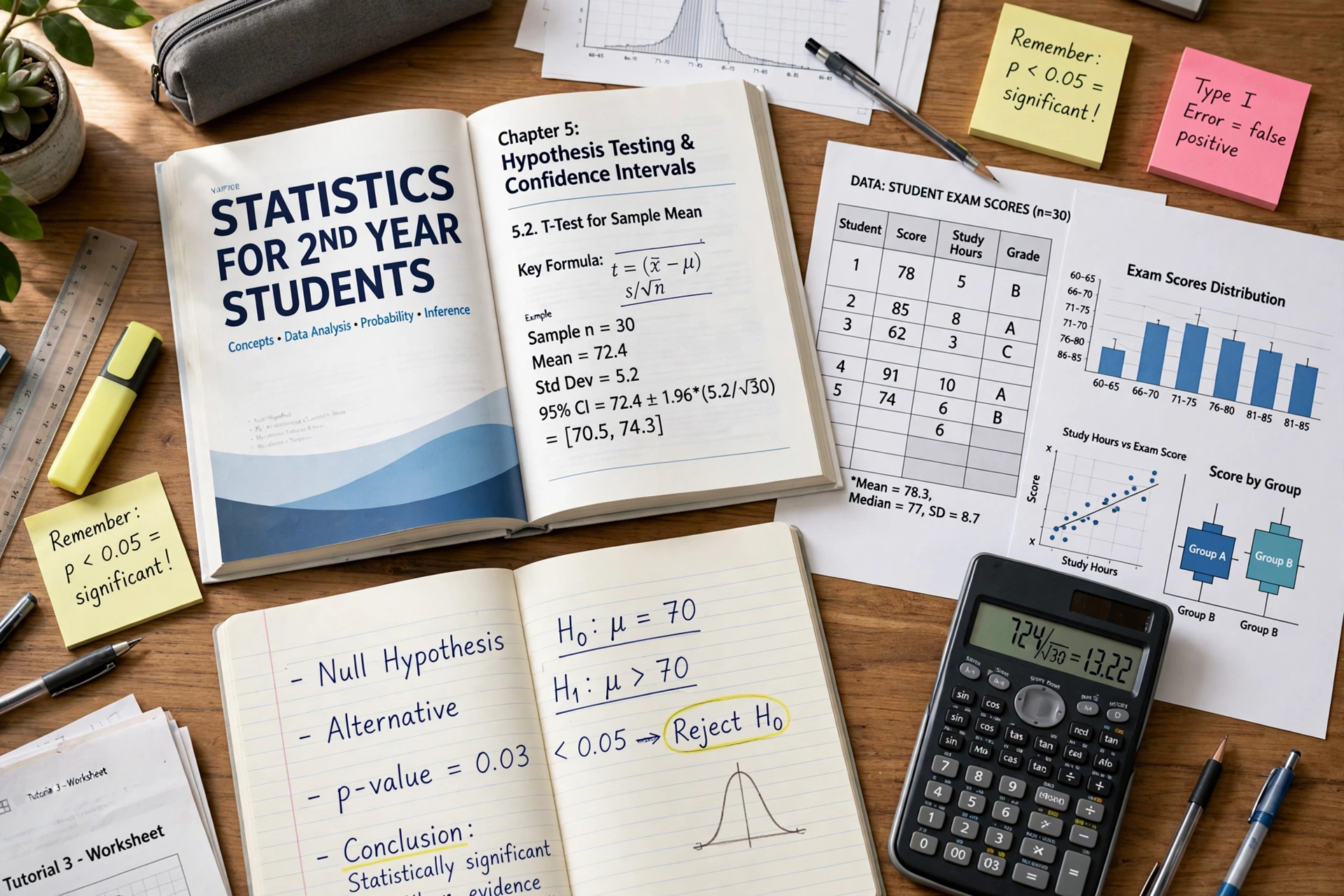
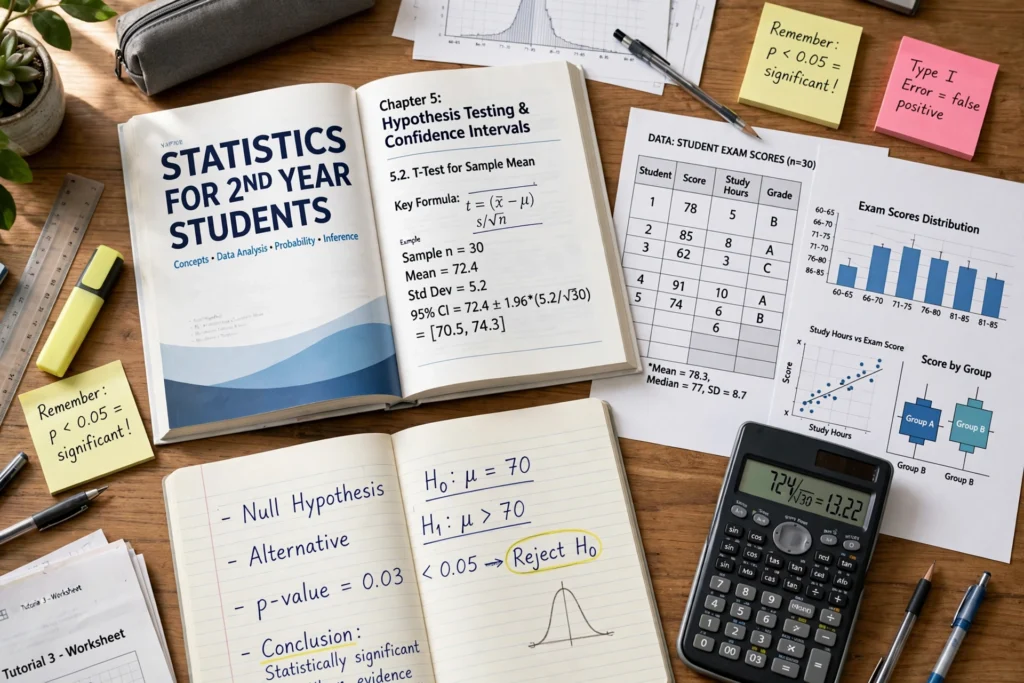
This statistics 2nd year guess paper 2027 guide is a focused revision plan for 2nd year Statistics students. It collects the topics that have appeared most often in recent years and turns them into clear short questions, long questions and MCQ practice themes, so you can revise in order instead of guessing at random.
Brief note: This is an original revision guide based on the general trend of past papers from 2020 to 2026. It is not an official paper, not a leaked paper and not a guarantee of any question.
Short Questions – Important Topics
Prepare each topic with its definition, one formula where needed, and one short example. Short questions usually test understanding, not long calculations.
- Population, sample, parameter and statistic – define each term and give a simple classroom or survey example.
- Types of data – qualitative and quantitative data, and discrete and continuous variables, with two examples of each.
- Mean, median and mode for grouped data – when to use the median instead of the mean, especially with extreme values.
- Measures of dispersion – range, quartile deviation, mean deviation, variance and standard deviation, and what each one shows about spread.
- Skewness and kurtosis – how to read a positively skewed, negatively skewed or symmetrical distribution from a graph.
- Laws of probability – addition law for mutually exclusive and overlapping events, and multiplication law for independent events.
- Conditional probability and Bayes theorem – the idea of updating a probability when new information is known.
- Random variables and probability distributions – discrete and continuous random variables, and how a distribution is checked.
- Binomial distribution – its conditions, mean np, variance npq, and a short problem on repeated trials.
- Normal distribution – its bell shape, symmetry, mean, median and mode at the centre, and the standard normal variable Z.
- Sampling distribution and standard error – why the mean of samples varies, and how sample size affects the standard error.
- Estimation – point estimation and interval estimation, and the meaning of a 95% confidence interval for a mean.
- Hypothesis testing basics – null and alternative hypotheses, Type I and Type II errors, level of significance and p-value.
- Chi-square test – goodness of fit and test of independence, and when each form is used.
- Correlation and regression in brief – correlation coefficient r, regression lines, and why correlation alone does not prove cause and effect.
Long Questions – Important Topics
Long questions need a full method: state the formula, show the working step by step, and write a short conclusion in words. Practise each topic with at least two different sets of numbers.
- Frequency distribution, histogram and ogive – build a grouped distribution from raw data, draw the graph, and find the median and quartiles from the ogive.
- Central tendency and dispersion together – find mean, median, mode, variance and standard deviation for grouped data and compare two data sets.
- Probability theorems and Bayes theorem – solve a problem using addition and multiplication laws, then a Bayes problem with prior and posterior probabilities.
- Binomial and Poisson distributions – check the conditions, find probabilities for a given value, and use mean and variance to describe the distribution.
- Normal distribution – convert values to Z, use the normal table to find areas, and solve a practical problem on marks, heights or weights.
- Sampling, estimation and confidence intervals – find a confidence interval for a population mean and for a proportion, and explain what the interval means.
- Tests of significance – test a single mean with Z or t, test the difference of two means, and test a proportion, stating hypotheses, test value and decision clearly.
- Regression, correlation and chi-square – find Karl Pearson correlation, fit both regression lines, estimate one variable from the other, and test independence in a contingency table with chi-square.
How to Attempt a Long Question
Write the given data first, choose the correct formula, substitute carefully, and check the answer for sense. A clear conclusion often earns the final mark, even when the arithmetic is long.
MCQ Practice Topics
Use these eight themes for timed MCQ drills. For each theme, practise the formula first, then answer without looking at the solution.
- Probability basics – practice: find the probability of a simple event, a union of events, and an independent combined event.
- Conditional probability – practice: find a probability when one event is already known to have happened.
- Binomial distribution – practice: identify n and p, then find the probability of a stated number of successes.
- Normal distribution – practice: use Z to find the probability that a value falls below, above or between two points.
- Sampling and standard error – practice: find the standard error of a mean and explain why it falls as sample size rises.
- Estimation and confidence intervals – practice: choose the correct interval form for a mean and read its limits correctly.
- Regression – practice: read a regression equation, find a predicted value, and state what the slope means in plain words.
- Correlation – practice: judge the strength and direction of r from a value or a scatter diagram, and avoid a causal claim from correlation alone.
How to Use This Guess Paper
- Start with the textbook chapter, then use the matching topic here as a checklist.
- Cover the short questions first, in small daily sets, and write answers from memory.
- Solve one long question at a time with full working, not only the final answer.
- Do MCQ drills under time, then review every mistake and the formula behind it.
- Finish with a mixed revision round across probability, distributions, sampling, regression and correlation.
Textbook Revision
Do not rely on this guide alone. Work through the textbook in this order, and tick off each area only after you can solve a question from it without notes.
- Presentation of data – frequency distributions, histograms, frequency polygons and ogives.
- Measures of central tendency and dispersion – mean, median, mode, variance, standard deviation and coefficient of variation.
- Probability and random variables – laws of probability, conditional probability and expectation.
- Probability distributions – binomial, Poisson and normal distributions, with their uses and limits.
- Sampling and inference – sampling distributions, estimation, confidence intervals and tests of significance.
- Regression, correlation and chi-square – scatter diagrams, correlation, regression lines and tests of independence.
Keep a one-page formula sheet for mean, variance, standard error, Z, t, correlation and regression. Revise it daily in the last week, and practise the normal table until reading Z values feels automatic.
Related Guides
- 2nd Year Notes, Guess Papers, Pairing Schemes and Past Papers
- Economics 2nd Year Guess Paper 2027 – Important Questions
- 12th Class Paper Pattern 2027 – Status Guide
FAQs
Is this statistics 2nd year guess paper 2027 official or leaked?
No. It is an original revision guide built from the general trend of past papers from 2020 to 2026. It is not issued by any board, and it does not contain leaked or guaranteed questions.
Can I pass by preparing only these topics?
No guide can guarantee a pass. Use these topics to focus your revision, but also study the full textbook, practise numericals, and revise chapters you find difficult.
Which chapters matter most in Statistics?
Probability, probability distributions, sampling and inference, and regression and correlation recur often, so give them extra time. Still, cover data presentation and dispersion well, because they support short questions and basic numericals.
How should I prepare for the MCQ part?
Learn the key formula for each theme, practise with the normal and binomial ideas, and answer timed sets. After each set, correct your mistakes from the textbook instead of only memorising answers.








1 thought on “Statistics 2nd Year Guess Paper 2027 — Important Questions”