Results for how to pass

1st year urdu paper presentation method and tips

May 10, 2024

 The students who are going to appear 1st time Intermediate exams really need to know 1st year paper pattern of all subjects first. When I published Urdu paper presentation for 2nd year, many students asked for the same type of post for 1st year Urdu. So, here is your 1st year Urdu paper pattern and paper presentation.

1st year Urdu paper Presentation

Paper presentation is what does miracles. You may have given good answers but in a bad way. So, you cannot expect much out of your answer sheet. I know many students who are good at studying but poor at paper presentations. This thing leads them to poor marks in Urdu.

If you have excellent preparation and excellent paper presentation, you can expect upto 90% marks in Urdu. Paper layout, sequence, use of a marker, section divisions, etc cast a healthy impression on the paper checker. 

As a result, you get high marks out of favor. Here is comes when many shining students don't get good marks in Urdu.

How to attempt 1st year Urdu paper for Good marks

The first thing I would recommend is the use of markers in a better way. The second thing is the overall layout of the paper. I have explained the procedure step by step. 

You can follow this procedure for an amazing and good paper presentation of 11th class Urdu.

You may want to see the paper pattern on 1st year Urdu here to know about the questions paper, the questions, and the sequence and weightage of all questions.

Here are some guidelines for 1st year Urdu paper presentation:

1. Use a good marker in a good way

Using a black or blue marker is a good practice while attempting 1st year Urdu paper. It not only gives a good layout to your paper but also facilitates the paper checker to navigate to various sections and questions on your answer sheet. 

So, the use of markers is the first thing that adds value to your paper presentation. Use a cut-tip marker for the following items on your answer sheet:

  1. Questions
  2. Division lines
  3. Headings and subheadings in your answers
  4. Verses (ashaar) and Quotations in your answers
  5. Draw margin lines if necessary
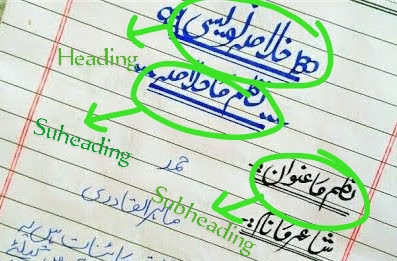
You can use two sizes for headings and subheadings. The heading is like your question No.s, titles, etc. The subheadings are those which come within your answers and represent various parts of your answers for example, "Siaq-o-Sabaq" will be a subheading under the main heading.

how to attempt 1st year urdu paper

In this way, you can keep your paper clean, sparse, and attractive. To differentiate the main headings and subheadings, you can underline the main headings, or you can centralize the main headings.

2. Star a new question on a new page

When you finish answering a question, the next questions may be started from the next page. It is so because it gives a good impression to the paper checker. He/She will easily understand and mark your questions. 

3. Use quotations and Poetry in answers

You should include poetry and quotations in your answers. You can use couplets (ashaar), quotations, and the translation of verses of the Holy Quran in the explanation of Ashaar, explanation of Nasar paragraph etc. You can also use proverbs in your answers. 

1st year urdu paper presentation tips

Use markers for writing verses of poetry, quotations, proverbs etc. You can leave a blank line above and below it. You can leave a little larger margin for this type of content. It covers more space and your answers become lengthy. You will get more marks if your answer's length is ideal.

Note: Do not include poetry/quotations etc in Khulasa of Nazam, Khulasa of Nasar, and Talkhees.

4. Keep your answers in the proper length

Many students don't know how many pages to write for which question. This is the main problem for the students. This is the main reason they get poor grades in 1st year Urdu. The boards have provided guidelines about how much content to be written for every question. You need to know this first before starting 1st year of Urdu paper preparation.

Here is the best and ideal length for every answer:

1. Explanation of Poems (Nazam k Ashaar ki tashreeh) = 3-4 pages
2. Explanation of Ghazal (Ghazal k ashaar ki tashreeh) = 1-1.5 page for each Shair
3. Siaq-o-Sabaaq = 8-12 lines
4. Explanation of Nasar (nasar k paragraph ki tashreh) = 2-3 pages
5. Summary of lesson(sabaq ka Khulasa) = almost 2.5 pages (+, - 4-5 lines)
6. Summary of Poem (Nazam ka Khulasa) = 7-10 lines
7. Dialogue (3 pages)/ Rodaad(3 pages)/ Raseed = 2 pages
8. Application: 1-2 pages
9. Talkhees (1/3 of the original paragraph)

1st year Urdu paper tips and methods

5. Follow the good sequence

You should start from the shortest answer to the largest. 1st of all attempt those question that requires short answers but carries more marks. For example, you can start with the summary of the poem which only needs 7-10 lines (almost half page).

You can follow this sequence to attempt 1st year Urdu paper in a proper way:

1. Khulasa of Nazam

2. Talkhees

3. Application

4. Dialogue/Rudad/Raseed

5. Nasar ki Tashreh

6. Sabaq Ka Khulasa

7. Nazam k Ashaar ki tashreh

8. Ghazal k Ashar ki Tashreh

6. Time Management

Time management in 11th class Urdu papers is the most problematic phenomenon for students. You have to write almost 22 - 25 pages in 2 hours and 30 minutes. Many students do not attempt the whole paper in time and they miss a question or two. 

This is why many brilliant students get low marks in Urdu papers. Time management is really important in 1st year Urdu papers.

You need to keep both speed and quality of writing in mind. If you can write a page in 6 minutes, you can attempt your paper in time. You may like to see the following ideal time management.

Ideal time management

1. Look at your questions paper/ draw margins etc = 3 minutes

2. Khulasa of Nazam = 5 minutes

3. Talkhees = 10 minutes

4. Application = 12 minutes

5. Dialogue/Rudad/Raseed = 18 minutes

6. Nasar ki Tashreh = 20 minutes

7. Sabaq Ka Khulasa = 20 minutes

7. Nazam k Ashaar ki Tashreh = 30 minutes

8. Ghazal k Ashar ki Tashreh = 30 minutes

9. Look at your answer sheet = 2 minutes

You can attempt your paper in time if you follow this time scale. You can also make your own time schedule like this.

Tips for students:

The students who are often attempting their paper in a poor way can see the following tips for 1st year Urdu paper presentation.

1. Do not write more than what is recommended length of an answer in order to save time.

2. Urdu is as important as other subjects. You should give proper time to Urdu. Many students neglect this subject thinking it is very easy, as a result, they get the least marks in this subject.

3. Use a marker (blue or black or both) in your paper to give a good presentation.

4. Learn the names of the poets, authors, and some popular proverbs, ayaat, ahadees and quotations to insert into your paper.

5. Learn to write fast but neat and cleanly. Although writing doesn't matter, but cleaner writing will get you more marks out of favour. 

You may like the following posts too:

1. 1st year Urdu notes

2. 1st year Urdu book pdf

3. 11th class Urdu solved papers

4. 1st year Urdu guess paper

How to attempt Urdu Paper 2nd year

May 04, 2024
Many shining students do not get good marks in Urdu just because they do not know how to attempt the paper. There are rules for Urdu paper and you have to follow all if you want to get good marks in it. 

Here are some tips based on the paper of a board topper who got 95 marks in Urdu in the board exams 2024.

More resources:
1. 2nd year All subjects Notes
2. 2nd year all subjects pdf Books
3. 2nd year all subjects guess papers
4. 2nd year subjects paper pattern

2nd year Urdu paper presentation

The first thing you keep in mind is the presentation of the paper. The look of your answer sheet is the 1st impression of your paper that a checker gets before he really starts marking your paper. 

So the 1st thing to keep in mind is the clean layout with proper headings and subheadings.

Attempt Urdu paper for Good marks

Your 1st aim must be to get good marks. Every student wants to get good marks in all subjects. But Urdu is the only subject in which many students fail just because they attempt the paper poorly and with the way, rules don't allow. 

You should download this helpful 2nd year Urdu full book 100 MCQs solved notes. 

You can see the following tips to attempt your Urdu paper in a proper way:

1. Use Marker and Headings

The first thing that makes your impression is the use of marker and headings. Headings make it easy for the paper examiner to quickly understand the various parts, questions, and portions of answers on your answer sheet. 

headings are also necessary for a clean and attractive layout of the paper. So, use Marker for the following headings:

  • Questions
  • Subheading of your answers
  • Writing verses (ashaar) and quotations
  • Difficult words or keywords within the texts.
While using headings, it is important to use two sizes for fonts. Use a little larger fonts for main headings for example titles, question No. etc and use a little smaller fonts for subheadings for example headings in your essay, siaq-osabaaq, tashreeh etc.

Tip: To differentiate the main headings and subheadings, you can underline the main headings, or you can centralize the main headings.

2nd year urdu paper presentation tips

2. Better Start new Questions on a new page

If your answer to the previous question end below half of the page, start a new question on the next page. It will make it easy for your paper checker to move to various questions of your paper. 

The more easiness you provide to the paper marker, the more marks you will get out of favor. The letter must be started on a new page.

3. Use Couplets (Poetry) and Quotes

You can use ashaar (verses of poetry) and quotes in your paper. The best parts of your paper to include qoutes and petry are essay, letter, explanation of stanzas, and explanation of Nasar. 

You may not add these into Khulasas of Nasar and poem. Use blue marker while writing these quotes and pieces of poetry. aways keep a line space above and below the piece of poetry or quote.

2nd year Urdu paper presentation sample

4. Write in proper quantity

Yes, the main thing here is the quantity of the content you write for each answer. There are certain rules which tell who much you will write for each question. Here are the various questions and their relevant tips:
  1. Explanation of Poems (Nazam k Ashaar ki tashreeh) = 3-4 pages
  2. Explanation of Ghazal (Ghazal k ashaar ki tashreeh) = 1-1.5 page for each Shair
  3. Siaq-oSabaaq = 8-12 lines
  4. Explanation of Nasar (nasar k paragraph ki tashreh) = minimum 2 pages
  5. Summary of lesson(sabaq ka Khulasa) = almost 2 pages (+, - 4-5 lines)
  6. Summary of Poem (Nazam ka Khulasa) = 7-10 lines
  7. Essay (Mazmoon) 5-6 pages
  8. Letter (Khat) = almost 1.5-2 pages
Note:
  • While writing tashreh of nasar, include 2-3 lines for the introduction of the author, do not include poetry in Khulasa of Nazam.
  • There are 3 verses of Ghazals and you have to explain each separately, so the explanation for 1 verse should be at least 1 page and not more than 1.5 pages. You can include more verses in the explanation.
  • While writing the answer to any question, do not repeat the same words or sentences again and again. 
  • You can download our best Urdu essays notes for 2nd year.

5. Start from Smaller to bigger

It is a good strategy to attempt your paper starting from the shortest answer to the longest one. for example, the longest part of your paper is the essay, so, attempt it at the end of the paper. 

You can have the following scheme according to the content of the answer, the time it takes and the weight of the marks:

The ideal arrangement

  1. Khulasa of Nazam
  2. Letter
  3. Nazam k ashaar ki tashreh
  4. Sabaq ka Khulasa
  5. Nasar k paragraph ki tashreh
  6. Ghazal k ashaar ki tashreh
  7. Essay

6. Follow the clock

You have three hours to solve all the questions. The 1st 20 minutes are assigned to the objective paper. The remaining 2 hours and 40 minutes are assigned to the subjective paper. 

So, you have to attempt the remaining 6 questions in two hours and forty minutes. Many students cannot attempt the complete paper and the time is up. 

So, if you want to get high marks, you must attempt the complete paper and attempt all questions in the light of the guidelines given above.

You can assign the following time to various questions:
  • Look at the question paper draw margins etc (2 minutes)
  • Nazam ka Khulasa (5 minutes)
  • Letter (10 minutes)
  • Nazam k ashaar ki tashreh (25 minutes)
  • Sabaq ka Khulasa (20 minutes)
  • Nasar k paragraph ki tashreh (20 minutes)
  • Ghazal k ashaar ki tashreh (33 minutes)
  • Essay (35 minutes)
  • Check your aswersheet (5 minutes)
In this way, you can easily attempt your paper in the best possible way. To attempt your paper in time and to follow the above-mentioned timing scheme, your speed must be as follows:
  • 6-7 minutes per page

7. Have a look at the answer sheet

After you have solved the paper, spare 5 minutes to look back at your answer sheet and make sure that all the headings are correct. match the question numbers on the question paper with that you have written on the answer sheet. 

If you have more than 5 minutes left, better deeply look into the paper to find small errors and mistakes and correct them.

8. General Tips:

  1. Writing does not matter in the paper. It is the content you write. The paper checker reads your paper thoroughly. He will give you a few marks if you have written more irrelevant content. If your writing can be read and understood easily, there is no problem with the style of writing. Anyhow try to write as good as you can while not compromising the speed.
  2. Read textbooks thoroughly and do not totally depend on guide books.
  3. use proverbs, ayaats, Ahadith, etc where it fits right.
  4. Give equal time to Urdu as you give to other subjects as it carries the same marks as other subjects.
  5. Learn the names of the authors and poets and their short biographies well.
You may like:


How to pass biology supplementary exams of 2nd year

October 22, 2019
Please note:
This post is for only Punjab Boards. If you are looking for such guidance for other boars like Sindh Board or KP board, you can search it on Google or you can browse other sources for your boards available on this website.

Now let me tell you how you can prepare for Biology of 2nd year in just 30 days and get 70 marks. The secret lies in the pairing scheme. If you look at the pairing scheme of biology, you will come to know that there are certain chapters that can give you maximum marks. Now if you have a compartment in biology, you can prepare it within 30 days to get more than 60 marks.

Pass 2nd year biology supply exams

Remember:
1. You have to pass both theory and practical exams to clear the subject.

2. The theory paper is 85 marks (2nd year only) and you have to get 28 marks to pass the theory exams.

3. The practical part has 30 marks (part 1 and 2 combined) and you have to get 20 marks to pass the exams.

4. In case of failing to get the minimum marks required to pass the exams, you will have to appear in supplementary exams.

5. This post can also help the marks improvers.

Now we come to the real thing.

How to get good marks in Biology 2nd year

Every student wants to get good marks. But there are some factors which influence the student's performance and harm their motivation. The major of all these is the lack of guidance. The students are not aware of how to prepare and what to do 1st. Believe me, many intelligent students get supply just because they haven't the idea of how to attempt the paper. They do not prepare according to a strategy. They just try to learn the whole book without any planning and strategy. This is where the compartment comes from.

With the simple guide and planing given below, you can get up to 60 marks in biology and with just a little effort and planning. Now let us see what it is.

It is the Pairing of Biology 2nd year

Yes, you read it right. We have to see the trick in the pairing scheme. If you want to check the complete pairing scheme for biology, you can check it on 2nd year biology pairing scheme 2020. Now I will only mention here how and which chapters will benefit you more.

2nd year biology important chapters

Part 1

Chapter 15 = 1 part of long questions + 3 short questions + 2 MCQs (12 marks)

Chapter 25
= 1 part of long question + 3 short questions + 1 MCQs (11 marks)

Chapter 16
= 1 part of long question + 3 short questions + 2 MCQs (12 marks)

Chapter 20
= 1 part of long question + 3 short questions + 1 MCQs (11 marks)

Important points

Now if you prepare these 4 chapters well, 46 marks paper will come from these four chapters.  These are paired chapters; a complete long question will come from the two given chapters. It means if you just want to clear the supply exams, this is best for you. You can easily get more than 28 marks from these four chapters.

But your purpose is not just to clear supply, you should get good marks, so you should prepare for more chapters and here it is how you can get good marks in biology.

Chapter 17 = 1 part of long question + 3 short questions + 1 MCQs (11 marks)

Chapter 18
 = 0 part of long question + 3 short questions + 2 MCQs (8 marks)

See, if you prepare the two chapters given above, you can still get more than 50 marks as 65 marks paper will come from all 6 given chapters. Your half long question remains to be prepared. You can easily get more than 50 marks. The students learn the whole book and still, they are unable to get 50 marks. I advise you to study these chapters but if you are going to appear in annual exams and you have time, revise them three times. Give tests again and again. You can get 60 marks if you have good preparation.

Tip: One part of long question carries 4 marks. It means you have to write two or three pages to get 4 marks and they will not give you full 4 marks yet. You will get 3 if you write well. so It means you will get 3 marks after writing two to three pages. So in short questions, you can get 2 marks by writing just 3 to 4 lines. How is that? Many students prepare short questions only and still get more than 50 marks. So, you can follow this strategy. You can attempt 61 marks paper without attempting any single long questions. And if you have good preparation, you can get more than upto 60 marks if you have good preparation.

You can download our best notes for 2nd year biology.

Now let us calculate it again.

Chapter 15 (short +long) = 12 marks
Chapter 25 (Short + long) = 11 marks
Chapter 16 (short +long) = 12 marks
Chapter 20 (Short + long) = 11 marks
Chapter 17 (short +long) = 11 marks
Chapter 18 (Short only) = 8 marks

Part 2

Now let us see if we do only short questions:

Questions 1 (8 questions) chapter 15, 16, 23
Questions 2 (8 questions) chapter 17, 18, 22
Questions 3 (6 questions) chapter 19, 20, 21

Total short questions = 22 = 44 marks
Objective = 12 = 12 marks

So if you only prepare short questions and objectives of only 9 chapters, you can easily get 50 marks which are not bad.

Also See: how to attempt 2nd year Urdu paper

Note:
All these marks calculations are without practicals. So including practicals, you will see that you can surely get 140 marks from biology part 1 and part 2 and this number is quite decent.

You may like to see the following related posts:

1. How to pass 1st year physics supply paper
2. How to pass 1st year biology supplementary exams
3. How to pass 1st year math exams
4. 1st year English supplementary exams pass

How to pass supplementary exams 2nd year

Pass 1st year Physics with Good Marks

September 19, 2019
First of all, let me tell you that you have to secure a combined total of 66 marks in both part 1 and part 2. You have to pass both theory and practical exams securing 33 % marks from each.  So, you have to make a total 66 marks combining both 1st year and 2nd year marks including practical and theory.

How to pass physics supplementary exams

If you want to pass physics supplementary in good marks, you are in the right place, because I am going to tell you how you can secure 60% marks with just a little effort. Here is how you will get it.


Follow the Pairing Scheme

If you look at the paper scheme, you will come to know that it is pretty easy to cover the syllabus. According to pairing scheme:

  • Chapter 1 = 1 part of long questions + 2 short questions + 2 MCQs
  • Chapter 11 = 1 part of long question + 4 short questions + 2 MCQs
  • Chapter 2 = 1 part of long question + 3 short questions + 2 MCQs
  • Chapter 3 = 1 part of long question + 4 short questions + 1 MCQs

What is the point?

The point is that if you prepare all these 4 chapters well, and do not even touch the other chapters, you can attempt a paper of 49 marks. You need 26 marks to pass in theory part. So, why is it a bad deal? The idea is given but the choice is yours.

Is it bad?

You can even look at it again. Chapter 1 will give you 9 or 11 marks. Chapter 11 will give you 13 or 15 marks. Both combined will give you 24 marks. And if you prepare chapter 3 along, you can solve a paper of 36 or 38 marks. You can surely get 26, that is needed, from this attempt.

Want to get even more marks?


If you want to get even more marks, you can also include chapter 5 for short questions only. 4 short questions and 2 MCQs will come from this chapter. So you total attempted papers will be of 59 marks. I think you can get 40 marks easily out of it. And if you prepare it well, you can get even 50 from it.

But if you want to get 1000 marks, you should read my other post on how to get 1000 marks in board exams.

How is that?

What you think it is? Is it workable? I hope you can give me your feedback so that we, together, may make it more precise and perfect.

You may like to see the following related posts:

1. 1st year Chemistry supplementary Passing Marks
3. How to pass 1st year math exams
4. 1st year English supplementary exams pass